Advances in Engineering Advances in Engineering features breaking research judged by Advances in Engineering advisory team to be of key importance in the Engineering field. Papers are selected from over 10,000 published each week from most peer reviewed journals.

Significance
Lithium-magnesium alloys are an emerging material that is quickly attracting interest amongst researchers due to its many applications. Just to name a few, this novel alloy has confirmed application in panzers, aerospace, electronic products and automobile manufacturing. The fact magnesium possesses a hexagonal-closed-packed crystal structure and a limited active slip system renders it impossible to deform it at room temperatures. Therefore, addition of lithium, which possess a body-centeredcubic crystal structure, has been observed to lower the density of magnesium and improve the deformability of the resulting alloys. Unfortunately, the resulting alloys are of low strength and therefore it becomes necessary to add a third or fourth element.
Aluminum and zinc are the most preferred with the former being a favorite. The resulting alloy becomes superplastic thereby requiring complex thermal mechanical processing, extruding and severe plastic deformation to achieve desired grain refinement. Multidirectional forging is the easiest to realize as a mass production severe plastic deformation technique. However, little has been done on the applicability of multidirectional forging in achieving grain refinement and in investigating the superplasticity of the Mg-Li-Al-Zn-Sr alloy.
Researchers led by professor Furong Cao at Northeastern University in China proposed a study to investigate the super-plasticity of a dual phase-dominated Mg-Li-Al-Zn-Sr alloy processed by multidirectional forging and rolling. They hoped to advance our knowledge on the super-plastic deformation behavior and microstructures of the multidirectional forging and rolling-produced alloy, in order to explore its’ plasticity and ductility at elevated temperatures. Their work is now published in the research journal, Materials Science & Engineering A.
The researcher begun their studies by fabricating a novel LAZ1022-0.2Sr alloy using the multidirectional forging and rolling technique. They then investigated its microstructures and mechanical properties at elevated temperatures. Latter, they observed the resulting deformation mechanisms of super-plasticity. Finally, the research team studied the cavity growth and fracture morphologies.
The authors observed that from the X-ray diffraction procedure, the existence of α (Mg) and β (Li) phases and Mg17Al12, Al4Sr and LiMgAl2 intermetallic compounds were confirmed. The researchers also realized that by studying the microstructures, they were able to reveal a thin banded-grained microstructure having a grain size of less than 3.75 µm which could be obtained using the multidirectional forging and rolling technique and annealing at 250 °C for one hour.
The Furong Cao and colleagues study presented an extensive investigation of the microstructures, mechanical properties, deformation mechanism and cavitation growth of a thin banded-grained LAZ1022-0.2Sr alloy fabricated by multidirectional forging and rolling. The results obtained from their study have shown that significant grain refinement can be attained. More so, a novel plasticity controlled cavity growth rate equation considering cavity interlinkage has been established. Since this is the first report on the superplasticity of Magnesium-Lithium alloy processed by multidirectional forging and rolling, we anticipate that it will attract the attention of many researchers and provide an avenue for future developments in this field.
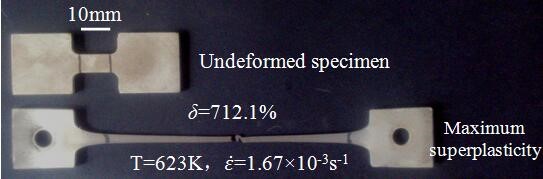
Appearance of superplastic sample of Mg-10.2Li-2.1Al-2.3Zn-0.2Sr alloy processed by multiple forging and rolling.
Reference
Furong Cao, Guoqiang Xue, Guangming Xu. Superplasticity of a dual-phase-dominated Mg-Li-Al-Zn-Sr alloy processed by multidirectional forging and rolling.Materials Science & Engineering A 704 (2017) 360–374
Go To Materials Science & Engineering: A