Advances in Engineering Advances in Engineering features breaking research judged by Advances in Engineering advisory team to be of key importance in the Engineering field. Papers are selected from over 10,000 published each week from most peer reviewed journals.

Significance
Presently, carbon based materials are the most efficiently implemented supercapacitor electrodes. This can be highly attributed to their low cost, excellent electrical conductivity and high surface area. Currently, the design of advanced high-energy-density supercapacitors calls for application of materials that combine hierarchical nanoporous structures with high surface area to facilitate ion transport and excellent electrolyte permeability. Unfortunately, designing of superior carbon materials for high-performance supercapacitors with tailored properties such as chemical stability, electrical conductivity, and large specific and functional surface area is a great challenge. To escape this, inorganic–organic hybrid porous metal–organic frameworks have recently been employed as sacrificial templates/precursors for synthesizing various hierarchical carbon materials, despite the challenges encountered during the controlled transformation of these metal–organic frameworks into 2D porous carbon nanosheets.
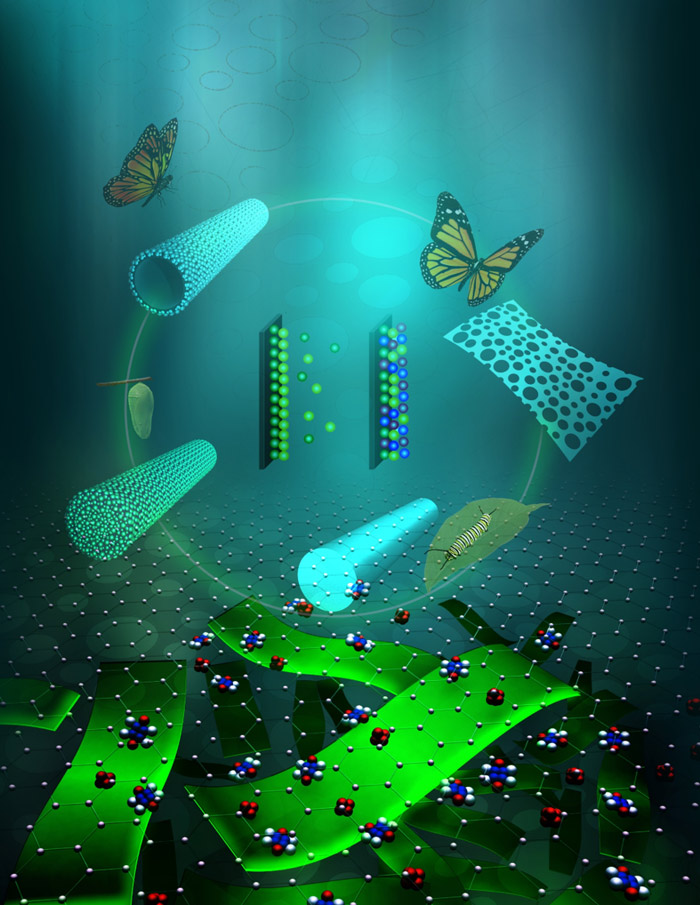
Researchers led by Professor Roland Fischer at Technical University of Munich in Germany in collaboration with scientists at Palacky University Olomouc in Czech Republic, developed a scalable strategy for the fabrication of shape-controlled 2D nanoporous carbon sheets by controlled carbonization of a specifically selected potassium-based metal–organic frameworks without any additional chemical etching agent. Furthermore, with scientists from Catalan Institute of Nanoscience and Nanotechnology (ICN2) in Spain and University of Adelaide (UoA) in Australia, they hoped to investigate and elucidate further the properties of the fabricated nanoporous carbon sheets in high energy density superconductors. Their work is currently published in the research journal, Advanced Materials.
The researchers synthesized the 2D carbon sheets from a potassium based-metal organic framework. The team then employed powder X-ray diffraction analysis to confirm the phase purity of the resulting K-MOF. They then used the fabricated K-MOF as the self-sacrificing template to selectively synthesize the 2D nanoporous carbon sheets via a facile, cost effective, shape controlled approach. Subsequent to the carbonization steps, potassium-based impurities were removed and eventually, the obtained material was dried at 1000 C.
The authors observed that the fabricated nanoporous carbon sheets electrode had the capability to provide an ultrahigh Brunauer–Emmett–Teller surface-area-normalized capacitance. Additionally, the team developed a new strategy of use of “Hybrid Electrolyte” in supercapacitors where the redox-active species (in particular potassium iodide) are introduced in a conventional sulphuric acid electrolyte. This approach led to exceptional further enhancement in the energy density of the symmetric cell thereby maintaining their high power density, which was superior to that of commercial aqueous rechargeable batteries.
The collaborative research study has successfully implemented high-surface-area hierarchical carbon nanosheets with controlled porosity derived from a suitably chosen metal–organic frameworks as self-sacrificial precursor and template for high voltage (1.6V) and high energy density supercapacitors. The ultrahigh value of the Brunauer–Emmett–Teller surface-area-normalized capacitance obtained has been seen to be remarkably superior to that of any other metal–organic frameworks -derived carbon material. The work therefore provided a new guideline for further development of carbon-based energy-storage systems with battery-level energy and capacitor-level power density.
K-MOF – {K3[C6H3(CO2)(CO2H0.5) (CO2H)]2}(H2O)2




Reference
Kolleboyina Jayaramulu, Deepak P. Dubal, Bhawna Nagar, Vaclav Ranc, Ondrej Tomanec, Martin Petr, Kasibhatta Kumara Ramanatha Datta, Radek Zboril, Pedro Gómez-Romero, Roland A. Fischer. Ultrathin Hierarchical Porous Carbon Nanosheets for High-Performance Supercapacitors and Redox Electrolyte Energy Storage. Adv. Mater. 2018, 1705789
Go To Advanced Materials