Advances in Engineering Advances in Engineering features breaking research judged by Advances in Engineering advisory team to be of key importance in the Engineering field. Papers are selected from over 10,000 published each week from most peer reviewed journals.

Significance
Graphene Oxide as a material is considered to have excellent mechanical properties, excellent water dispersion, and atomically thin thickness among others. Graphene Oxide membranes have demonstrated high potential for purification of water due to the presence of Nano-channels in their flakes. Moreover, the filtration layers have high water permeance and high rejection factor for larger organic molecules making them much suitable for nanofiltration application.
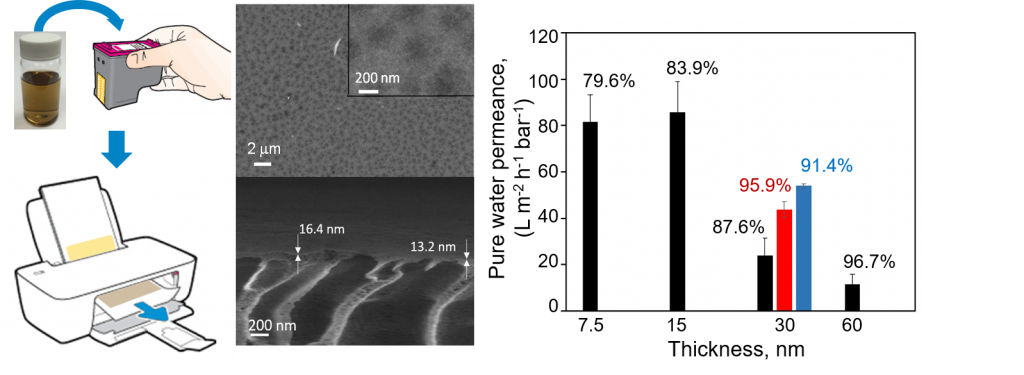
Researchers at Rensselaer Polytechnic Institute led by Professor Miao Yu developed for the first time a nanofiltration membrane from an ultrathin Graphene Oxide. They demonstrated inkjet printing as a fast, scalable and cost-effective method of fabrication of nanofiltration membranes on a polymeric material with high water purification effectiveness. Their research work has been published in the peer-reviewed Journal of Materials Chemistry A.
According to the researchers a high-quality nanofiltration membranes made from Graphene Oxide supported by a polymeric can be developed through the use of inkjet printer whose function is to deposit an ultra-thin Graphene Oxide material. For the development of an effective printing for Graphene Oxide ink, the concentration and the flake size of the Graphene Oxide solution are essential properties to be considered. Dispersions with larger flake size cause a blockage on cartridge nozzle while smaller flake size showed smooth printing. Similarly, higher concentration causes a snarl-up while a lower amount of the graphene oxide in the solution can cause leakage from the printer’s cartridge nozzle due to dispersions low viscosity. The polymeric support should have a hydrophilic surface to ensure proper wetting of the ink droplets and for better merge of droplets to form a liquid film that is continuous. The support should be a skin layer thick with a small pore of the membrane. A polyacrylonitrile material was selected for the support material as it is highly hydrophilic when hydrolyzed with a solution of sodium hydroxide.
The permeation performance of water through the membrane is dependent on the water wettability. Water wettability is known to increase as the surface roughness increases according to the Wenzel equation. The evaluation of permeation of the graphene oxide membranes which were printed under various conditions showed pure water permeance increased as the membrane thickness increase. On the other hand, the rejection of organic molecules also increased with increase in thickness of the membrane. Therefore this excellent performance of the printed graphene oxide membranes in nanofiltration as compared to other commercial membranes including trisep, microdyn, nadir and Dow filmech. For this reason, the graphene oxide nanofiltration membrane can be applied with confidence in pharmaceuticals, endocrinelites and antibiotic companies to remove contaminants
The study successfully demonstrated for the first time that it is possible to come up with a highly effective nanofiltration membrane using graphene oxide. The process of fabrication of this essential component is fast and scalable as it only requires the use of a conventional inkjet printer which deposits an ultrathin film of the material on a support made of polyacrylonitrile (M-PAN).The solution based graphene oxide considered to be environmentally friendly as it doesn’t produce poisonous gases. Further, on optimization, the graphene oxide nanofiltration membranes have shown to have a high rejection of small molecules and high permeance of water during application and therefore best for use in purification of water. The support on which the graphene oxide solution is printed on is highly hydrophilic hence making it possible for the use of this solvent. The inkjet printing as a method of manufacture of graphene oxide nanofiltration membranes is highly effective and a critical advancement in the purification of water among other filtration application.
Research updates in Printing GO membranes at Dr. Yu’s group:
Fanglei Zhou, Ph.D. candidate and the leading researcher of printing membrane technology in Dr. Miao Yu’s group, is developing printing graphene oxide-based membranes for desalination and gas separations. “We have successfully demonstrated printing is a facile and scalable technique to deposit defect-free, ultrathin graphene-oxide membranes that can be used as an effective water nanofiltration membrane to remove small organic contaminants in water. Currently, we are exploring its performance for seawater desalination and carbon dioxide capture”, says Zhou. Promising results for these applications have been found according to their preliminary reports. “By using printing technology, we can fabricate ultrathin and large area graphene oxide-based membranes and improve the separation performance by modifying the graphene oxide materials and/or adding various functional agents”, Zhou says. He further points out, “Membrane production scale-up is always one of the major concerns for their practical industrial applications. This novel technology, however, brings a facile and scalable graphene oxide membrane preparation method for large area membrane production. We expect this simple and scalable technique may greatly accelerate application of graphene-oxide membranes in separations”.



Reference
Mahdi Fathizadeh, Huynh Ngoc Tien, Konstantin Khivantsev, Jung-Tsai Chen and Miao Yu. Printing ultrathin graphene oxide nanofiltration membranes for water purification. Journal of Material Chemistry A , (2017),5: 20860-20866.
Go To Journal of Material Chemistry A