 Advances in Engineering Advances in Engineering features breaking research judged by Advances in Engineering advisory team to be of key importance in the Engineering field. Papers are selected from over 10,000 published each week from most peer reviewed journals.

Significance
Dimethyl peroxide decomposes easily into two radicals when excited by ultraviolet radiation. The produced radicals can thereafter trigger polymerization processes. In the atmosphere, hydro peroxides and peroxides are present as pollutants and are responsible for a series of chemical reactions. Therefore, it is important to have an understanding of their spectra in a bid to keep an eye on their chemical processes.
The value of the dihedral angle R-O-O-R’ at equilibrium is of ultimate importance for the attributes of peroxides. The dihedral angle would be about 120° without any interaction between the substituents R and R’. This would be similar to dihydrogen peroxide. When this dihedral angle is changed, the molecule would pass through two conformations, the trans– and the cis-conformations, under which dihydrogen peroxide would form torsional barriers. For these two conformations defined by 180° and 0°, respectively, the fragment formed by the two hydrogen atoms as well as their neighbors is planar. Incase R=R’, the symmetric trans structure has a center of inversion, there is a non-permanent dipole moment. Furthermore, no purely rotational spectrum exists for this kind of a molecule.
An array of experimental information is available for dimethyl peroxide. A photo-electron experiment has also been conducted and confirmed the trans or near-trans structure. These experiments have been done under stringent conditions, considering that the molecule of dimethyl peroxide is highly explosive. Vibrational spectra, both infrared, in gas phase and argon matrix have been published. Finally, the structure has been determined by electron diffraction. However, there has been a disagreement as to the gas-phase structure of dimethyl peroxide.
Researchers led by Professor Alexander Alijah at Université de Reims Champagne-Ardenne in France investigated the existing problem with high-level CCSD(T)-F12 and MRCI procedures. They demonstrated that theoretical and experimental results were not necessarily in contradiction. Their research work is published in peer-reviewed journal, Physical Chemistry Chemical Physics.
The authors characterized the structure of dimethyl peroxide by MRCI and CCSD(T) implementing the aug-cc-pVTZ basis and through CCSD(T)-F12 implementing the VTZ-F12 basis. They then performed a thorough analysis of the experimental data available for the title molecule and suggested a new interpretation of the electron diffraction experimental data. The researchers observed that these were keeping with the findings of the high-level ab initio computations in case the floppy character of the molecules was appreciated.
There was a seeming agreement of the gas-phase electron diffraction data with the results obtained from quantum computations with small basis sets that was delusive. A systematic improvement of the level of ab-initio theory led to a well-defined and a unique structure, which was the trans-structure. There was reported no contradiction between the conclusions obtained from the various experimental methods. Therefore, the more than thirty-year-old problem has finally been solved.
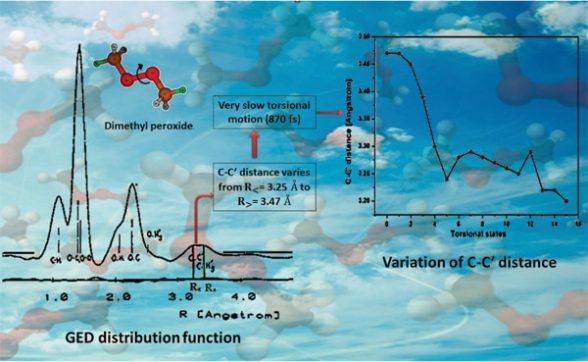
In the electron diffraction experiment (GED), no sharp signal was obtained for the C-C distance. The new calculation can explain quantitatively the variation of this distance.



Reference
Olfa Ferchichi, Najoua Derbel, Nejm-Eddine Jaidane, Thibaud Cours and Alexander Alijah. The gas-phase structure of dimethyl peroxide. Physical Chemistry Chemical Physics, volume 19 (2017), pages 21500-21506.
Go To Physical Chemistry Chemical Physics