Advances in Engineering Advances in Engineering features breaking research judged by Advances in Engineering advisory team to be of key importance in the Engineering field. Papers are selected from over 10,000 published each week from most peer reviewed journals.

Significance
Recent technological advances contributed to the evolution of thermal insulation materials. Currently, the need for efficient thermal insulation cannot be overstated owing to our limited energy resources. Furthermore, established materials have proven inadequate for their prescribed role pushing the need further for excellent insulators. Aerogels emerged as promising thermal insulators. However, aerogels suffer from poor mechanical properties and elaborate, energy-intensive fabrication. Silica hollow spheres, on the other hand, offer excellent control over their hierarchical assembly structure. In their case, the geometry of the colloidal particles is not the only decisive parameter that determines the thermal insulation. This, therefore, calls for further research to elucidate other critical factors.
Researchers led by Professor Markus Retsch at the University of Bayreuth in Germany conducted a series of studies to improve our understanding of thermal insulation mechanisms in porous, particulate materials. The goal of the researchers was to shade light on the fundamental limit of thermal conductivity in hollow silica sphere ensembles. They discovered this limit through critical structure-property relationships. Furthermore, they investigated several parameters including: the aspect ratio of the hollow particles, the degree of order in the colloidal assembly, and the bonding strength between adjacent particles, among others. Their work was recently published in Advanced Functional Materials.
The researchers began their studies by synthesizing a variety of hollow silica spheres. The team then obtained colloidal crystals by slow evaporation of a concentrated particle dispersion under ambient conditions. Subsequently, they characterized their material using transmission electron microscopy, scanning electron microscopy, and nitrogen sorption measurements. Laser flash analysis determined the effective thermal diffusivity of the colloidal assemblies. Combining the thermal diffusivity measurement with the density of the colloidal crystals and their corresponding specific heat capacity allowed to calculate the thermal conductivity.
The authors observed a decrease in thermal conductivity when the particle size was increased and the shell thickness reduced. Besides the particle geometry, they investigated the number and strength of the inter-particle contact points. The researchers reduced both the packaging density of the spheres in the assembly and the bonding strength between adjacent particles. These alterations resulted in a substantial reduction of the thermal conductivity and diffusivity in a vacuum.
Markus Retsch and his research team successfully presented a holistic picture of the thermal transport properties of dense silica hollow nanoparticle packings. Their work concentrated on the influence of the hollow sphere size and shell thickness. The thermal diffusivity is mainly influenced by the shell thickness. Altogether, their comprehensive study on the interplay of vacuum- and gas-dependent thermal diffusivity and thermal conductivity in nanostructured materials will help in developing new and innovative insulation materials.
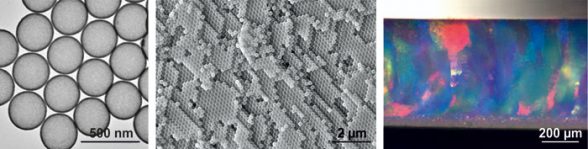
Left:Transmission electron microscopy: Hollow silica nanoparticles can be fabricated with high structural precision based on a templating strategy. Particle diameter and shell thickness can be controlled with nanometer precision.
Middle: Scanning electron microscopy: Self-assembly of such monodisperse colloidal particles readily yields highly periodic superstructures. The particles crystallize in a face-centered cubic symmetry.
Right:Optical microscopy: Slow drying of colloidal dispersions leads to macroscopically free-standing films with a thickness of several hundred micrometers. The highly crystalline order can be inferred from the bright opalescent color.


Reference
Pia Ruckdeschel, Alexandra Philipp, and Markus Retsch. Understanding Thermal Insulation in Porous, Particulate Materials. Advanced Functional Materials. 2017, volume 27.
Go To Advanced Functional Materials