Advances in Engineering Advances in Engineering features breaking research judged by Advances in Engineering advisory team to be of key importance in the Engineering field. Papers are selected from over 10,000 published each week from most peer reviewed journals.

Significance
Biomedical materials are vital in advancing medicine. They are widely used by medical practitioners and biomedical engineers to address various medical issues such as fixing broken limbs, artificial heart transplants, artificial veins among others. More research, however, is still being done on inventing more materials that will help address the challenges experienced in the medical and other related fields. NiTi alloys represent such widely used biomedical material. Such materials have distinct properties such as biocompatibility, superelasticity and good shape memory effect hence cannot affect the normal body function in any way.
However, more effort is still being put into manufacturing advanced structures with specialized properties for use as biomedical materials. An example of such is the porous NiTi alloy which is technically an improvement of the NiTi alloys. Various preparations methods can be used in the manufacturing of such structures to fit a specific use. For instance, it is possible to form laminated structured porous materials in various chemical compositions.
Although there is little information available on the microstructural features, superelasticity and preparation procedure of NiTi-Nb porous materials, there is still a belief that they are the crucial consideration in making such materials among new researchers. This has led to the development of various fabrication techniques for NiTi-Nb alloys such as the brazing process and metallurgic bonding for enhancing some properties like stiffness.
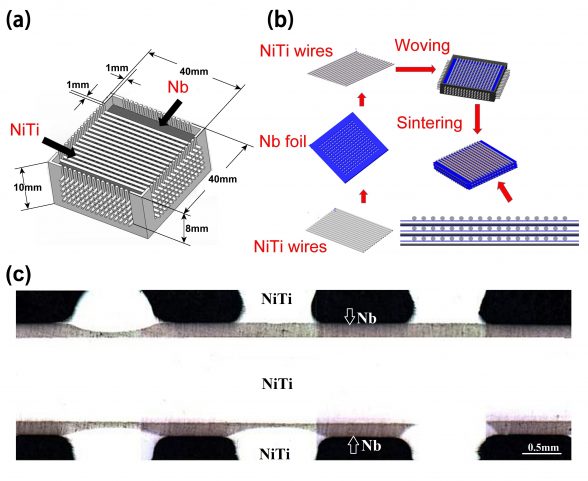
A group of researchers at Shanghai Jiao Tong University, School of Materials Science and Engineering in China: Professor Liqiang Wang, Professor Lechun Xie, Dr. Liangyu Chen, Zihao Ding, Yuting Lv, Wei Zhang, Professor Weijie Lu and Professor Di Zhang in collaboration with Professor Lai-Chang Zhang from Edith Cowan University in Australia developed a combination of several techniques to fabricate NiTi-Nb layer-like porous structures. They used 3-dimensional interconnected channels together with NiTi-Nb eutectic reactions. They further focused on analyzing the formation of the NiTi matrix and the solidified NiTi-Nb eutectic interface. Their research work is currently published in the journal, Acta Materialia.
From their experiments, the authors observed that the eutectic phase transformation process is highly dependent on the stacking faults and the dislocations taking place between the Nb-rich phase and the eutectic phase. On the other hand, the stress-induced martensite nucleation was aided by the reduction in the rate of the dislocation process due to the formation of the rod-like eutectic phase.
The interface between the brazed NiTi-Nb specimen experienced inhomogeneous chemical composition resulting to chemical instability in the region and thus the formation of the martensite phase. During the amorphous phase transformation, there is a reduction in the free energy due to various factors such as the presence of the stacking faults and dislocations, thereby leading to the amorphization of the crystalline NiTiNb. Much more superelastic recovery and elastic recovery for such a layer-like porous structure were attributed to formation of more martensites during deformation. It is the first demonstration that a strong, ductile layer-like NiTiNb porous metal can be easily created between NiTi wires to bond Nb foils, thus opening the door to producing shape-memory or superelastic NiTi scaffolds brazed from stacked, woven or braided wires. The researchers are optimistic that their combined techniques will advance manufacturing of more advanced biomedical materials.


Reference
Wang, L., Xie, L., Zhang, L., Chen, L., Ding, Z., & Lv, Y. et al. (2018). Microstructure evolution and superelasticity of layer-like NiTiNb porous metal prepared by eutectic reaction. Acta Materialia, 143, 214-226.