Advances in Engineering Advances in Engineering features breaking research judged by Advances in Engineering advisory team to be of key importance in the Engineering field. Papers are selected from over 10,000 published each week from most peer reviewed journals.

Significance
The rapid advancement in computers experienced in the recent decades has significantly contributed to the improvement of computer simulation tools used in different fields for both, practical and scientific purposes. Although many new models have been developed, their increasing complexity has created new challenges for users around the world. Most modelers today find it very hard to understand and properly implement these highly complex models, which is compounded by the fact that such models typically carry numerous parameters.
Therefore, it reasonable and efficient to provide the modelers with a tool that can help them understand the relationships between the model inputs and outputs, as well as to proper manage the data uncertainty. Although there are several tools, Global Sensitivity Analysis (GSA) equipment methods are used the most for such tasks. GSA are capable of providing qualitative and/or quantitative sensitivitye information regarding the input variations and their effects on the output.
Many of the existing GSA approaches, however, are based on the assumption that the inputs are independent. This limits their functionality and accuracy in models with numerous dependent inputs, where their use can lead to fallacious outcomes or incorrect inferences.
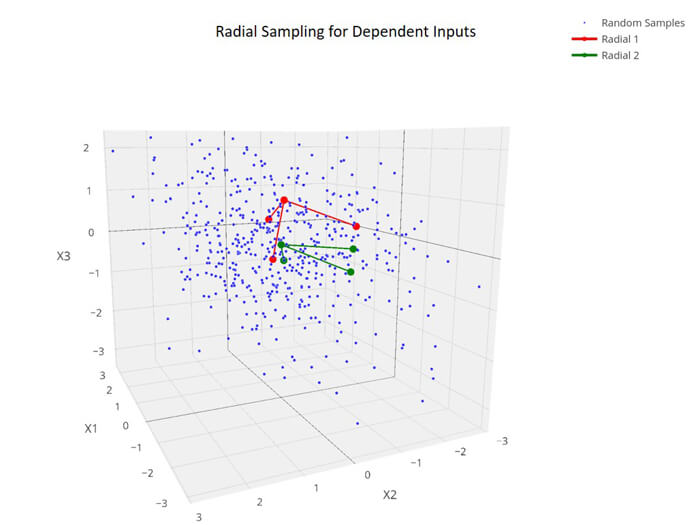
Researchers at the Institute for Transport Planning and Systems in ETH Zurich, Switzerland, Dr. Qiao Ge and Professor Monica Menendez (currently at New York University Abu Dhabi) proposed a non-parametric approach for screening model inputs before performing the GSA. The method is based on an improvement of the classic elementary effects method, mostly used for independent inputs screening. They performed three numerical experiments and compared the screening results obtained from the three experiments to those of a variance-based GSA. The research work is published in the journal, Reliability Engineering and System safety.
The authors observed that the screening method could be effectively used in complex models with many dependent and independent inputs, or with inputs that have different marginal distributions. In all cases the method is capable of correctly identifying both the influential and non-influential model inputs. The comparison between the results of the three numerical examples and those of the variance-based GSA showed reasonable accuracy level rundespite requiring much lower computational effort.
In summary, the screening method by Qiao Ge and Monica Menendez has demonstrated to be highly accurate yet computationally efficient. As stated by the authors “it is a practical tool for the initial stage of the GSA in models with dependent inputs, especially when the models are high dimensional and computational expensive. It allows one to use a factor fixing approach to find the least- influential inputs and fix them to their nominal values without necessarily changing the model outputs, before proceeding to conduct a more in depth and computationally demanding quantitative analysis to refine the results.



Reference
Ge, Q., & Menendez, M. (2017). Extending Morris method for qualitative global sensitivity analysis of models with dependent inputs. Reliability Engineering & System Safety, 162, 28-39.
Go To Reliability Engineering & System Safety