Advances in Engineering Advances in Engineering features breaking research judged by Advances in Engineering advisory team to be of key importance in the Engineering field. Papers are selected from over 10,000 published each week from most peer reviewed journals.

Significance
Electrically conductive polymer composites are widely used for various industrial applications today. They can be formed from a dispersion of conductive fillers in either a polymer blend or matrix through extrusion or injection molding. A good example of commonly used conductive filler are the carbon nanotubes (CNT), which has a good electrical conductivity and high aspect ratio so could promote low percolation thresholds in the composite. As matrix, the blends of polyamide 12 and polyamide 6 (PA12/PA6) have added advantages such as better dimensional stability as compared to using a single polyamide 6.
However, various factors determine the nanocomposite morphology in the case of use immiscible blends as PA12/PA6 blends. They include viscosity ratio of the polymers, kinetic effects, and thermodynamics. On the other hand, evaluation of the rheological behaviors and electrical conductivity of the nanocomposites can be used to investigate their percolation threshold. It also provides an in-depth understating of the organization structure of the MWCNTs in their polymeric matrices.
A group of researchers at the University of Coruna in Spain: Dr. Laura Arboleda-Clemente, Assistant Professor Ana Ares-Pernas, Mr. Xoan Garcia, Dr. Sonia Dopico and Assistant Professor Maria Jose Abad designed a carbon nanotube nanocomposite with low percolation threshold and excellent electrical conductivity. They used an immiscible PA12/PA6 blend as matrix. This was in a bid to understand and explain the macroscopic properties of nanocomposites. Their research work is currently published in the research journal, Polymer Composites.
The authors used rheological tests and alternating current measurements to deduce the percolation threshold. Furthermore, to investigate the carbon nanotubes localization and the nanocomposite morphology in the polymer matrix, transmission electronic microscopy and light microscopy were used. Lastly, they calculated the electrical and rheological percolations using graphical methods.
The authors observed from rheological tests, a liquid-like to solid-like transition that takes place between 0.15% and 0.31% of the entire MWCNT volume. On the other hand, a 0.09% of the MWCNT was estimated using the power-law relationship. Additionally, it was found that the insulation to conduction transition of the material was also located between 0.15 and 0.31 of the MWCNT percentage volume, but in this case,the electrical threshold, using the power-law relation, was found to be 0.26%. The obtained results were similar to those obtained in the previous studies.
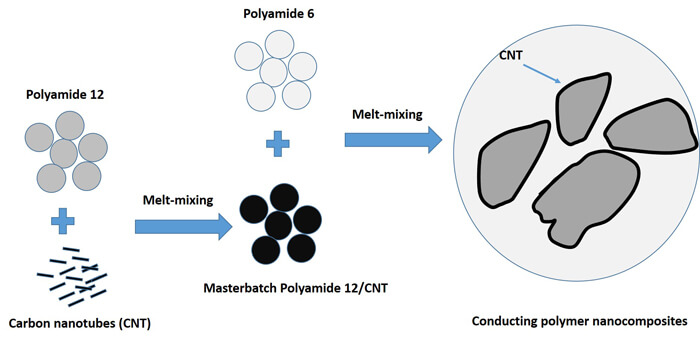
The sequence of mixing of PA12, PA6 and MWCNTs during processing promoted the development of a segregated conductive network. The preferred localization of the CNTs is the interface of the two used polyamides. This morphology explains the low percolation thresholds obtained for the PA12/PA6/MWCNT composites. Besides, a lower rheological percolation than electrical percolation was observed. This was attributed to the fact that the electrical percolation depends on the network created by carbon nanotubes while the rheological percolation depends on both nanotube-nanotube and nanotube-polymer networks.




Reference
Arboleda-Clemente, L., Ares-Pernas, A., García, X., Dopico, S., & Abad, M. (2015). Segregated conductive network of MWCNT in PA12/PA6 composites: Electrical and rheological behavior. Polymer Composites, 38(12), 2679-2686.
Go To Reliability Polymer Composites