Advances in Engineering Advances in Engineering features breaking research judged by Advances in Engineering advisory team to be of key importance in the Engineering field. Papers are selected from over 10,000 published each week from most peer reviewed journals.

Significance
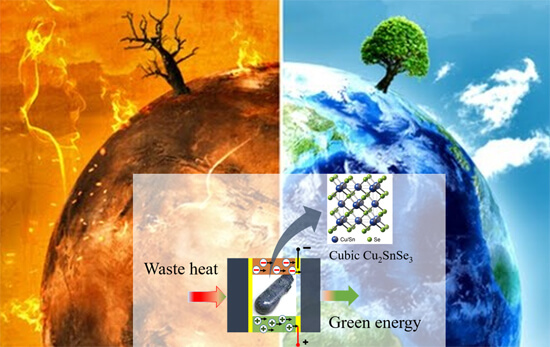
The global environmental challenge has led to intensive innovations of new renewable energy sources. Thermoelectric energy using waste heat can be used for electric power generation. The use of this technology is set to grow due to vast potential applications of thermoelectric materials such as in remote area sensors and electronic devices. Although most of the currently available thermoelectric materials such as Bi2Te3 are expensive and toxic in nature, the newly developed materials such as Cu2SnSe3 are cost-effective, readily available and less toxic.
The physical and electrical properties of Cu2SnSe3 can be enhanced and controlled through doping on the Sn site which for example increases the Seebeck coefficient of the material. Generally, Cu2SnSe3 exist in different allotropic forms including cubic structures, orthorhombic and monoclinic. Also, other conditions such as temperature and pressure affect the phase transformation of Cu2SnSe3 compounds. However, different thermoelectric materials synthesis and stoichiometric conditions result in the formation of different phases. Therefore, a good understanding of the thermodynamic conditions of the phases is vital for the synthesis of Cu2SnSe3 material with excellent properties. For instance, phase transitions can induce different lattice and band gap parameters that may further affect the physical properties of the materials in one way or the other.
A group of researchers at Seoul National University led by Professor Chan Park investigated thermoelectric properties of different Cu2SnSe3 sample phases through examining the effects of the annealing temperature on the transition phases. The work is published in the research journal, Journal of Materials Chemistry C.
The research team commenced their studies by synthesizing the Cu2SnSe3 samples by melting and solidification, annealing at different temperatures and lastly carrying out water quenching. Powder X-ray diffraction (XRD) was used to analyze the different phases formed. Eventually, the different phase structures obtained and thermoelectric properties of various phases at high and low temperature were compared at a specified temperature range of 300-600K.
The authors successfully observed monoclinic phase and relatively small cubic phase in the Cu2SnSe3 samples annealed at a temperature range of 720-820K, while cubic phase was the dominant phase in the samples annealed at 960K. Also, cubic phases exhibited a better dimensionless figure of merit (ZT) than monoclinic phases, especially at 600K. Generally, the cubic phase samples of Cu2SnSe3 exhibited better thermoelectric performances as compared to monoclinic samples.
The first principle calculations showed significantly enhanced electrical conductivity of cubic phases as compared to monoclinic phases. This was attributed to the induced higher carrier concentration and the decrease in the band gap. However, a relatively small change in the thermoelectric conductivities of both cubic and monoclinic phase samples resulted from the photonic scattering induced by the formation of a minor secondary phase and also polymorphic modification due to the increase in the annealing temperatures.
The research group studied thoroughly the thermoelectric properties of the cubic and monoclinic phases of Cu2SnSe3. The results showed the excellent performance of cubic phases as compared to monoclinic phases. Also, it is possible to improve the cubic phase performance by interstitial alloying or doping at the Sn sites to optimize the Seebeck coefficient. Therefore, according to the authors, cubic phase Cu2SnSe3 is better for various thermoelectric applications.


Reference
Siyar, M., Cho, J., Youn, Y., Han, S., Kim, M., Bae, S., & Park, C. (2018). Effect of annealing temperature on the phase transition, band gap and thermoelectric properties of Cu2SnSe3. Journal of Materials Chemistry C, 6(7), 1780-1788.
Go To Journal of Materials Chemistry C