 Advances in Engineering Advances in Engineering features breaking research judged by Advances in Engineering advisory team to be of key importance in the Engineering field. Papers are selected from over 10,000 published each week from most peer reviewed journals.

Significance
The freeze drying process is often used to slow down denaturation and aggregation of protein-based pharmaceuticals. Unfortunately, both drying and freezing processes induce stresses in the protein that may result in loss of activity. For instance, low temperatures and formation of the ice-water interface lead to freezing-induced denaturation.Furthermore,, removal of the protein hydration shell induced by drying disrupts the native state of the protein, possibly resulting in unfolding. Therefore, the need to prevent the loss of activity of biopharmaceuticals has compelled researchers to look for a suitable formulation.
Amino acids, sugars, and polyols are the main stabilizers used for cryo- and lyo-protection of proteins. In drying and freezing, the protein stabilization mechanisms by excipients are different. For instance, a good cryoprotectant may be a poor lyoprotectant, because of its inefficiency in replacing the hydration shell of the protein. Although significant efforts have been made to investigate the efficiency of different excipients, most of the reported findings have only leaned on the interactions between the excipients and proteins with little reported about the effects of drying and freezing conditions on the protein structure.
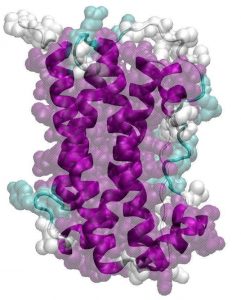
Recently, Professor Roberto Pisano and Andrea Arsiccio (PhD student) at Polytechnic University of Turin investigated the effects of freezing and drying conditions on the protein structure. The authors used molecular dynamics to estimate the interaction between the human growth hormone (hGH) (model protein) and the ice-water interface, both in the presence and absence of excipients. They also investigated the effect of removing water on the stability of the protein, in order to fully clarify the role of cryo- and lyo-protectants in the biopreservation of proteins. Their research work is published in the research journal, Physical Chemistry Chemical Physics.
The authors observed that even though good cryo-protectants may be not equally effective as lyo-protectants, excipients generally have the capability to reduce the damage induced by drying and freezing conditions. The simulations were also validated by experimental results. Furthermore, the authors pointed out that the interaction of stabilizers with specific amino acid sequences of the protein was a key consideration for protein preservation. Therefore, it emerged that specific regions on the protein surface, rather than the whole molecule, drive the unfolding process during freeze-drying, and its inhibition by means of excipients. Remarkably, in many cases these unfolding-prone regions also coincided with the protein regions that were more prone to aggregation.
The Roberto Pisano-Andrea Arsiccio study successfully analyzed the effects of drying and freezing conditions on the preservation of proteins like the human growth hormone. Moreover, similar results were obtained in the same work for another model protein, lactate dehydrogenase (LDH), suggesting that the conclusions drawn in the paper are of general application. This study is expected to advance biopharmaceuticals preservation and may help increase the shelf-life of protein-based drugs.


Reference
Arsiccio, A., & Pisano, R. (2018). Clarifying the role of cryo- and lyo-protectants in the biopreservation of proteins. Physical Chemistry Chemical Physics, 20(12), 8267-8277.
Go To Physical Chemistry Chemical Physics