Advances in Engineering Advances in Engineering features breaking research judged by Advances in Engineering advisory team to be of key importance in the Engineering field. Papers are selected from over 10,000 published each week from most peer reviewed journals.

Significance
Recently, fabrication of functional and smart materials using green preparation techniques and renewable resources has attracted significant attention among researchers and scientists. For instance, cellulose has been widely used in the preparation of functional materials as a robust and stable carrier. It is a natural polymer that exhibits excellent properties regarding chemical stability, renewability and biodegradability among others. Moreover, nanostructured inorganic materials are employed in the modification of the cellulose matrix. As such, various functional materials based on nanomaterial-integrated cellulose have been fabricated through mixing and coating processes. These materials have henceforth been used in numerous applications including sensors and electronic devices.
Presently, graphene has opened ways for the design of advanced smart materials owing to its unique properties. Graphene can be prepared by reducing its precursor graphene oxide. Graphene oxide possesses numerous functional groups like hydroxyls that improve its dispersion in polar environments. Consequently, cellulose solvents have also been used in the fabrication of graphene oxide composites. Even though the presence of graphene oxide improves the mechanical and thermal properties of cellulose-based materials, their practical applications are still limited due to lack of electrical conductivity.
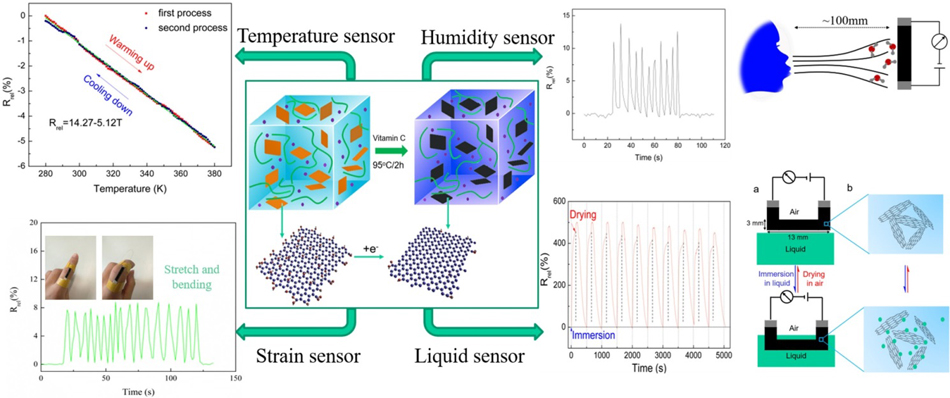
To this note, researchers have been looking for simple methods to fabricate conductive graphene-based cellulose nanocomposites with stable morphology. Scientists at Leibniz-Institut für Polymerforschung Dresden, Germany: Yian Chen (PhD candidate), Dr. Petra Pötschke, Dr. Jürgen Pionteck and Professor Brigitte Voit in collaboration with Professor Haisong Qi at South China University of Technology fabricated cellulose/ reduced graphene oxide (rGO) nanocomposite films by homogeneous dispersion of graphene oxide in alkaline-urea aqueous solution of cellulose. This was immediately followed by chemical reduction of graphene oxide using environmental friendly vitamin C forming conducting cellulose films. Eventually, they investigated the properties, structure and sensing application of the resultant materials. Their work is published in Journal of Materials Chemistry A.
The authors observed that the resultant composite film exhibited good electrical, thermal and mechanical properties. Increasing the content of rGO in the cellulose films resulted in a significant increase in the conductivity of the composite films. Consequently, the cellulose films can be used as multifunctional sensor materials because they were capable of responding to various external stimuli like stress/strain, temperature and humidity. The combination of wide ranges of humidity, temperature and strain sensing is the unique characteristics of such composites, reported here for the first time.
The research team successfully developed a sustainable, flexible and lightweight material. Due to their accuracy and efficiency, these cellulose films are capable of detecting human (hand) motion and breathing cycles. Their sensitivity to liquids is determined by the type of liquid, the ion concentration and the liquid temperature. This can extend applications of cellulose composite films in other fields such as medicine, catalysis and optoelectronics. The present functional groups permit tailoring the chemical and electrical behavior of rGO/cellulose composites. Therefore, the study will advance the design and fabrication of smart materials based on graphene oxides and cellulose.





Reference
Chen, Y., Pötschke, P., Pionteck, J., Voit, B., & Qi, H. (2018). Smart cellulose/graphene composites fabricated by in situ chemical reduction of graphene oxide for multiple sensing applications.. Journal of Materials Chemistry A, 6(17), 7777-7785.
Go To Journal of Material Chemistry A