Advances in Engineering Advances in Engineering features breaking research judged by Advances in Engineering advisory team to be of key importance in the Engineering field. Papers are selected from over 10,000 published each week from most peer reviewed journals.

Significance
In a very short time, perovskite absorbers have managed to revolutionize research on solar energy with very high solar power-conversion efficiencies. This has mainly been achieved by optimizing perovskite-film fabrication and device architecture. Recently, advances in the hybrid organic-inorganic perovskites have enabled large inorganic cations with 12-fold coordination to be replaced by organic ions, preserving the octahedral network of anions which controls the perovskite crystal structure. Such hybrid perovskites are easy to fabricate, economical and have high efficiency in converting light to electricity. Unfortunately, shortcomings related to their inherent instability upon exposure to oxygen, UV light and water among others, hinder further development of perovskite-based solar cells in the long term. Therefore, it is imperative that a novel chemical technique to stabilize these and other lead-free perovskites, preserving at the same time their excellent absorption and charge-transport properties, be developed.
Recently, Dr. Sabine Körbel and Professor Silvana Botti from the Institute for Solid State Theory and Optics at Friedrich Schiller University Jena in collaboration with Professor Miguel Marques at Martin Luther University of Halle-Wittenberg assessed the thermodynamic stability and the electronic band structures of new hybrid organic-inorganic perovskites, using a broad range of elements. Their goal was to propose viable substitutions for both lead and the organic cation that would result in enhanced thermodynamic stability, preservation of small effective masses and produce optimal band gaps for photovoltaics. Their work is currently published in the Journal of Materials Chemistry A.
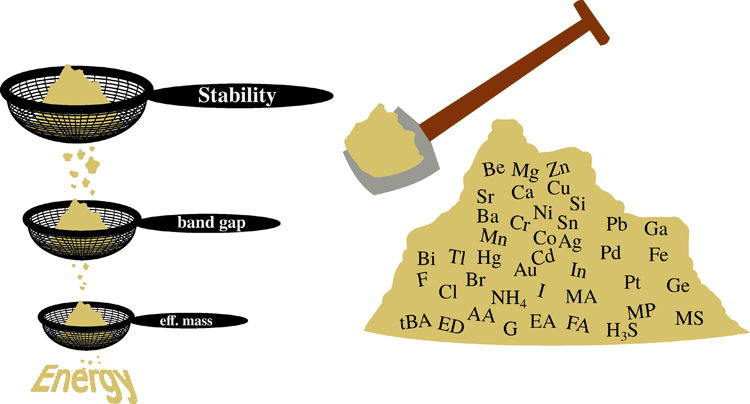
The research method employed entailed a thorough consideration of compounds with the composition A+B2+X3-, where A represented the molecular organic cation, X a halogen, and B a divalent element. The researchers then adopted the most promising molecules based on previous studies. Specifically, they varied the molecule size from the very small sulfonium to the very large tert-butylammonium. Lastly, all the resulting thermodynamically stable hybrid perovskites were then further characterized by calculating their band gaps and effective masses, so as to identify the most promising candidates for further experimental and theoretical characterization.
The authors observed that there were few elements that could help in stabilizing hybrid perovskites if substituted partly for the predominant lead element. They also found out that the A site ion had potential to be used to improve stability. The researchers noted that the most promising compounds were those with methylphosphonium or sulfonium as the molecular cation and a group-IV element on the B site. This was attributed to the fact that the compounds combined to form a favorable band gap with a small effective mass.
In summary, the study presented a thorough screening of a large part of the periodic table for possible substitutions for lead, methylammonium, and iodine in methylammonium lead iodide that could enhance the thermodynamic stability of hybrid organic-inorganic perovskites. In general, they observed that their unbiased high-throughput approach had immense potential to yield unexpected compounds. Altogether, their study highlighted that the substitution of organic molecule is the most promising way to enhance thermodynamic stability, while there is no optimal replacement for lead or tin, unless one considers partial substitution or alloying.



Reference
Sabine Körbel, Miguel A. L. Marques, Silvana Botti. Stable hybrid organic–inorganic halide perovskites for photovoltaics from ab initio high-throughput calculations. Journal of Materials Chemistry A, 2018, volume 6, page 6463.
Go To Journal of Materials Chemistry A