Advances in Engineering Advances in Engineering features breaking research judged by Advances in Engineering advisory team to be of key importance in the Engineering field. Papers are selected from over 10,000 published each week from most peer reviewed journals.

Significance
Steels are widely used in various applications owing to their excellent physical and mechanical properties such as strength, toughness and ductility. Unfortunately, steels are susceptible to various failures resulting from causes like temperature changes that reduce their functionality and reliability. In a recently published literature, advanced 9-10% Cr steels with high boron and low nitrogen content were developed. These steels demonstrate an exceptional high-temperature strength making them favorable for critical application like power plants components. However, little emphasis has been given to the causes of embrittlement of high-chromium steels with high boron and low nitrogen content.
Recently, Dr. Roman Mishnev, Dr. Nadezhda Dudova, Dr. Valeriy Dudko and Professor Rustam Kaibyshev at Belgorod State University investigated the effect of lowering nitrogen and increasing boron content on ductile-brittle transition temperature of the 10% Cr steel under impact loading. They compared the results obtained with that for the P92-type steel chemical composition. Their work is published in the research journal, Materials Science and Engineering.
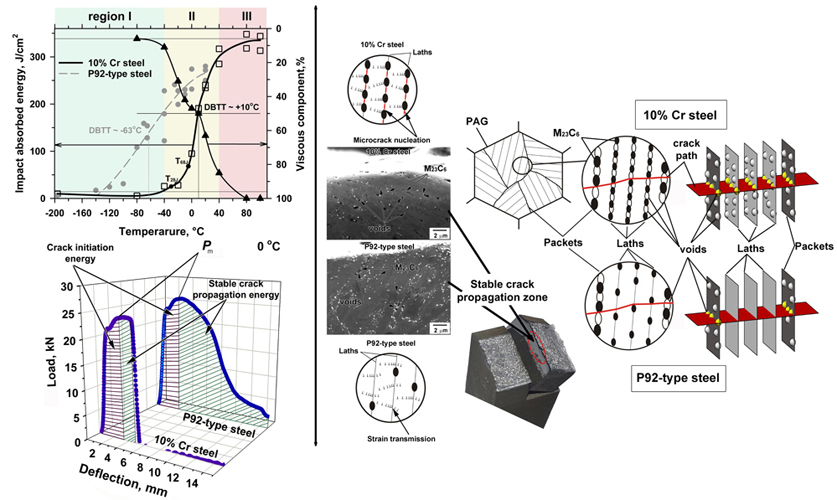
From the experimental results, the authors obtained a ductile-brittle transition temperature of 10°C. However, full embrittlement was obtained at a temperature of -80°C. Furthermore, lowering nitrogen content and increasing boron content resulted in an increase in the ductile-brittle transition temperature of the 10% Cr steel as compared to the conventional high-chromium steels like the P92-type steel. This was attributed to the high density of the carbides located at the boundaries that led to the formation of the voids and cracks.
The study successfully investigated the effect of low nitrogen and high boron in ductile-brittle transition temperature of the 10% Cr steel. For instance, resulting voids at the carbide-matrix boundaries produced a principal unstable crack with critical dimension after propagation of a stable crack on a very short distance. This led to low impact energy and embrittlement at relatively high temperatures. Therefore, the Belgorod State University scientists are optimistic that the study will advance the application of high-chromium martensitic steels for critical components in various dimensions. This will further help in component failure prevention.




References
Mishnev, R., Dudova, N., Dudko, V., & Kaibyshev, R. (2018). Impact toughness of a 10% Cr steel with high boron and low nitrogen contents. Materials Science and Engineering: A, 730, 1-9.
Go To Materials Science and Engineering