Advances in Engineering Advances in Engineering features breaking research judged by Advances in Engineering advisory team to be of key importance in the Engineering field. Papers are selected from over 10,000 published each week from most peer reviewed journals.

Significance
At present, the rate of carbon emission is alerting. Consequently, much time, money and research has been directed toward the development of an alternative energy source. Potential fossil fuel substitutes have been found in solar, wind, thermoelectric and hydroelectric power systems – among others. The use of thermoelectric power generators to convert waste heat into electricity could help reducing the carbon footprint of mankind. The constituent materials should have a high thermoelectric figure of merit. Unfortunately, maximization of such a figure of merit provides a significant challenge for material design, since it requires optimization of apparently conflicting properties. This situation favours trial-and-error approaches over the development of simple and predictive design rules.
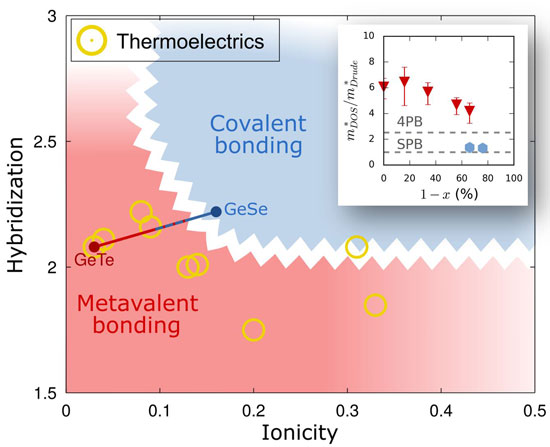
To establish an alternative approach to identify suitable thermoelectric materials, Matteo Cagnoni (PhD candidate), Daniel Führen, and Professor Matthias Wuttig from the I. Institute of Physics (IA) of RWTH Aachen University inferred a correlation in certain chalcogenides between high thermoelectric performance and metavalent bonding, a novel bonding mechanism identified recently by the same group (Wuttig et al., Advanced Materials 2018, 1803777). Convinced that the assessment of a link between the two phenomena would lead to better understanding and application of the aforementioned materials, they investigated the thermoelectric performance of alloys on the tie line between germanium selenide and germanium telluride. Their work is currently published in the research journal, Advanced Materials.
Samples were prepared by DC magnetron co-sputtering deposition and characterized by EDX and XRD techniques. By measuring Seebeck coefficient, electrical conductivity, carrier concentration and optical reflectivity in the mid-infrared spectral range, the authors could draw important conclusions. First, they observed that doping is not responsible for the superior performance of the metavalent samples. Second, they associated the large thermoelectric figure of merit of the metavalent samples to the remarkably strong anisotropy of the effective mass tensor of the relevant charge carriers. Based on a tight-binding model, they argued that the observed anisotropy stems from the p orbital nature of the electronic states of metavalently bonded materials.
In summary, Professor Matthias Wuttig and his research team identified and explained a link between chemical bonding and thermoelectric performance of crystalline IV–VI compounds. Their study presents insights relating the aforementioned properties and even establishes a map for the same, thanks to the correspondence between tight-binding parameters and chemical coordinates. All in all, the elementary model they derived encompassed simple design rules aimed at optimizing the anisotropy in order to maximize the thermoelectric performance. Altogether, the approach presented can also be applied for other material classes with thermoelectric behaviour, in order to identify new thermoelectric materials.



Reference
Matteo Cagnoni, Daniel Führen, Matthias Wuttig. Thermoelectric Performance of IV–VI Compounds with Octahedral‐Like Coordination: A Chemical‐Bonding Perspective. Advanced Materials 2018, volume 30, 1801787.
Go To Advanced Materials