 Advances in Engineering Advances in Engineering features breaking research judged by Advances in Engineering advisory team to be of key importance in the Engineering field. Papers are selected from over 10,000 published each week from most peer reviewed journals.

Significance
Recent technological advancement has led to effective methods of manufacturing plastic products through injection molding. Unfortunately, realizing the desired product quality have remained a challenge due to the unsuitable methods for measuring the cavity pressure curve, which is a key consideration in enhancing and optimizing the molding processes. To this end, effective methods for measuring the cavity pressure curves are highly needed thereby attracting significant attention amongst researchers.
Among the available cavity pressure measurement methods, pressure sensors are widely used owing to their high accuracy. Unfortunately, the sensors are limited to specific set measuring positions and also results in the formation of defects on the surfaces of the final products. Consequently, high initial and installation costs render their use expensive. In a recently published literature, alternatives and non-destructive techniques including ultrasonic and thermocouples have been developed. Alternatively, the need for offline and online monitoring methods have further escalated the development of new technologies. For instance, it is possible to determine material physical properties as well as detecting material defects and deformations using ultrasonic methods. However, most of these methods are not suitable for effective measuring of cavity pressure curves during injection molding.
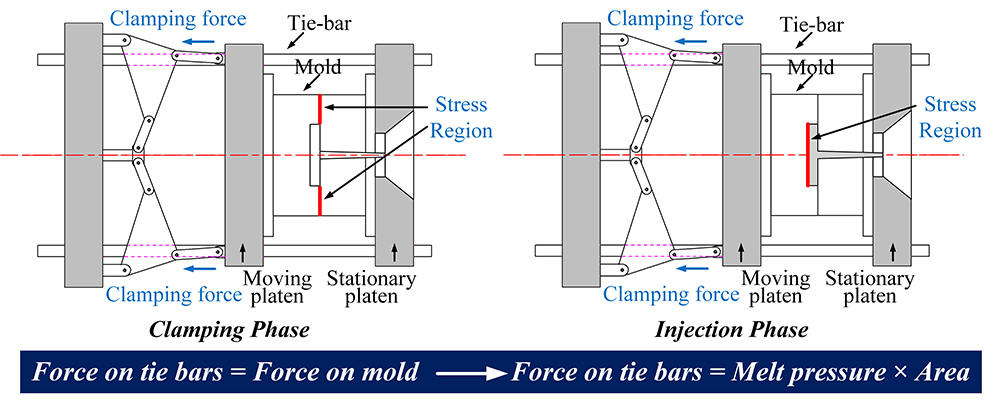
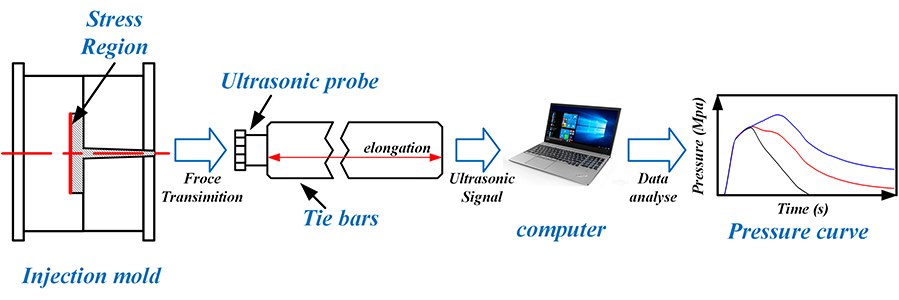
To this note, a group of Zhejiang University scientists (Professor Peng Zhao, Jianfeng Zhang, Yao Zhao, Junye Huang, Neng Xia, and Jianzhong Fu) developed a non-destructive method for measuring of cavity pressure in injection molding. In particular, they utilized a precise ultrasonic technology to determine the stresses on the tie bars of the injection molding machine and further investigated the possibility of using such method to measure the molding cavity pressure. Their work is currently published in the research journal, Sensors and Actuators A: Physical.
Briefly, the study entailed both theoretical and experiments works. The authors used a magnetic clamping force detector to measure the strains produced by the tie bars as a way of evaluating the relationship between the stress on tie bars and ultrasonic signals. Next, the technique was accurately calibrated with R-squared value up to an average of 0.99962 to enable efficient measurement of the cavity pressure. Lastly, they also investigated the effects of the clamping forces on the pressure cavity measured.
The authors observed minimal errors within 4% in measuring the molding cavity pressure using the developed technique. In addition, accurate measurements were obtained through selection of appropriate clamping forces. Furthermore, the ultrasonic measurements were consistent with those obtained in pressure sensors.
In summary, the study by Professor Zhao’s research group is the first to measure clamping force on tie bars and cavity pressure in injection molding by ultrasonic methods. Consequently, it will enable the efficient optimization of the process through online monitoring to determine the machine variations and product properties. Generally, their work demonstrates a cost-effective, stable and non-destructive method that will ensure high-quality products thus advancing injection molding industries.






Reference
Zhang, J., Zhao, P., Zhao, Y., Huang, J., Xia, N., & Fu, J. (2019). On-line measurement of cavity pressure during injection molding via ultrasonic investigation of tie bar. Sensors and Actuators A: Physical, 285, 118-126.
Go To Sensors and Actuators A: Physical