 Advances in Engineering Advances in Engineering features breaking research judged by Advances in Engineering advisory team to be of key importance in the Engineering field. Papers are selected from over 10,000 published each week from most peer reviewed journals.

Significance
Several polymerization methods for the synthesis of polymeric materials are available. Among them, atom transfer radical polymerization (ATRP) techniques have been effectively used to synthesize both homopolymers and block copolymers with well-defined structure, composition and molecular weight. Considering the increasing call for environmental protection, the use of eco-friendly solvents during polymer preparation is highly encouraged thus attracting significant attention of researchers.
Previously, solvents were shown to have general impact on the environment, health, safety and overall cost of polymer production. As such, the use of efficient solvents with eco-friendly character is highly desirable. Alternatively, water which is highly used as a solvent in most of the industrial processes has been identified as a promising solution. Unfortunately, the impurities contained in water may lead to adverse effects on ATRP reactions. To this note, the use of untreated water as solvent has been identified as a promising candidate for enhancing the efficiency of the industrial ATRP processes.
A group of researchers at the University of Coimbra: Dr. Patricia Mendonça, Andreia Oliveira (MSc), Jessica Ribeiro (Msc), Professor Ana Castilho, Professor Arménio Serra, and Professor Jorge Coelho assessed the feasibility of untreated water as a polymerization solvent. Fundamentally, they used different ATRP variation techniques for the synthesis of several water-soluble polymers. Their research work was published in the research journal, Polymer Chemistry.
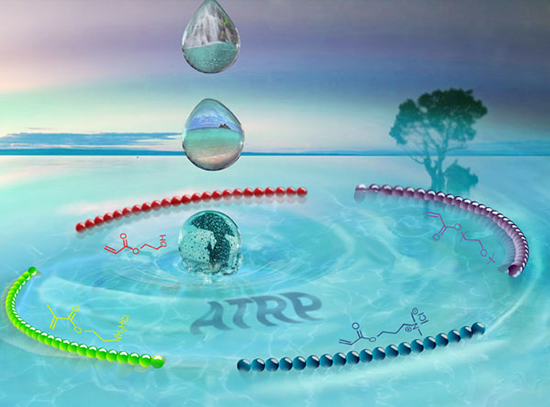
In brief, the research team first harnessed untreated water with varying ionic composition from different natural sources i.e. rainwater, rivers and springs. Next, without purification, the untreated water was used as the polymerization solvent for the synthesis of four different water-soluble polymers by several ATRP variations. The polymers included: poly(2-hydroxyethyl acrylate) (PHEA), poly(ethylene glycol)-b-poly(2-aminoethyl methacrylate hydrochloride) (PEG-b-PAMA) block copolymer, poly[oligo(ethylene oxide) methyl ether acrylate] (POEOA), and poly((3-acrylamidopropyl)trimethylammonium chloride) PAMPTMA.
The authors confirmed the feasibility of using untreated water as the polymerization solvent for the synthesis of various polymeric materials with sufficient control over the molecular weight. For instance, the polymerization kinetic were observed to be similar to those obtained using ultrapure deionized water as solvent. Furthermore, it was worth noting that high concentration of halide salts such as sodium chloride (sea water) could be used in the polymerization of neutral OEOA monomer without any major effects on the control over molecular weight or polymerization kinetics.
In summary, Patrícia Mendonça and colleagues successfully presented the significance of using untreated water as polymerization solvent for the synthesis of water-soluble polymers by ATRP. Altogether, the study provides vital information that will pave way for the development of low-cost ATRP processes for large scale industrial applications.






Reference
Mendonça, P., Oliveira, A.S.R., Ribeiro, J.P.M., Castilho, A., Serra, A.C., & Coelho, J.F.J. (2019). Pushing the limits of robust and eco-friendly ATRP processes: untreated water as the solvent. Polymer Chemistry, 10(8), 938-944.
Go To Polymer Chemistry