Advances in Engineering Advances in Engineering features breaking research judged by Advances in Engineering advisory team to be of key importance in the Engineering field. Papers are selected from over 10,000 published each week from most peer reviewed journals.

Significance
In most industrial machining operations cutting process failures are caused by undesired chatter vibrations of the workpiece, cutting tool and machine tool. This specifically affects the production of high-precision mechanical components. Therefore, chatter vibrations should be minimized or avoided as much as possible.
Over the past few decades, researchers have developed several techniques and devices for addressing this problem especially in turning and milling. These techniques include passive, semi-active, active and hybrid strategies, the latter based on the regulation of the cutting parameters and on chatter onset detection. However, passive strategies are mostly preferred due to their low operating cost as they do not require intensive machine modifications or additional resources.
Among the passive devices, advanced cutters with complex irregular geometries – e.g. with variable angular pitch and variable helix – have been recently developed for disturbing chatter onset. Moreover, both advanced and conventional cutters are always affected by teeth runout consisting of misalignment errors between subsequent teeth.
Nevertheless, tool asymmetry may have a deep impact on the overall milling dynamics. Specifically, it may influence the resulting machining system vibrations, cutting forces, tool wear and the machined surface quality. Accordingly, understanding the effects of tool asymmetry in milling dynamics is of great significance for enhancing cutting process performance in real industrial applications.
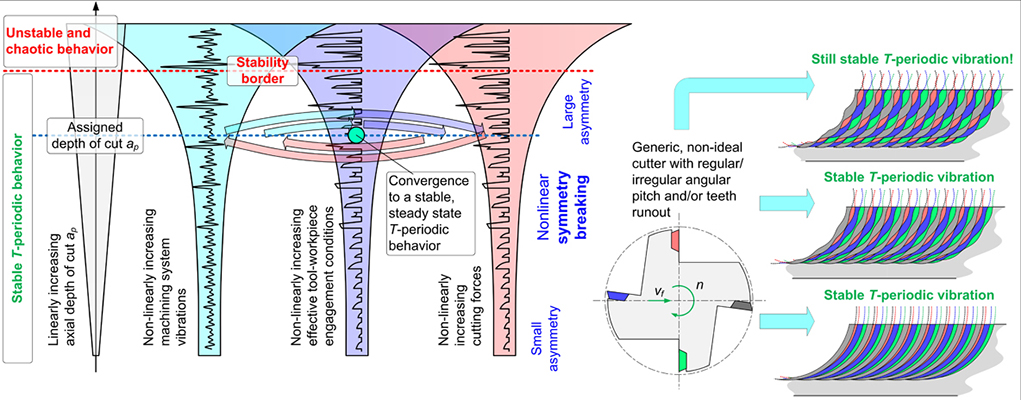
State of the art models of milling dynamics perform the stability analysis of the cutting process by considering the nominal tool-workpiece engagement conditions. These are derived from a purely geometric-kinematic analysis of the milling operation. Nevertheless, in the presence of tool asymmetries the machining system vibrations become more irregular within one single spindle revolution, although they keep a periodic behavior between subsequent revolutions. Such irregular vibrations may considerably alter the effective tool-workpiece engagement conditions with respect to the nominal conditions, thus affecting the stable regions where optimal cutting parameters can be found.
To this note, Prof. Giovanni Totis and Prof. Marco Sortino from the University of Udine in collaboration with Prof. Tamás Insperger and Prof. Gábor Stépán from the Budapest University of Technology and Economics developed a new approach for stability analysis of advanced cutting tools with a complex irregular geometry. Specifically, accurate numerical simulations in the time domain were performed to estimate the true steady-state forced vibrations of the machining system for a given combination of cutting parameters. The model took into consideration the influence of forced vibrations on the effective tool-workpiece engagement conditions. This enabled the linearization of milling dynamics around the true steady-state solution. The main objective was to provide theoretical basis and experimental proof of the symmetry-breaking mechanism in milling dynamics. The work is currently published in the International Journal of Machine Tools and Manufacture.
The newly developed model correctly predicted the changes in the tool-workpiece contact conditions, time delays and cutting forces perceived by each tooth when cutting parameters were varied, as opposed to the conventional classical models. Also, the stability borders were more accurately predicted by reducing the prediction error of about 30%. Both the classic and the new method were not able to correctly classify the cutting process state at high depths of cut, because symmetry breaking amplifies the effects of model uncertainties. However, the better results and deeper insights provided by the new approach were based on time consuming simulations in the time-domain. Accordingly, future research should focus on developing faster and more efficient algorithms that take into account the symmetry breaking phenomena.

Reference
Totis, G., Insperger, T., Sortino, M., & Stépán, G. (2019). Symmetry breaking in milling dynamics. International Journal of Machine Tools and Manufacture, 139, 37-59.
Go To International Journal of Machine Tools and Manufacture