 Advances in Engineering Advances in Engineering features breaking research judged by Advances in Engineering advisory team to be of key importance in the Engineering field. Papers are selected from over 10,000 published each week from most peer reviewed journals.

Significance
Fluorophores have found applications in numerous areas including bioimaging applications owing to their excellent properties in terms of photostability, environmental sensitivity and localization. In particular, chromenylium-cyanine (CC) probes have been used to demonstrate the use of fluorophores in structural modification to activate different response channels. However, activating such photophysical processes have both advantages and disadvantages. In addition to low quantum yield and signal to noise ratio, they have not been effectively used in imaging microscopy due to the interference problems between the given photophysical characteristics and another optical property. As such, ensuring precise control of the probe response and specific localization during the imaging process is very challenging and may result in inaccurate results interpretation.
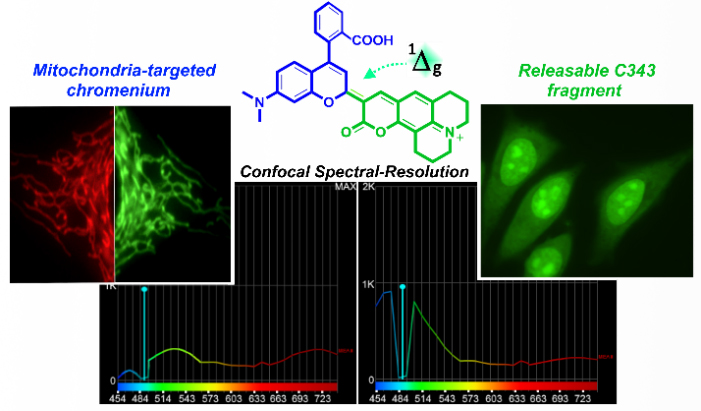
To address the aforementioned limitations, a group of researchers at Universidad Nacional Autónoma de Mexico: Ricardo Flores-Cruz, Dr. Rafael López-Arteaga, Lizbeth Ramírez-Vidal, Fernando López-Casillas, and led by Professor Arturo Jiménez-Sánchez developed a new strategy for analyzing multi-stimuli scenarios of chromenylium-cyanine probes. Specifically, the chromenylium-cyanine 334 (CC334) probe derived from chromenylium ion and coumarin 334 exhibiting highly complex photophysical and interfered bioanalytical responses. Based on exhaustive and concise analysis of the CC334, various optical responses such as spectroscopic calibrations and steady-state microenvironment effects were investigated. Their work is currently published in the research journal, Physical Chemistry Chemical Physics.
For imaging experiments, it was vital to investigate the acid-base properties of the CC334 to determine the species existing in various pH. After analysis of the pH properties and determining the possible species existing in the environment, the oxidation reactions were investigated because chromenylium ions exhibit potential reactivity to the analytes.
The research team presented a new strategy for applying the probe in singlet oxygen reactive oxygen species that was ideal in understanding the dynamic behavior of different subcellular environments. Being a representative of chromenylium-cyanine family of fluorophores, versatile CC334 probes permitted bioanalytical sensing and analysis of local microenvironment parameters and different species. This was attributed to the understanding of the effects of the change in the molecular nature between the excited states on its reactivity based on the photophysics of the excited-state dynamics.
Additionally, the origin of the chromenylium-cyanine dual emission behavior from the kinetic process involving the formation of the ICT by the locally excited state was confirmed. Irrespective of whether the absorption bands had dual absorption or not, the dual emission was observed to be intrinsic to the chromenylium-cyanine probes. This unique advantage of the chromenylium-cyanine probes grants significant properties of great importance in the analysis of living systems. For instance, the spectrally resolved confocal microscopy enabled the analysis of oxygen without any kind of interference. As such, the probe was fed with continuous information during measurements.
According to the authors, the use of CC334 probes in different media induces redox, pH, specific ionic interactions and polaritons for high-resolution microscopy. Therefore, the study by Professor Arturo Jiménez-Sánchez and his colleagues provides essential information that will advance the design of more efficient fluorescent probes for interference-free investigation of the dynamic behavior of subcellular environments.
Reference
Flores-Cruz, R., López-Arteaga, R., Ramírez-Vidal, L., López-Casillas, F., & Jiménez-Sánchez, A. (2019). Unravelling the modus-operandi of chromenylium-cyanine fluorescent probes: a case study. Physical Chemistry Chemical Physics, 21(28), 15779-15786.
Go To Physical Chemistry Chemical Physics