 Advances in Engineering Advances in Engineering features breaking research judged by Advances in Engineering advisory team to be of key importance in the Engineering field. Papers are selected from over 10,000 published each week from most peer reviewed journals.

Significance
Liquid metal fast reactors (LMFR) use liquid metals for thermal transport as they can handle larger heat fluxes as opposed to air or water. At present, the LMFR represent a promising concept among the Generation IV reactors. Ideally, the design and safety of LMFR depends on the capabilities of the tools used to model the turbulent heat transfer phenomenon properly. This phenomenon has been modelled to a reasonable accuracy for unity Prandtl number fluids; however, the approaches applied to fluids with Pr ~ 1 give limited results when applied to low Prandtl number fluids, such as liquid metals. During modeling, the geometry used has been seen to be of utmost importance and the backward facing step (BFS) has been one of the simplest upgrades to the channel geometry. When modeling separated flows, of particular interest are points or regions on walls, at which the velocity changes its direction; this technically denotes the ‘Separation Points’. Various experimental investigations of separated flows in the BFS geometry have been undertaken. Nonetheless, with the need to expand the range of applicability of relations used to model turbulent heat transfer phenomenon to low-Prandtl fluids ever increasing, further research is necessitated.
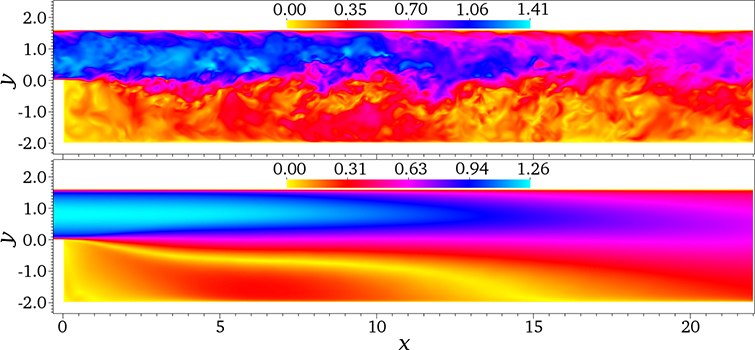
On this note, researchers from the Jožef Stefan Institute in Slovenia: Dr. Jure Oder, Professor Leon Cizelj and Professor Iztok Tiselj, in collaboration with Dr. Afaque Shams at the Nuclear Research and Consultancy Group NRG in the Netherlands proposed to expand the reference database with a direct numerical simulation (DNS) in a backward facing step (BFS) geometry with a flow of liquid metal. Their goal was to gather statistical properties of velocity and thermal fluctuations and produce useful results for other researchers and the scientific community. They further aimed at calculating the budget for the terms that are present in the Reynolds averaged Navier-Stokes equations without buoyancy. Their work is currently published in International Journal of Heat and Mass Transfer.
Essentially, their approach entailed the use of DNS of a confined backward facing step geometry with a flow of two fluids with Prandtl numbers 0.005 and 0.1. The geometry used was surrounded by no-slip walls and had no periodic boundaries. Additionally, a step wall and a heater were simulated, which were thermally coupled with each other and to the fluid domain. The researchers also used a recycling boundary condition to achieve a fully turbulent inflow boundary condition with a constant mass flow rate.
The authors reported that the friction Reynolds number of the flow in the channel before the step was around 207 and the Reynolds number based on the bulk velocity at the inflow and the hydraulic diameter of the inflow was approximately 7100. In addition, the reattachment zone was found at about 7.9 step heights downstream of the step. Since the step was confined in the span-wise direction, the average flow was seen to exhibit strong 3D features.
In summary, the researchers performed a direct numerical simulation in a fully constrained backward facing geometry with expansion ratio of 2.25. The simulation was performed with Reynolds number based on bulk velocity and hydraulic diameter of the inflow of a certain Re number. Overall, they explored the 3D features and give first and second order statistics for flow and thermal fields, which were relevant for the validation of RANS modelling approach. In an interview with Advances in Engineering, Dr. Jure Oder said “As we started this project, we were a little taken aback that a DNS of a fully 3D case requires orders of magnitude longer averaging times’. He also highlighted that the comparison of RANS models showed good agreement for streamwise velocity component and the turbulence kinetic energy to the DNS results.

Reference
Jure Oder, Afaque Shams, Leon Cizelj, Iztok Tiselj. Direct numerical simulation of low-Prandtl fluid flow over a confined backward facing step. International Journal of Heat and Mass Transfer, volume 142 (2019) 118436.