 Advances in Engineering Advances in Engineering features breaking research judged by Advances in Engineering advisory team to be of key importance in the Engineering field. Papers are selected from over 10,000 published each week from most peer reviewed journals.

Significance
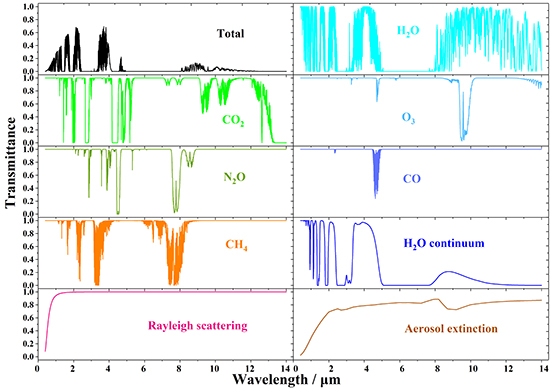
In atmospheric optics, scattering is defined as the process by which small particles suspended in a medium of a different index of refraction diffuse a portion of the incident radiation in all directions. With scattering, there is no energy transformation, but a change in the spatial distribution of the energy. Accompanied with scattering, incident electromagnetic energy will be transformed into other forms by absorbing. The atmosphere possesses such a characteristic in that it has scattering particles that redirect the electromagnetic energy attenuated by absorbing gases and aerosols. Ideally, the type and amount of scattering that occurs depends on the size of the particles and the wavelength of the energy, while that of absorption mainly depends upon atmospheric temperature, pressure, relative humidity and gas concentrations; consequently, the atmospheric transmittance and radiation (ATR) varies at different spatiotemporal scales. Such an observation has been reported credit to the stratified nature of the atmosphere, where the layer between the lower stratosphere and surface level, is composed of the primary atmospheric scattering and absorbing particles. It is of major importance to get vertical distributions of atmospheric scattering and absorbing particles along with their contributions to the ATR at different altitude. Nonetheless, the kind of particle-made contributions to the ATR, how much this contribution is and which is larger, is hard to answer.
On this account, researchers from the Key Laboratory of Atmospheric Optics at Anhui Institute of Optics and Fine Mechanics- Chinese Academy of Sciences: Associate Professor Shengcheng Cui, Professor Wenyue Zhu, Associate Professor Xuebin Li, Professor Tao Luo, Ms Zihan Zhang and Professor Heli Wei, proposed to resolve the aforementioned shortfalls by proposing a different impact indexing method for sorting the different atmospheric components. For such an endeavor, it was necessary to get the local atmospheric profiles and utilize the general radiative transfer model compute code (e.g. MODTRAN), to perform sensitivity investigations on the effects of atmospheric profiles variations on atmospheric transmittances and radiances. Their work is currently published in the OSA Laser Congress.
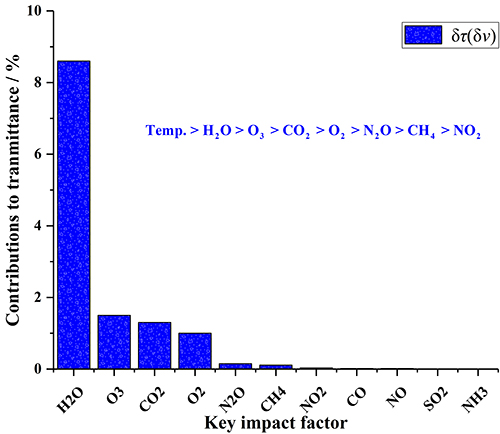
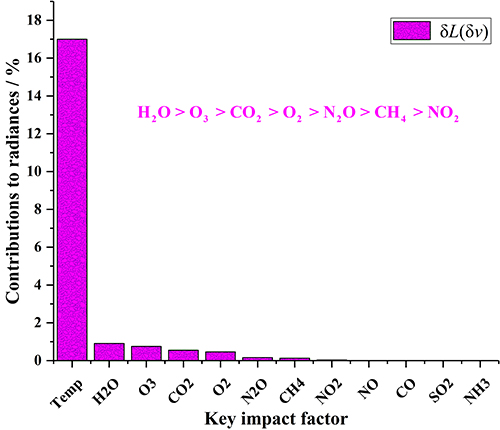
In their approach, seasonal atmospheric profiles were generated by fusing numerical whether predicted model results, satellite and ground measurements. The generated profiles were then digested by the combined atmospheric radiative transfer (CART) model. Eventually, key impact factors (KIF) of different atmospheric components were indexed by sorting their contributions to atmospheric transmittances and radiances, respectively.
The researchers reported that with the regional maximum and minimum atmospheric profiles obtained in the first step, the key impact factors method successfully used CART to calculate the corresponding atmospheric transmittance and radiances variations at different altitudes, typically including ground and airborne levels. Consequently, they were able to analyze the data in a statistical manner.
In summary, the study presented the KIF indexing method. Remarkably, the presented method could serve as a guidance for in-situ atmospheric optical properties measurement and instruments configurations. In a statement to Advances in Engineering, Dr. Shengcheng Cui, the first author highlighted that the results they obtained suggested that transmittance variance was mainly related to water vapor content, ozone, carbon dioxide and oxygen, while radiance variance was largely due to temperature and water vapor content.




Reference
Shengcheng Cui, Wenyue Zhu, Xuebin Li, Tao Luo, Zihan Zhang, Heli Wei. Key Atmospheric Profiles Parameters to Ground and Airborne Horizontal Atmospheric Transmittances and Radiances. Laser Congress 2019 (ASSL, LAC, LS&C) OSA Technical Digest (Optical Society of America, 2019), Joint Poster Session Tuesday