 Advances in Engineering Advances in Engineering features breaking research judged by Advances in Engineering advisory team to be of key importance in the Engineering field. Papers are selected from over 10,000 published each week from most peer reviewed journals.

Application to natrolite, chabazite and clinoptilolite
Significance
Zeolites are microporous solids of the aluminosilicate mineral family that are commonly used as commercial adsorbents. Typically, they confer interesting structural properties that tend to favor their application in industrial processes. In particular, their impact has been notorious in petrochemical and biochemical manufacture of fuels and feedstocks, adsorption and separation, as well as ion-exchange; especially in the case of zeolite-supported nanoscale zero-valent iron which has been suggested to have a great potential for treating water and soil multi-contaminated with heavy metals (As, Cd and Pb). Consequently, it is crucial to highlight the uses of zeolites in environmental care. To date, large modeling studies, focused on attaining crystallographic-quality description of the extra-framework structure of complex zeolites, have been conducted using interatomic potentials with much less space occupied by the expensive Density Functional Theory (DFT) based studies. Studies have shown that the sensitive properties of the zeolites show a remarkable dependence on the structural model, thereby calling for the necessity of more zeolite models to properly describe them. Moreover, previous research showed that such large exploration of the configurational space of complex zeolites using DFT approaches is challenging due to the inherent computational cost; therefore, alternative approaches ought to be sought.
To date, numerous approaches for solving optimization problems have been proposed. Among them, Simulated Annealing (SA) has emerged as one of the most versatile method. However, SA methods have not been applied to predict the structure of the extra-framework species in zeolites considering their inherent structural relaxation and flexibility. In this view, researchers from the University of Sevilla, Spain: Dr. Mohamed Abatal and Professor Norge Cruz Hernández, in collaboration with Dr. A. Rabdel Ruiz-Salvador at the Pablo de Olavide University demonstrated SAs’ usefulness in DFT-based calculation in zeolites bearing charge-compensating cations and polar molecules. Their work is currently published in the research journal, Microporous and Mesoporous Materials.
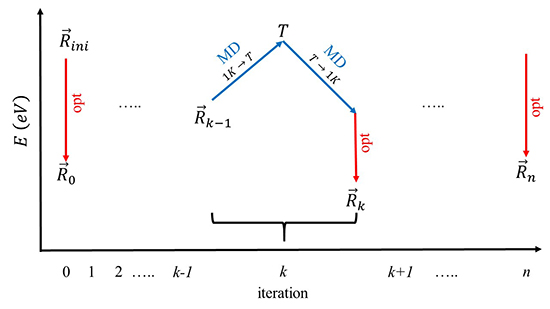
Basically, the SA idea is to perform a molecular dynamics (MD) by increasing the temperature step-by-step to overcome local energy minima; after that, by subsequent energy optimization, it is possible to move to a different local minimum. In their work, the researchers implemented the aforementioned procedure up to the temperatures of 300 and 400K. Further, MD, as well as, geometry optimization, were carried out in a periodic framework and dispersion corrected DFT calculation using VASP. Also, in their approach, they used three widely studied zeolites as model systems: i.e. natrolite, chabazite and clinoptilolite.
As such, the research team were able to obtain the global minimum energy by using SA in DFT-based calculation in zeolites including charge-compensating cations and polar molecules. Indeed, their results were able to show slight differences depending on the peak temperature of the rump up of SA, suggesting there that more than one simulation with different maximum temperature should be considered.
In summary, the study demonstrated the SA method as an efficient and relatively cheap approach to perform DFT studies of the zeolites structure including strongly interacting extra-framework species, when their structural relaxation and flexibility are considered. Remarkably, the reported method was able to explore multiple minima in the complex systems used, thus minimizing the chances of getting trapped in a local minimum. In a statement to Advances in Engineering, Professor Norge Cruz Hernández highlighted that their findings were in good agreement between their interaction energy results after performing SA and experimental/theoretical data available in literature.



Reference
Mohamed Abatal, A. Rabdel Ruiz-Salvador, Norge Cruz Hernández. A DFT-based simulated annealing method for the optimization of global energy in zeolite framework systems: Application to natrolite, chabazite and clinoptilolite. Microporous and Mesoporous Materials, volume 294 (2020) 109885. DOI 10.1016/j.micromeso.2019.109885