 Advances in Engineering Advances in Engineering features breaking research judged by Advances in Engineering advisory team to be of key importance in the Engineering field. Papers are selected from over 10,000 published each week from most peer reviewed journals.

Significance
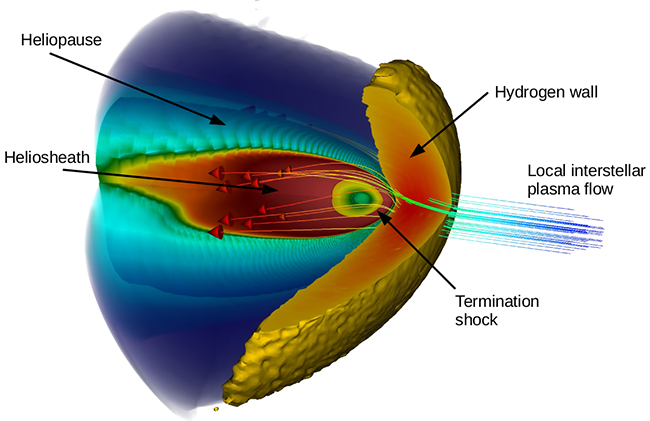
In plasma physics, the heliosphere is the cavity formed by the Sun in the surrounding interstellar medium. The heliosphere enclaves the sun and the solar system. It propels supersonically for several solar radii from the sun outwards until it reaches the termination shock where it slows down and heats up. In most models of the interaction between the solar wind and interstellar medium, both the plasma and neutral hydrogen distributions are each assumed to be in thermal equilibrium, i.e., a Maxwellian velocity distribution, although they are generally not in equilibrium with each other. Other approaches show that the plasma and neutral populations are coupled through charge-exchange collision source terms that allow for the transfer of energy and momentum between the two species. One of the consequences of the charge-exchange process in the heliosphere is the creation of ions possessing properties that are different from the background plasma. These new ions are picked up by the motional electric field of the plasma and are therefore termed pickup ions (PUIs). Recognizing that plasma in the heliospheric interface is mediated by PUIs is important for understanding various astrophysical phenomena. Recent research has shown that a simple way to include the presence of suprathermal protons, such as PUIs, is to assume that the protons follow a generalized Lorentzian (also known as “kappa”) distribution.
Generally, numerous space and astrophysical environments are dominated by magnetohydrodynamic plasma interactions that are virtually collisionless. However, pseudo-elastic collisions are present through mechanisms of ion-neutral charge-exchange. To further investigate this, Professor Anthony Michael DeStefano from the University of Alabama in collaboration with Professor Jacob Heerikhuisen at the University of Waikato in New Zealand, proposed to analytically derive the source terms for charge-exchange collisions between Maxwellian neutrals and kappa-distributed ions. Their goal was to investigate how charge-exchange collisions affect the balance of momentum and energy between ions and neutrals within the plasma. Their work is currently published in the research journal, Physics of Plasmas.
The two researchers begun by defining the charge-exchange source term formalism followed by derivations of analytical solutions to the Boltzmann collision term for charge-exchange between a kappa distribution and a Maxwellian distribution, effectively extending to suprathermal distributions. Next, they derived forms for the charge-exchange collision rates and effective speeds between the two distributions. Further, they derived finite expressions that depended on an energy cutoff to the charge-exchange cross section.
Additionally, the two researchers compared the momentum and energy charge exchange source terms for the kappa-distributed protons with those obtained for the Maxwellian protons. Consequently, they were able to discuss differences in the energy and momentum transfer rates depending on whether the plasma is modeled by a Maxwellian or kappa distribution. Remarkably, their analytical derivations were able to provide a path forward for insight into the physics of supra-thermal ions charge-exchanging with thermal electrons that previously were not available.
In summary, the DeStefano- Heerikhuisen study presented successfully the analytical derivation of formulas for charge-exchange coupling between protons with suprathermal tails, modeled as a kappa distribution, and a relatively cool population of thermal hydrogen that is moving with respect to the plasma. Based on their results, the primary application for their work is the heliosphere, where the transfer of momentum and energy between protons and interstellar hydrogen ultimately modifies its shape and structure. In a statement to Advances in Engineering, Professor Anthony Michael DeStefano emphasized that the formalism they developed could be extended to cases where there are interactions between Maxwellian and kappa-distributed species.
Reference
Anthony Michael DeStefano, Jacob Heerikhuisen. Analytic solution to charge-exchange source terms between Maxwellian and kappa distributed velocity distributions in the heliosphere. Physics of Plasmas, volume 27, 032901 (2020)