Advances in Engineering Advances in Engineering features breaking research judged by Advances in Engineering advisory team to be of key importance in the Engineering field. Papers are selected from over 10,000 published each week from most peer reviewed journals.

Significance
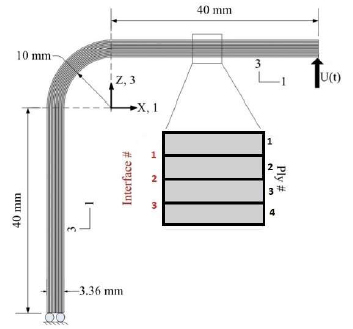
The global trend in material engineering has been to merge various materials, exploiting only their best attributes, so as to develop a composite that performs better property-wise than the individual constituents. To this end, composite materials, particularly Fibre Reinforced Polymers (FRP) have been increasingly used for engineering purposes due to their favorable mechanical characteristics. Nonetheless, research has shown that there are various failure mechanisms in composite components which differ from isotropic materials, such as: delamination, fibre fracture and matrix cracking. Therefore, for one to properly predict when these failure mechanisms will initiate, the critical stresses must be properly predicted. Unfortunately, for finite width geometries such as L-shaped components, free-edge effects and imposed boundary conditions can make this prediction challenging. Since L-shaped composite components are becoming more commonplace in engineering applications, it is of vital importance to understand their failure mechanisms and stress fields. An extensive literature review reveals that interlaminar delamination is the critical failure mode for curved composite components. Despite this, most literature only provides a two-dimensional analysis of the interlaminar stresses and the free edge effects and asymmetry due to induced torsion are not considered.
Further review on previous research reveals that the edge effects must be considered in delamination prediction in L-shaped components for the results to be substantive. Regardless, no research group has addressed this. On this account, researchers from the Royal Military College of Canada, Capt Anthony Nagle and Associate Professor Diane Wowk together with Dr. Catharine Marsden at Concordia University explored three main aspects of L-shaped components in bending yet to be explored in literature: i.e. layup, free edges and component constraint. Their work is currently published in the research journal, Composite Structures.
In their approach, lay-ups with angled plies were considered rather than the traditionally studied unidirectional and cross ply lay-ups. More so, the radial stress distribution across the width of the component was examined with specific attention paid to the region at the free edges. In addition, a resin interface modelling approach was used to enable finite values of the interlaminar normal stress to be extracted in the free edge region. Overall, the effect of the imposed boundary condition on the internal loading and resulting radial stress distribution was examined in relation to the ply layup.
The authors reported that the curvature in an L-shaped component introduced a radial stress which acts out of plane to the laminate and could result in delamination initiating at lower applied loads than a straight laminate with the same lay-up. Moreover, it was seen that the interlaminar normal stress that developed locally at the free edges was the same in both the L-shaped and straight components.
In summary, a series of studies were performed in order to identify the factors that affect the magnitude of the interlaminar normal stress across the width of an L-shaped laminate component. In the approach reported, three factors were considered: i.e. curvature of the component, the local stresses generated at the free edges and the effect of induced torsion due to component constraint. In a statement to Advances in Engineering, Diane Wowk, the corresponding author highlighted that by using a two-dimensional model, one could underpredict the interlaminar normal stresses by up to 37% for the lay-ups analyzed as per their work.


Reference
Anthony Nagle, Diane Wowk, Catharine Marsden. Three-dimensional modelling of interlaminar normal stresses in curved laminate components. Composite Structures, volume 242 (2020) 112165.