Advances in Engineering Advances in Engineering features breaking research judged by Advances in Engineering advisory team to be of key importance in the Engineering field. Papers are selected from over 10,000 published each week from most peer reviewed journals.

Confined porespace endows methane hydrates with enhanced formation kinetics via adsorption-induced two-way nanoconvection
Significance
Over the years, natural gas (>80% methane) has become the most popular source of heating for many households. Such popularity can be credited to abundant availability coupled with affordability. More so, many cities advocate for its use due to it high energy density and low carbon dioxide emission. However, worldwide acceleration in the consumption of natural gas is gradually deteriorating regionally; a consequence of lack of effective storage and transport technologies. Although tremendous effort has been made, liquefied natural gas (LNG) is still the most accessible, with respect to the consideration of safety and low cost. One promising alternative technology to conveniently store and transport natural gas is commonly proposed to be natural gas hydrates (NGHs), which can deliver ca. 170 m3 of methane per unit volume at standard condition. So far, published research examining this new approach have reported that stochastic nucleation of hydrates usually corresponds to long induction period, and this coupling with low methane storage capacity limits its commercial application. To this end, the pursuit of fast kinetics and high methane storage capacity of natural gas hydrates has been on a meteoric rise.
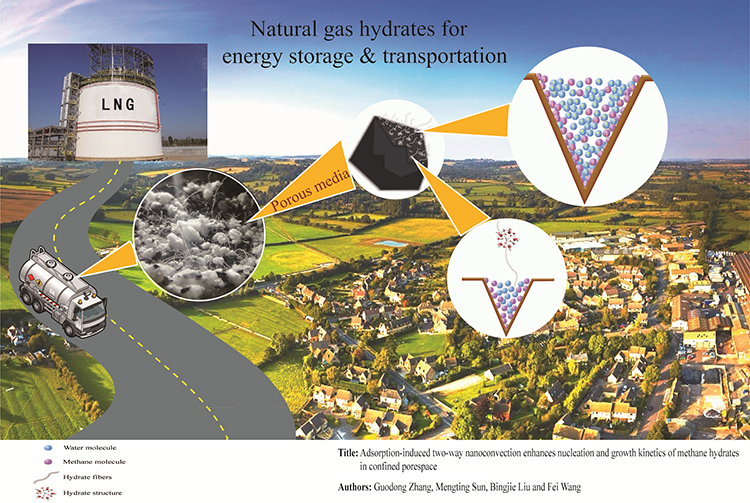
In essence, although methane storage in dry activated carbon (AC) has not been popularized, the use of typical porous media: such as pre-adsorbed water activated carbon (PW-AC) under hydrate favorable conditions, has been confirmed to be more efficient due to the hybrid effect of adsorption and hydration. Although the synergy of adsorption and hydration were confirmed to correspond to large methane storage capacity in PW-AC, the mechanisms with respect to fast hydrate nucleation and growth kinetics are still unclear to some extent. Bearing this in mind, researchers from the Qingdao University of Science and Technology in China: Dr. Guodong Zhang, Dr. Mengting Sun, Dr. Bingjie Liu and Professor Fei Wang, proposed a novel adsorption-induced two-way nano-convection mechanism. They aimed at addressing how methane is absorbed on PW-AC, how confined pore-space influences hydrate morphologies and how the content of pre-adsorbed water influences hydrate formation. Their work is currently published in the Chemical Engineering Journal.
In their approach, they used sapphire crystallizer to estimate hydrate nucleation and growth kinetics loaded by AC. Typically, the crystallizer was laid in a thermostatic chamber to keep a constant experimental temperature, and a camera was used to record the growth of methane hydrates via remote control by taking a picture every two minutes. In addition, the crystallizer was ‘de-gased’ three times using methane before each experiment, which was repeated three times under the same condition. Overall, the researchers also evaluated the chemical properties on AC surface, where almost no oxygen containing functional groups was observed.
The authors reported that two new kinds of hydrate morphologies, hydrate chunks and hydrate fibers, were clearly observed on AC bed as anticipated based on the new mechanism, which nucleate and grow in interstitial and inner pores, respectively. Remarkably, it noteworthy to mention that this was the first observation of hydrate fibers on AC surface, the size of which is governed by pore size and pre-adsorbed water contents.
In summary, the study investigated on the hybrid effect of physical adsorption and hydration on methane storage in PW-AC. Surprisingly, an adsorption induction period was first observed, which was extremely short and independent of the adsorption pressure. Most impressively, hydrate formation kinetics provide new information, which is beneficial to improve the understanding on the mechanisms corresponding to fast kinetics of hydrate nucleation and growth. In a statement to Advances in Engineering, Professor Fei Wang said their findings will pave way for methane storage using PW-AC under hydrate favorable conditions, which is a step towards of the industrial application of this promising technology.


Reference
Guodong Zhang, Mengting Sun, Bingjie Liu, Fei Wang. Adsorption-induced two-way nanoconvection enhances nucleation and growth kinetics of methane hydrates in confined porespace. Chemical Engineering Journal; volume 396 (2020) 125256.