Advances in Engineering Advances in Engineering features breaking research judged by Advances in Engineering advisory team to be of key importance in the Engineering field. Papers are selected from over 10,000 published each week from most peer reviewed journals.

Significance
A wind farm is composed of a group of wind turbines situated in a given location to produce electricity. Wind farms vary in size from a small number of turbines to several hundred wind turbines covering an extensive area and can be either located onshore or offshore. An onshore wind farm is a capital-intensive project due to high wind turbine cost, which may account for a large majority of the total life-cycle cost. As far as an onshore wind farm is concerned, the operational cost involved is also an important part of the overall cost due to costly inspection and maintenance actions for support structures as these actions require specific training and equipment fit for the offshore environment. As the bottom fixed offshore wind technology is already considered as a proven technology, the offshore wind farms are planned to be built in greater size with more powerful offshore wind turbines to make the offshore wind energy more cost-effective, which leads to more significant capital investment. Moreover, increasing the size of offshore wind farms has consequences not only from a capital investment point of view but also from an operational cost point of view because large-scale offshore wind farms with a higher number of support structures to be inspected increase the operational cost.
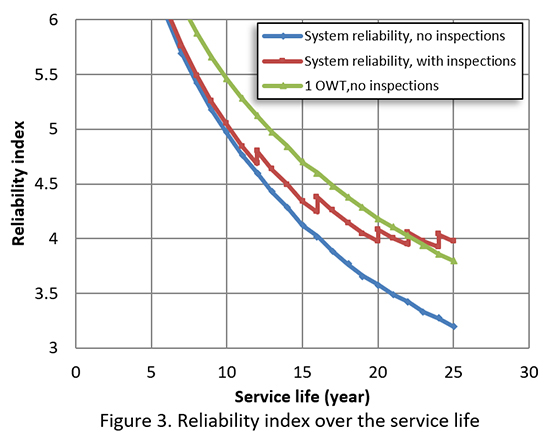
In essence, there is a need for constant monitoring of the structural condition of the support structure through scheduled inspections. This enables decision-makers to have better information about the structural safety and more confidence in the success of the offshore wind turbines support structure fulfilling its service purpose, allowing investors to achieve better management of the investment risk. Still, the need remains for refinement of analysis techniques for better projections. On this account, Centre for Marine Technology and Ocean Engineering, Instituto Superior Técnico, University of Lisbon researchers: Dr Baran Yeter, Professor Yordan Garbatov and Professor Carlos Guedes Soares developed a risk-based maintenance planning for offshore wind farm installations. They aimed to find the optimal number of offshore wind turbines in an offshore wind farm, resulting in the minimum life-cycle cost per produced energy. Their work is currently published in the research journal, Reliability Engineering and System Safety.
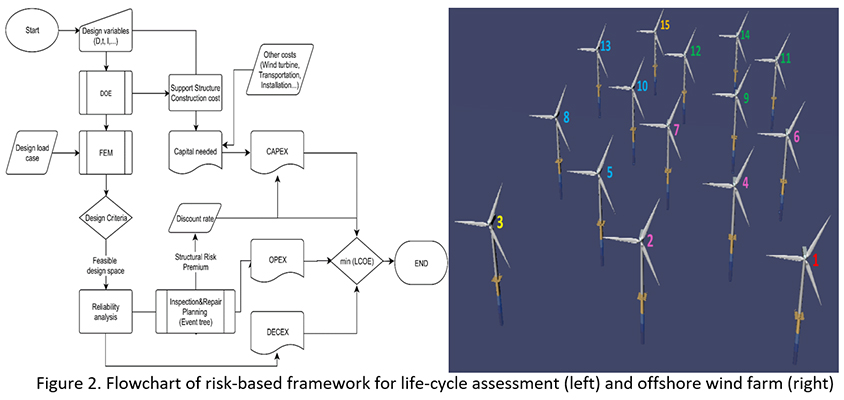
In their approach, the research team considered an offshore wind farm consisting of correlated components. The system reliability was then estimated using the Ditlevsen bounding technique, which is based on a time-variant correlation matrix of offshore wind turbines. The researchers then employed the event tree method to assess the expected cost of failure to be included in the capital investment as the structural risk premium and the total expected cost as a part of the operational cost.
The team reported that the developed framework was able to connect the results of the risk assessment with both CAPEX and OPEX, and the number of offshore wind turbines to be installed in an offshore wind farm was estimated. Following this, the minimization of the levelized cost of energy was adopted as an objective function. Overall, the optimal number of monopile offshore wind turbines to be installed in an offshore wind farm was estimated as 60.
In summary, the Centre for Marine Technology and Ocean Engineering, Instituto Superior Técnico, Lisbon University study presented a framework to conduct a life-cycle cost assessment accounting for the optimal inspection and maintenance policy to be implemented. A case study was performed using the developed framework, where outstanding results were successfully achieved. In a statement to Advances in Engineering, the authors explained that the presented framework in the paper involves an intricate network of a structural risk assessment, inspection planning, and life-cycle cost assessment; therefore, the initial assumptions regarding some cost components may impact the final results since the difference between the offshore wind farms with a different number of offshore wind turbines is relatively low.




Reference
B. Yeter, Y. Garbatov, C. Guedes Soares. Risk-based maintenance planning of offshore wind turbine farms. Reliability Engineering and System Safety; volume 202 (2020) 107062