 Advances in Engineering Advances in Engineering features breaking research judged by Advances in Engineering advisory team to be of key importance in the Engineering field. Papers are selected from over 10,000 published each week from most peer reviewed journals.

Significance
Acoustic Black Hole (ABH) effect has gained significant research attention owing to its unique propagation characteristics in a structure whose thickness dimension is determined based on the power-law relationship. A decrease in the structural thickness results in a corresponding decrease in the phase velocity of the flexural waves. Due to this phenomenon, ABH effect offers possibilities for new applications such as energy harvesting, sound radiation reduction and vibration control. In particular, single ABH structures have been extensively investigated for potential vibration attenuation applications, and positive results have been reported. Unfortunately, broadband ABH effects are only achievable above a threshold frequency in the high-frequency range. This requires the incoming wavelength to be smaller than the ABH structure dimension because when the dimension becomes larger like in the case of lower frequency range, it impairs its practical applications. With the growing interest in extending the ABH effects in lower frequency regions, sub-wavelength control is a promising strategy.
Periodic or multiple ABH structures provide feasible means for realizing sub-wavelength control. Broad band gaps have been achieved over low and high-frequency ranges by combining Bragg Scattering and local resonances. Consequently, different ABH-based periodic beam designs have been studied and validated. Sub-wavelength control has been successfully achieved in one-dimensional (1D) periodic ABH structures where wave propagation occurs in a feasible and controllable manner. However, complete sub-wavelength band gaps in periodic 2D ABH plates have not yet been materialized to date, opening avenues for extensive research in this interesting but rather complicated area.
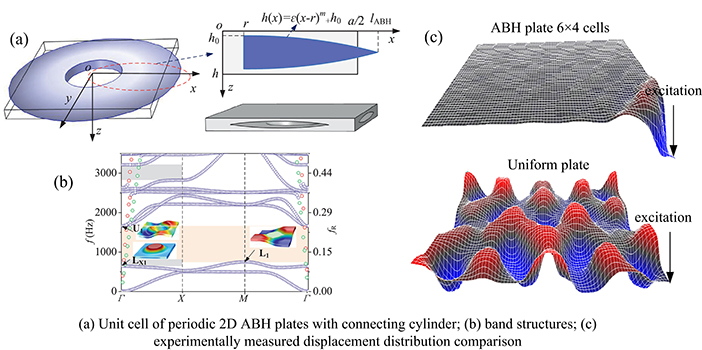
Motivated by the existing results, Professor Liling Tang and Professor Kean Chen from Northwestern Polytechnical University and Professor Li Cheng from The Hong Kong Polytechnic University proposed the design of new compound plates comprising periodically arranged double-layer ABH cells. Through numerical simulations, the researchers analyzed the design principles of the 2D plates, the mechanism behind the formation of the band gaps, and their resulting wave propagation characteristics. Different methods of enhancing the performance of the band gaps, such as the addition of structural elements and tailoring the ABH parameters, were also explored. Lastly, the numerical results were validated experimentally to establish the feasibility of the proposed 2D plates. The work is currently published in the research journal, Journal of Sound and Vibration.
The researchers confirmed the existence of complete sub-wavelength in band gaps in the lattice of the 2D plates with periodic ABH cells, which was absent in their 1D configuration. The double-layer ABH effects resulted from the dual-process comprising effective channeling of the wave propagation paths and impaired coupling between the structural vibration of the unit cells and the local resonances. It was responsible for generating the band gaps. The band gaps performance could be improved by tuning the ABH parameters like increasing the taper power index or reducing the truncation thickness. This approach provided limited tuning capabilities in broadening the bandwidth and lowering the frequency range. In addition, adding a connecting cylinder to the center of the double ABH branches was more effective in improving the band gap performance.
In summary, the research team capitalized on the unique ABH wave propagation properties in a 2D ABH plate configuration to design a new compound double-layered periodic plate. Results demonstrated the ability of the proposed structure to offer omnidirectional and complete band gaps suitable for various applications. It was shown that implementing the design principle with few ABH cells could achieve substantial vibration control and energy insulation across the 2D plate. In a statement to Advances in Engineering, Professor Liling Tang pointed out that the proposed plate design strategy requires fewer ABH cells that are potential basic building blocks for realizing complete sub-wavelength vibration attenuation in structures with reasonable dimensions. In addition, the follow-up research shows the proposed plate also exhibit superior sound radiation properties in an ultra-broad frequency range with improved mechanical properties, thus showing promise as a light-weight solution for broadband vibration and noise reduction.



Reference
Tang, L., Cheng, L., & Chen, K. (2021). Complete sub-wavelength flexural wave band gaps in plates with periodic acoustic black holes. Journal of Sound and Vibration, 502, 116102.