Advances in Engineering Advances in Engineering features breaking research judged by Advances in Engineering advisory team to be of key importance in the Engineering field. Papers are selected from over 10,000 published each week from most peer reviewed journals.

Enhanced mechanical properties of CoCrFeMnNi high entropy alloy films with Mo doping
Significance
Unlike the conventional alloy design that comprises one or two major base elements with relatively smaller amounts of other elements, high entropy alloys (HEAs) contain at least five major elements mixed in equal or somewhat larger proportions of 5 – 35 at.%. These alloys are currently the main focus of scientific research in materials science and engineering owing to their potentially desirable properties. Research indicates that some HEAs exhibit considerably better fracture toughness, fatigue resistance, strength and thermal stability than conventional alloys, making them potential candidates for the design of various structural and functional materials. Despite the extensive studies on bulk HEAs prepared via various methods like casting, there are limited studies on high entropy alloy films (HEAFs).
Sputtering deposition is the most preferred method for preparing HEAFs because it allows the synthesis of different stoichiometries by simply varying the deposition and target composition parameters. The distinct difference between HEAs and HEAFs is in their phases and microstructural evolution during their preparation processes. For instance, unlike the production methods involved in the processing of HEAs, the production of HEAFs readily attains much higher cooling rates, resulting in limited diffusion and grain growth and promoting amorphous phase formation. Consequently, the grain sizes of HEAFs are much smaller than those of bulk HEAs. In addition, research has shown that doping certain elements into HEAs can significantly affect their phases, microstructures, and mechanical properties. For CoCrFeMnNi HEAs, the addition of Mo promotes solid solution strengthening and precipitation strengthening. Nevertheless, more studies are still required to fully clarify the impact of doping Mo into CoCrFeMnNi HEAFs.
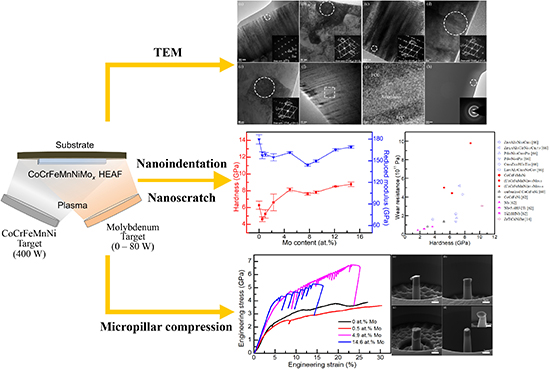
On this account, Mr. Tzu-Hsuan Huang and Distinguished Professor Chun-Hway Hsueh from National Taiwan University systematically investigated the effects of Mo addition on the microstructures and mechanical properties of CoCrFeMnNi HEAFs. In their approach, a series of (CoCrFeMnNi)100–xMox HEAFs was prepared via magnetron co-sputtering technique. The chemical composition, structures, and mechanical properties of the fabricated films were measured and characterized using various techniques like XRD, SEM, TEM, nanoindentation, nanoscratch and micropillar compression tests. Also, the correlation between the microstructures and mechanic properties was analyzed and discussed. Their research work is currently published in the journal, Intermetallics.
The research team reported that the HEAFs comprised of face-centered cubic (FCC) structure without Mo addition but composed of both FCC and hexagonal close-packing (HCP) structures upon adding minor Mo content of 0.5 – 1.0 at.%. However, the films transformed into an amorphous structure with a further increase in Mo doping. Films with low Mo contents below 1 at.% exhibited a decrease in hardness with Mo addition due to the presence of high-density nanotwins with small twin spacing of 2.8 nm and less and the effects of detwinning observed after the micropillar compression test. In contrast, an increase in the Mo content above 1 at.% played a vital role in solid solution strengthening and formation of nanotwins with larger twin spacing leading to an increase in the hardness. Furthermore, higher Mo content was characterized by higher wear resistance, higher yield strength, and decreased fracture strain.
In summary, Huang and Hsueh conducted an in depth and comprehensive study on the microstructures and mechanical properties of (CoCrFeMnNi)100–xMox (x = 1, 0.5, 1.0, 2.3, 4.9, 7.7, 14.6) HEAFs. Their findings confirmed the influence of Mo doping on the microstructures and mechanical properties of CoCrFeMnNi HEAFs. Mo-doped HEAFs displayed remarkably low coefficient of friction, good wear resistance and high hardness. The studied HEAFs reported the lowest coefficient of friction and highest wear resistance and hardness properties at x = 14.6 and optimal mechanical properties with the fracture strength of 6.51 GPa and fracture strain of 25% at x = 4.9. In a statement to Advances in Engineering, Professor Hsueh explained their findings contribute to the design of high-performance HEAFs important for various structural and functional industrial applications.
NOTE: This work was supported by the Ministry of Science and Technology, Taiwan under Contract no. MOST 109-2221-E-002-124.


Reference
Huang, T. H. and Hsueh, C. H. (2021). Microstructures and mechanical properties of (CoCrFeMnNi)100–xMox high entropy alloy films. Intermetallics, 135, 107236.