Advances in Engineering Advances in Engineering features breaking research judged by Advances in Engineering advisory team to be of key importance in the Engineering field. Papers are selected from over 10,000 published each week from most peer reviewed journals.

Significance
Friction is usually discussed as a mechanical response of surfaces in contact, but many sliding interfaces contain internal degrees of freedom that can store, rearrange, and dissipate energy during motion. In such systems, the frictional force is not governed only by the externally applied load or by surface roughness. It may instead depend on how the internal order of the interface responds while one body moves relative to another. Magnetic order provides a particularly clean setting for this problem because magnetic moments can interact across a gap, change orientation, and dissipate energy without requiring direct mechanical abrasion. Amontons’ law gives a familiar monotonic relation between normal load and frictional force. Its empirical usefulness is undeniable, but it does not explain what happens when the sliding process perturbs structural, electronic, or magnetic configurations at the interface. Magnetic friction has therefore become an important test case for asking whether dissipation can arise from configurational dynamics alone. Earlier work had connected magnetic ordering with friction, and scanning probe methods had measured magnetic interactions at very small scales. Yet those approaches usually involve a localized tip interacting with a surface. They are powerful for probing local forces, but they do not naturally expose the collective rearrangements that can occur between two extended, laterally aligned magnetic lattices.
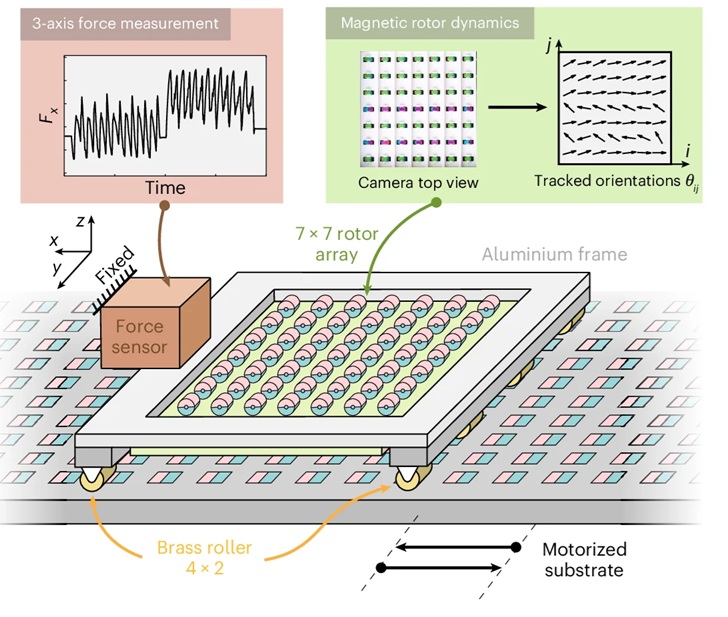
In a recent research paper published in Nature Materials, Dr. Hongri Gu, Dr. Anton Lüders & Professor Clemens Bechinger from the University of Konstanz in Germany developed a two-dimensional macroscopic magnetic rotor array that allows direct measurement of sliding friction while tracking the orientation of every magnetic moment. They paired this experiment with dipole-based molecular dynamics simulations and a reduced two-sublattice model that captures the essential ferromagnetic–antiferromagnetic switching mechanism. The technically distinct element is the direct linkage between non-monotonic magnetic friction, collective rotor reorientation, and hysteretic torque cycles under commensurate sliding. The platform separates magnetic dissipation from mechanical friction and makes collective magnetic order an experimentally accessible variable during motion.
The researchers built a spatially resolved macroscopic analogue of a magnetic sliding interface. The top layer consisted of a square array of rotatable neodymium–iron–boron ring magnets, each mounted so that its magnetic moment could rotate in the xz plane. Beneath it, a commensurate substrate array of fixed cylindrical magnets provided a periodic magnetic field during lateral translation. The slider was moved forwards and backwards over seven lattice periods while the lateral force and the orientation of each rotor were recorded. This design choice mattered because it converted a normally inaccessible many-body magnetic rearrangement into an experimentally trackable rotor dynamics problem.
Changing the vertical separation between the two magnetic layers tuned the balance between the substrate field and the interactions among neighbouring rotors. At small separations, the substrate field dominated. The rotors responded collectively and remained largely ferromagnetically aligned during sliding. At large separations, the substrate influence weakened and intralayer interactions prevailed, producing antiferromagnetic ordering with only small collective angular motion. The intermediate regime was more interesting. There, the interlayer and intralayer magnetic interactions became comparable, and the rotors switched between ferromagnetic and antiferromagnetic arrangements in a discontinuous fashion.
To quantify this behaviour, the researchers used an orientation correlation parameter that distinguishes parallel from antiparallel alignment of neighbouring moments. As the layer separation increased, the average magnetic order changed gradually from ferromagnetic to antiferromagnetic. The important point is that the friction peak appeared near the separation where the average order passed through zero, meaning that no single magnetic ordering dominated over a full sliding period. The force response was therefore not simply following magnetic attraction between the layers. Although the effective magnetic load decreased monotonically with separation, the measured friction did not. It reached a maximum around the intermediate competing regime.
The force signal contained both magnetic and mechanical contributions, so the researchers separated these terms rather than treating the total force as the final observable. Mechanical friction came mainly from the brass rollers used to maintain layer spacing against magnetic attraction, with an additional small load-independent contribution. Once this mechanical part was removed, the isolated magnetic friction retained the same non-monotonic dependence on separation. In the ferromagnetic and antiferromagnetic regimes, the force oscillations were nearly symmetric around the mechanical contribution, leaving little net magnetic friction over a lattice period. In the competing regime, that symmetry was lost, and the asymmetric force cycle produced a substantial magnetic contribution.
Molecular dynamics simulations, with the magnets represented as point dipoles and with rotational degrees of freedom matching the experimental geometry, reproduced the main features of the measurements. The simulations captured the ferromagnetic and antiferromagnetic regimes especially closely and also reproduced the transition between ordering states in the competing regime. The remaining irregularity in experimental switching was attributed to small physical variations in magnets and structure dimensions, which is reasonable in a system operating near a tipping point. The agreement between measured orientations, reconstructed magnetic friction, and dipole-based simulations made the central interpretation difficult to dismiss: dissipation was tied to collective magnetic reorientation, not to a hidden mechanical artefact.
The simplified theoretical description sharpened that interpretation. Because the rotor array largely occupied ferromagnetic or antiferromagnetic configurations, the slider could be reduced to two magnetic sublattices with two angular variables. In the overdamped limit, the model related energy dissipation to the torque exerted by the substrate field and to the angular motion of the moments. At small separation, torque oscillated in a nearly symmetric way and the average magnetic dissipation remained small. At large separation, both torque and angular velocity were weak. Between these limits, asymmetric torque cycles generated hysteresis, and the area of those hysteresis loops corresponded to dissipated energy during sliding.
The work of Professor Clemens Bechinger and colleagues connects friction to a sliding-induced change in collective magnetic order. The friction maximum is not an incidental feature of stronger coupling or higher load. It occurs where competing magnetic interactions force the rotor array through repeated configurational switching. That gives the work a clean physical message: magnetic friction can be generated by internal reorientation dynamics even when direct mechanical contact is not the source of dissipation. This changes the interpretation of load dependence in magnetic sliding systems. A monotonic decrease in magnetic attraction with separation does not guarantee a monotonic decrease in friction, because the relevant dissipative channel may be strongest when the interface is neither firmly in one ordered state nor another. The competing regime is therefore not just a crossover between ferromagnetic and antiferromagnetic order. It is the condition under which sliding produces hysteretic torque cycles, and those cycles provide the route for energy loss.
The new study also gives friction a diagnostic role because the frictional anomaly appears at the point where magnetic order becomes dynamically frustrated, the lateral force can act as a sensitive readout of collective magnetic rearrangement. The macroscopic nature of the experiment is useful here, not because it imitates every microscopic detail of atomic magnets, but because it makes the internal dynamics visible while preserving scale-free governing relations. The authors’ claim is carefully bounded: the mechanism should be relevant to systems with similar energetic symmetries and competing interlayer and intralayer interactions, including low-dimensional magnets, spintronic materials, XY-type systems, patterned magnetic interfaces, and possibly ferroelectric tribology where domain polarization changes influence sliding friction. The design logic is also important and instead of controlling friction through surface chemistry, roughness, or wear-prone contact, the paper points toward interfaces whose dissipation can be tuned through internal many-body ordering. The requirement is not simply “magnetism,” but a regime where sliding can repeatedly drive the system between competing configurations. That distinction gives the study its real value for future contactless friction control and magnetic metamaterial concepts.

Reference
Gu, H., Lüders, A. & Bechinger, C. Non-monotonic magnetic friction from collective rotor dynamics. Nat. Mater. (2026). https://doi.org/10.1038/s41563-026-02538-1
Go to Journal of Nature Materials