Advances in Engineering Advances in Engineering features breaking research judged by Advances in Engineering advisory team to be of key importance in the Engineering field. Papers are selected from over 10,000 published each week from most peer reviewed journals.

Significance
Carbon dioxide (CO2) capture and storage is a critical technology in the fight against climate change. CO2 is a greenhouse gas that contributes to global warming and climate change, and reducing its emissions is essential to mitigating the impacts of climate change. Nanotechnology, which involves manipulating materials at the nanoscale level, has shown great promise in the field of CO2 capture. Nanotechnology offers several advantages for CO2 capture. First, it allows for the development of materials with high surface area and high selectivity for CO2 adsorption. Second, it allows for the design of materials with tailored properties, such as high thermal stability and resistance to moisture. Third, nanomaterials can be used in a variety of CO2 capture technologies, including absorption, adsorption, and membrane separation. Examples of nanotechnology being used for CO2 capture is the development of metal-organic frameworks and carbon nanotubes. While preventive methods promote renewable energies and energy-efficient programs, mitigative methods focus on capturing CO2 from existing power plants and electricity generation sources, which accounts for about 42% of global CO2 emissions. Particularly, post-combustion CO2 capture and sequestration strategies are promising routes for industrialized economies owing to their benefits like high reaction rate, non-corrosive nature and low cost. However, these methods use chemical absorbents, which suffer from various inadequacies.
Importantly, it is possible to obtain valuable products during CO2 capturing process. In particular, producing sodium bicarbonate (NaHCO3) nanomaterials during CO2 capturing using Gly/NaOH solution has drawn significant attention. Due to their high commercial value, the resulting nanomaterials can be sold to offset the cost of the carbon-capturing process. This also presents a novel route for producing sodium bicarinate with a wide range of applications in different fields. In order to produce highly valuable NaHCO3 nanomaterials, it is imperative to develop innovative CO2 capture processes.
On this account, Rui Wang, Dr. Husain Ashkanani and Professor Badie Morsi from University of Pittsburgh together with Professor Bingyun Li from West Virginia University developed a novel process for CO2 capturing from a split flue gas stream emitted from post-combustion coal power plant. The split flue gas stream with a flow rate of 12.43 kg/s contained 0.0023 and 13.33 mol% of SO2 and CO2, respectively. The process comprised five main units designed to remove all SO2 and capture more than 90 mol% of CO2 in the flue gas stream while producing highly valuable NaHCO3 nanomaterials. Their work is currently published in the research journal, International Journal of Greenhouse Gas Control [1].
The authors analyzed the mass transfer characteristics, hydraulics and the process performance, levelized costs of the CO2 capture as well as the capital and operating expenditures to validate the feasibility of the proposed method. The process hydraulics obtained in the SO2 washing and CO2 capture units showed no flooding in both the countercurrent packed beds. The results for both the flue gas washing unit and CO2 absorber depicted greater gas-side mass transfer coefficients than liquid-side mass transfer coefficients. For instance, the hydraulics in the CO2 capture and SO2 washing showed a pressure drop of 1 kPa and 12 kPa, respectively. Additionally, the normalized specific wetted packing area and liquid holdup in both units exhibited similar behaviors.
The novel process could capture 8.466 tons of CO2 per hour and produce 16.149 tons of NaHCO3 solid nanomaterials per hour. The produced NaHCO3 nanomaterials are in high demand for numerous applications and could be sold to offset the process costs. Furthermore, the captured capital expenditure, operating expenditure and levelized cost of CO2 capture of the process were remarkable, indicating the feasibility and practical applicability of the proposed CO2 capture process.
The importance of CO2 capture using nanotechnology cannot be overstated. CO2 emissions are a major contributor to climate change, and reducing these emissions is essential to mitigating the impacts of climate change. CO2 capture technologies, including those that use nanotechnology, can help reduce CO2 emissions from power plants, industrial processes, and other sources. By capturing CO2 before it is released into the atmosphere, these technologies can help mitigate the impacts of climate change and move us towards a more sustainable future. In summary, a novel process for post-combustion CO2 capture from a split stream of an actual power plant flue gas was reported. The process comprised five main units: washing unit, reverse osmosis unit, a packed-bed CO2 absorber, ultra-filtration unit, and NaOH makeup unit for smooth operation. The results showed the effectiveness of the process. In a statement to Advances in Engineering, the corresponding author Professor Badie Morsi explained that the novel post-combustion CO2 capture is a cost-effective and promising method for CO2 capture and sequestration in post-combustion applications.
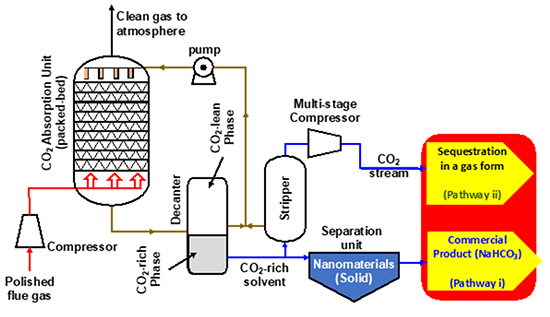
In addition, due to the unique phase-change behavior exhibited by the CO2-Gly/NaOH reaction products, the research team has recently expanded the use of this process into CO2 capture for sequestration purposes. This work is currently published in the Journal of Energy and Power Technology [2]. Thus, this innovative process has two unique pathways as depicted in the figure below. In Pathway (i), the solid nanomaterials are separated and sold as a valuable product (bicarbonates); and in Pathway (ii), the CO2-rich phase is regenerated, and the CO2 released is further conditioned for subsequent sequestration.




References
[1] Wang, Rui, Husain E. Ashkanani, Bingyun Li, and Badie I. Morsi. “Development of an innovative process for post-combustion CO2 capture to produce high-value NaHCO3 nanomaterials.” International Journal of Greenhouse Gas Control 120 (2022): 103761. DOI: https://doi.org/10.1016/j.ijggc.2022.103761 .
Go To International Journal of Greenhouse Gas Control
[2] Wang, Rui, Husain E. Ashkanani, Bingyun Li, and Badie I. Morsi. “TEA of a Unique Two-Pathways Process for Post-Combustion CO2 Capture.” Journal of Energy and Power Technology. DOI: https://doi.org/10.21926/jept.2204033 .