 Advances in Engineering Advances in Engineering features breaking research judged by Advances in Engineering advisory team to be of key importance in the Engineering field. Papers are selected from over 10,000 published each week from most peer reviewed journals.

Significance
Reconfigurable antennas play a crucial role in the development of future communication networks such as 6G. These antennas have the ability to adjust their properties, such as frequency or radiation beams, in real-time and from a remote location. However, many current reconfigurable antenna designs have limitations that can affect their functionality and performance. These limitations include dysfunction in extreme temperatures, power constraints, and the need for frequent servicing.
To address these limitations, Dr. Galestan Mackertich-Sengerdy, Dr. Sawyer Campbell, Dr. Douglas Werner from the Penn State College of Engineering has developed a novel approach by combining electromagnets with compliant mechanisms. Compliant mechanisms are engineering designs that utilize the inherent properties of materials to create motion when force is applied, eliminating the need for traditional rigid body mechanisms with hinges. The team published their proof-of-concept reconfigurable compliant mechanism-enabled patch antenna in Nature Communications.
The compliant mechanism-enabled design allows the antenna’s arms to bend predictably, thereby changing its operating frequencies without the use of hinges or bearings. This concept is similar to how a chameleon triggers the movement of tiny bumps on its skin to change color. By configuring the mechanical properties enabled by the compliant mechanism, the reconfigurable antenna can change its frequency from low to high and back.
This innovative design surpasses existing origami-based reconfigurable antenna technologies in terms of robustness, long-term reliability, and high-power handling capability. While origami antennas are known for their compact folding and storage capabilities, they often require complex stiffening structures to prevent warping or bending once deployed. This limitation can lead to environmental and operational constraints in real-world applications.
The authors focused on developing a circular, iris-shaped patch antenna prototype using commercial electromagnetic simulation software. They then 3D printed the prototype and tested it for fatigue failures, frequency range, and radiation pattern fidelity in an anechoic chamber at Penn State. Although the prototype was only slightly larger than a human palm and targeted a specific frequency for demonstration purposes, the technology is scalable to higher frequencies at the integrated circuit level or can be increased in size for lower frequency applications.
The integration of compliant mechanisms in reconfigurable antennas has gained popularity due to advancements in 3D printing, which allows for endless design variations. According to the authors, their work introduces compliant mechanisms as a new design paradigm for the entire electromagnetics community, with the potential to open up exciting applications that have yet to be explored. Indeed, reconfigurable antennas, including those based on compliant mechanisms, have the potential to revolutionize communication systems by reducing the need for multiple antennas to achieve various functionalities. This can help address the hardware bottleneck, maximize performance, and lower system costs. Moreover, improvements in hysteresis, reliability, and high-power handling can further enhance the operational capabilities of reconfigurable antennas.
Mechanically reconfigurable antennas have traditionally relied on origami-based solutions, but these come with their own limitations. Origami antennas require specific assumptions about material performance and behavior to achieve the desired functionality. They also face challenges related to structural rigidity, implementation into three-dimensional structures, and force amplification for actuation devices. Additionally, the use of thin, flexible substrates in origami antennas can lead to mechanical and electrical degradation over time, limiting their reliability and operational lifetime.
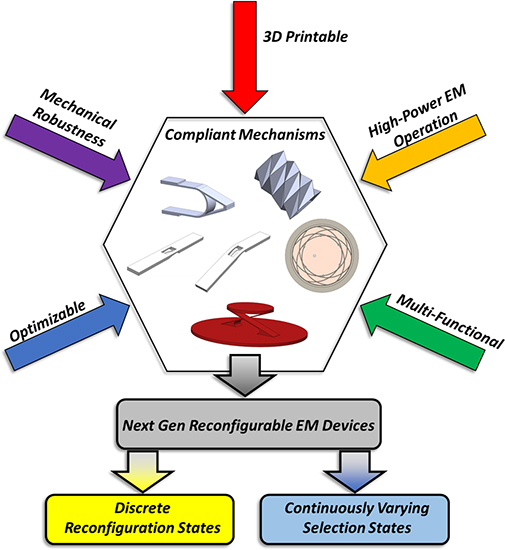
The integration of compliant mechanisms addresses these limitations by utilizing a material’s elastic properties to achieve controlled deformation and motion. Compliant mechanisms can be made from a single material and designed as planar structures, achieving multi-axis motion with minimal assembly and no need for lubrication. They have been successfully applied in various fields, from fiber optic alignment to surgical instrumentation. Compliant mechanisms offer a wider range of possibilities compared to traditional rigid body mechanisms and can be further optimized through mechanical optimization techniques.
By integrating compliant mechanisms into reconfigurable antenna systems, engineers can achieve transformative variable electromagnetic properties. Integrating compliant mechanisms into reconfigurable antenna systems enables engineers to achieve transformative variable electromagnetic properties. These mechanisms offer a unique advantage by providing controlled and predictable deformation, allowing the antenna to adjust its operating frequencies, radiation patterns, or other properties in real-time. One of the key benefits of compliant mechanisms in reconfigurable antennas is their ability to simplify the overall design. Unlike traditional rigid body mechanisms that require multiple parts and complex assemblies, compliant mechanisms can be fabricated from a single material, reducing the number of components and potential points of failure. This simplification leads to improved reliability, lower maintenance requirements, and increased operational lifetime.
Moreover, compliant mechanisms offer excellent scalability and versatility in design. They can be easily customized and optimized for different frequency bands, beam directions, or other performance parameters. This flexibility allows for the creation of compact and efficient antenna systems that can adapt to changing communication requirements. Another advantage of compliant mechanism-enabled reconfigurable antennas is their enhanced power handling capability. The compliant nature of the mechanisms allows for controlled deformation and redistribution of stress, reducing the risk of fatigue failures and improving the antenna’s ability to handle high-power signals. This makes them suitable for applications that require robust and reliable antennas, such as wireless communication networks, satellite systems, or radar systems. Additionally, the integration of compliant mechanisms with reconfigurable antennas opens up possibilities for advanced functionalities. For example, the antenna can dynamically steer its radiation beam to track a moving target or mitigate interference. It can also adapt its frequency range to accommodate different communication standards or optimize signal quality in varying environments. These capabilities enhance the overall performance and adaptability of the antenna system.
As the field of reconfigurable antennas continues to evolve, the integration of compliant mechanisms offers promising opportunities for further innovation. Researchers and engineers are actively exploring novel designs, materials, and fabrication techniques to maximize the potential of compliant mechanism-enabled antennas. This includes advancements in additive manufacturing technologies, such as 3D printing, which enable the production of intricate and optimized compliant structures. In conclusion, the integration of compliant mechanisms in reconfigurable antennas proposed by Dr. Doug Werner and colleagues holds significant potential for revolutionizing communication systems. These mechanisms provide improved reliability, scalability, power handling, and advanced functionalities, contributing to more efficient and adaptable antenna systems.

Reference
Galestan Mackertich-Sengerdy, Sawyer D. Campbell, Douglas H. Werner. Tailored compliant mechanisms for reconfigurable electromagnetic devices. Nature Communications, 2023; 14 (1) DOI: 10.1038/s41467-023-36143-6