Advances in Engineering Advances in Engineering features breaking research judged by Advances in Engineering advisory team to be of key importance in the Engineering field. Papers are selected from over 10,000 published each week from most peer reviewed journals.

Significance
Single-atom catalysts (SACs) represent a fascinating and rapidly developing area in the field of catalysis. They are characterized by their unique structure, where individual atoms, typically of a precious metal, are dispersed on a suitable support material at the atomic level. In SACs, nearly every atom of the precious metal is exposed and available for catalytic action, leading to a very efficient use of these often expensive materials. The unique electronic properties of individual atoms can lead to high selectivity and activity in chemical reactions, which is crucial for many industrial processes. The reactivity of SACs can be finely tuned by choosing different metal atoms and support materials, allowing for a high degree of control over the catalytic process. SACS has several important industrial applications, for instance SACs are used in various chemical synthesis processes, including hydrogenation reactions, where their high selectivity and activity can lead to more efficient and cleaner production methods. They are also utilized in the treatment of pollutants, such as in catalytic converters for automobiles, where they help in breaking down harmful emissions into less toxic substances. Additionally, in fuel cells, SACs can act as efficient electrocatalysts for the oxygen reduction reaction, a critical process in converting chemical energy into electrical energy. Moreover, they can be used in the synthesis of complex organic compounds, including drugs, where their high selectivity helps in producing purer products.
Extended X-ray Absorption Fine Structure (EXAFS) spectroscopy is a powerful analytical technique used to study the structural properties of materials at the atomic level. EXAFS spectroscopy involves measuring the absorption of X-rays as they interact with a material. When X-rays are absorbed by an atom, they can cause the ejection of core electrons, leading to a phenomenon known as the photoelectric effect. The absorption intensity varies with the X-ray energy, providing unique spectral patterns. The oscillations in the absorption spectra (the ‘fine structure’) beyond the X-ray absorption edge provide detailed information about the distances and distribution of neighboring atoms around the absorber atom, essentially offering a ‘fingerprint’ of the local atomic structure. EXAFS can be used to study a wide range of materials, including liquids, solids, and gases, and is not limited by the state of the sample (crystalline or amorphous). EXAFS is crucial for understanding the atomic structure of SACs. It provides information about the coordination environment of the single atoms dispersed on the support material, which is vital for understanding their catalytic behavior. By analyzing the structural properties of SACs, researchers can optimize the catalyst design for better performance. This includes adjusting the metal-support interaction, the dispersion of the single atoms, and the overall stability of the catalyst. EXAFS helps in elucidating the mechanism of catalytic reactions facilitated by SACs. Understanding how single atoms interact with reactants can lead to the development of more efficient and selective catalysts. Additionally, EXAFS can be used to study SACs under real working conditions (in situ or operando studies), providing insight into how the catalysts behave during actual chemical reactions.
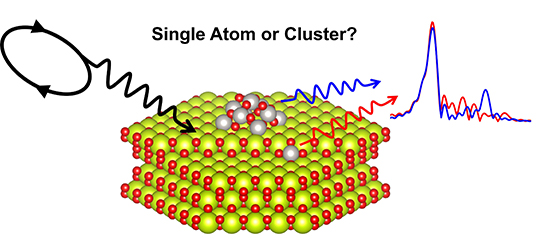
In a new study published in ACS Catalysis and led by Professor Phillip Christopher at the University of California Santa Barbara and distinguished scientist Dr. Simon Bare at the Stanford Synchrotron Radiation Lightsource- SLAC National Accelerator Laboratory and conducted by Jordan Finzel, Kenzie Sanroman Gutierrez, Adam Hoffman, Joaquin Resasco assessed the detection limits of EXAFS in identifying metal or metal oxide clusters within predominantly single-atom samples.
The team modeled EXAFS spectra for mixtures containing atomically dispersed metals and clusters. This approach was critical in quantifying the ability of EXAFS to detect clusters coexisting with single-atom active sites. The authors specifically targeted platinum on cerium dioxide Pt/CeO2 systems, which are of considerable interest in catalysis. By examining this system, the researchers could draw broader conclusions about the limitations of EXAFS in characterizing SACs. To refine their analysis, the researchers utilized a continuous Cauchy wavelet transform. This sophisticated mathematical technique allowed them to screen bulk metal oxides and better understand the challenges in differentiating atomically dispersed metals from metal oxide clusters. The study showed that EXAFS has significant limitations in detecting clusters in the presence of SAC active sites. This implies that a considerable fraction of clusters could remain undetected, potentially leading to misinterpretations about the presence or absence of clusters in SACs. The researchers highlighted the difficulty of distinguishing between atomically dispersed metal species and metal oxide clusters in certain materials using EXAFS. This finding is crucial as it indicates that the technique might not always provide clear or conclusive evidence about the structure of SACs. One of the most important implications of this study is the need for caution in interpreting EXAFS data, especially regarding the presence of clusters in SACs. The researchers emphasize that the absence of evidence (of clusters) in EXAFS should not be interpreted as evidence of absence. In conclusion, the authors recommended for best practice and in future research in SACs should involve multiple structural models in EXAFS analysis, acknowledge the limits of detection, and consider employing complementary characterization techniques alongside EXAFS for a more accurate understanding of SAC structures. In a statement to Advances in Engineering, Dr. Simon Bare said “Many groups publish catalysis data claiming the unique activity is from the presence of single atoms on their support, and they use EXAFS data to “prove” that they only have single atoms. But how confident can we be to make this claim using EXAFS? This is the question we set out to answer”.

Reference
Jordan Finzel, Kenzie M. Sanroman Gutierrez, Adam S. Hoffman, Joaquin Resasco, Phillip Christopher,* and Simon R. Bare*. Limits of Detection for EXAFS Characterization of Heterogeneous Single-Atom Catalysts. ACS Catal. 2023, 13, 6462−6473.