Advances in Engineering Advances in Engineering features breaking research judged by Advances in Engineering advisory team to be of key importance in the Engineering field. Papers are selected from over 10,000 published each week from most peer reviewed journals.

Significance
Lithium-ion batteries essential for energy storage as the world moves toward renewable energy and electric vehicles. However, as demand for lithium skyrockets, getting enough of it is becoming a real challenge. Lithium doesn’t just sit by itself in nature; it’s usually mixed with other ions like magnesium, which are frustratingly similar in size and charge which make separations is challenging, hard and time-consuming. Currently, there are few methods used to extract lithium, like electrodialysis, graphene membranes, and ion adsorption, however, they have some big drawbacks. They are expensive, energy intensive, and not exactly great for the environment. That’s where the search for something smarter comes in, and metal-organic frameworks, or MOFs, are looking like a game-changer. These materials have this amazing ability to be tailored for specific tasks. One MOF in particular, UiO-66, has tiny pores just the right size for catching lithium ions while letting others, like magnesium, stay behind. Additionally, they can be modified with amine groups and by this improve even further the lithium separation. However, there is still a lot that we do not know about MOFs. For example, why is lithium so much easier to separate than magnesium in these systems? What’s happening on a molecular level when these ions interact with the MOF? And what role do things like hydration shells and electric fields play? These are critical questions that are key in designing even better, more efficient lithium extraction systems. To this account, recent study published in Journal of Materials Chemistry A and led by Professor Joonmyung Choi from the Hanyang University in South Korea and co-authored by Yejin Lim and Youngoh Kim set out to explore using super-detailed molecular simulations, they studied in more detail how amine-modified UiO-66 interacts with lithium and magnesium ions, especially under an electric field. They wanted to uncover the tiny, invisible dynamics that make lithium stand out. What they found could change the way we extract lithium, making the process faster, cleaner, and more efficient. In a world racing toward renewable energy, that’s a pretty big deal.
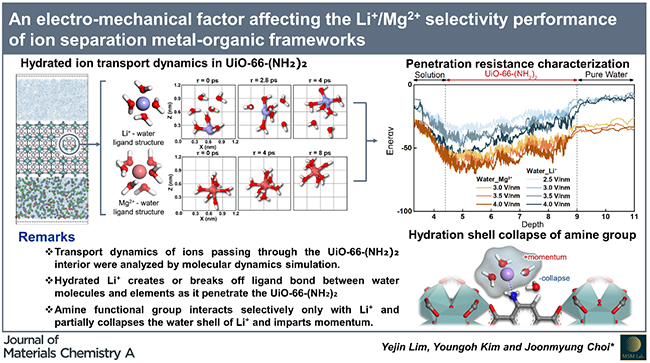
In one key experiment, the team looked at how these hydrated ion clusters moved through the MOF’s pores under various electric field strengths. The results were pretty striking. Lithium ions had a unique “hopping” behavior, where their hydration shells broke apart and reformed as they passed through the pores. This hopping made lithium ions quick and responsive, especially when the electric field gave them a boost of energy, shaking off their water molecules and speeding up their journey. Magnesium ions, on the other hand, clung tightly to their water shells. This rigidity created a barrier, making it much harder for them to move through the MOF. In short, lithium zipped through, while magnesium lagged behind—perfect for selectively filtering lithium. Moreoer, the amine groups added to the MOF played a big role too. These chemical modifications were designed to interact with the ions in specific ways. For lithium, the nitrogen in the amine groups temporarily bonded with the ion, pushing water molecules out of the way and smoothing its path through the framework. But magnesium wasn’t so cooperative. Its strong water bonds resisted the same interactions, and the amine groups acted more like roadblocks, slowing it down even further.
The authors also looked at how voltage influenced this whole process. As they cranked up the electric field, lithium ions got even better at making their way through, while magnesium struggled more and more. This proved that electric fields could be a powerful tool for fine-tuning the MOF’s selectivity, a game-changing insight for scaling up lithium extraction. Finally, the researchers analyzed why this all worked so well. They found that magnesium’s higher hydration energy—basically how strongly it holds onto its water shell—keeps it stable but less mobile. Lithium’s lower hydration energy, on the other hand, made it flexible and easier to work with. That flexibility is why lithium moves so efficiently through the MOF, even though both ions are similar in size. These findings could pave the way for smarter, more efficient lithium extraction technologies.
In conclusion, Professor Joonmyung Choi and his team achieved a significant advancement in lithium extraction and it is practical, scalable, greener and simple in concept. The metal-organic framework UiO-66-(NH2)2, when chemically modified with amine groups make the material selectively interact with lithium ions, helping them slide through while slowing magnesium to a crawl. According to the authors, the difference comes down to how the ions’ hydration shells behave—basically, how tightly water molecules cling to each ion. Lithium’s shell breaks apart more easily, making it nimble, while magnesium’s shell stays stubbornly intact, keeping it stuck. The results were even better with electric current. Lithium zipped through the material faster, while magnesium became even more sluggish. It is an innovation that shows how electric fields can be used to fine-tune the separation process, making it faster and more efficient. The new technology may go beyond just solving the challenge in lithium production, and the study gives us a deeper understanding of how ions behave in tight spaces. It could indeed pave the way for advancements in other areas, like water purification or recovering valuable resources from waste streams.

Reference
Yejin Lim, Youngoh Kim and Joonmyung Choi. Electro-mechanical factor affecting the Li+/Mg2+ selectivity performance of ion separation metal–organic frameworks. J. Mater. Chem. A, 2024, 12, 166