Advances in Engineering Advances in Engineering features breaking research judged by Advances in Engineering advisory team to be of key importance in the Engineering field. Papers are selected from over 10,000 published each week from most peer reviewed journals.

Significance
In the relentless global search of clean, sustainable, and virtually limitless energy, nuclear fusion has emerged as one of humanity’s most ambitious and promising frontiers. Unlike conventional fission-based nuclear power, fusion harnesses energy by fusing light atomic nuclei, mimicking the processes that power the sun. While the theoretical advantages of fusion—abundant fuel, negligible greenhouse gas emissions, and minimal long-lived radioactive waste—are well established, turning this promise into a practical reality demands unprecedented advancements in materials science and engineering. At the heart of this technological transformation lie the in-vessel components of fusion reactors, which must endure not only extreme heat and radiation but also complex mechanical stresses over extended operational lifetimes. One of the most crucial yet technically complex fabrication methods for these components is remote laser welding, a technique that enables precise, non-contact joining of reactor structures inside hazardous or confined environments. However, despite its precision, laser welding introduces a formidable challenge: residual stress. These stresses are locked into the material during the rapid thermal cycles of welding, especially within the fusion zone (FZ) and heat-affected zone (HAZ), leading to localized hardening or softening, unexpected strain concentrations, and potential mechanical failures under service conditions. Compounding this challenge is the high operating temperature of fusion systems, often reaching 550–650°C, which can further deteriorate mechanical integrity by accelerating creep, phase transformation, and cracking. P91 steel—a high-performance ferritic-martensitic alloy—is frequently selected for its excellent strength retention at elevated temperatures and resistance to thermal fatigue. Yet, when subjected to laser welding, even this robust material undergoes complex microstructural changes and stress redistributions that are poorly understood, especially at the microscopic scale. Traditional methods for evaluating residual stress, such as neutron diffraction or finite element analysis, often lack the resolution or material specificity needed to accurately characterize the heterogeneous zones within welded joints.
New research paper published in Journal of Materials Research and Technology and conducted by Bin Zhu, Omar Mohamed, Abdalrhaman Koko, Hannah Zhang, Jiří Dluhoš, Yiqiang Wang, Michael Gorley, and led by Professor Mark J. Whiting and Professor Tan Sui from the School of Engineering at University of Surrey, the researchers undertook a comprehensive investigation to correlate residual stress with microstructural evolution and mechanical performance in laser-welded P91 steel. Their goal was not simply to measure these parameters in isolation, but to understand how they interact—how residual stress influences micro-hardness, how microstructure dictates deformation under load, and how these intertwined effects ultimately govern the failure behavior of welded components under real-world, high-temperature conditions. This study represents an essential step toward developing safer, longer-lasting fusion reactor materials by providing engineers with the detailed insights needed to refine welding processes, predict component lifespan, and design future reactors with higher confidence in structural resilience.
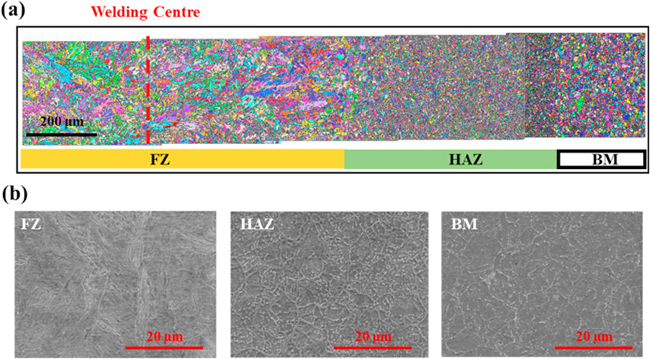
The research team began by preparing samples through single-pass laser welding, replicating the narrow fusion and heat-affected zones typical of in-vessel reactor components. These zones, though only millimeters wide, carry the burden of significant thermal and mechanical history—details that are invisible to the naked eye but critical to long-term structural integrity. To peer into this hidden world, the team employed a technique as sophisticated as the problem itself: Plasma Focused Ion Beam combined with Digital Image Correlation (PFIB-DIC). This allowed them to physically release and measure microscopic strains in the material by milling ring-shaped cores at key locations—fusion zone, heat-affected zone, base metal, and their interfaces. What emerged was a nuanced stress landscape. They discovered a peak tensile residual stress of approximately 150 MPa nestled at the fusion line, where rapid heating and cooling had softened the structure. In contrast, the neighboring HAZ/BM interface exhibited compressive stresses peaking around 550 MPa, likely stemming from restrained thermal contraction. These measurements offered more than numbers—they revealed how stress is not evenly spread, but woven intricately into the very fabric of the weld. But stress alone tells only part of the story. Through nanoindentation, the researchers probed the surface hardness and validated the PFIB-DIC findings with high-resolution depth profiling. The hardest region wasn’t the weld itself but the edge of the HAZ, where microstructural transformations had left behind a mosaic of martensite and dissolved carbides. Interestingly, compressive stresses were found to enhance hardness by up to 25%, while tensile ones subtly softened the metal by around 10%. To observe how these complex stress patterns played out under real strain, they turned to tensile testing—both at room temperature and at 550°C, simulating reactor-like conditions. At room temperature, the fusion zone showed the highest yield strength, bolstered by compressive stress and microstructural refinement. Yet at elevated temperatures, the strength diminished markedly, and ductility waned. Fractography revealed a shift from mixed brittle-ductile failure to predominantly ductile behavior, underscoring how thermal environments reshape failure modes. Altogether, these experiments didn’t just produce data—they told a coherent, human-centered story about how steel remembers its past and responds to the future.
In conclusion, the university of Surry scientists provided a rare, high-resolution window into the hidden stresses and structural transformations that silently form during the welding of reactor components. These insights are not theoretical—they address real-world problems where microscopic irregularities can trigger large-scale failures in billion-dollar systems. By establishing a validated method to map residual stress at the micrometer scale, the researchers have given engineers a powerful diagnostic tool. It’s no longer necessary to rely solely on computational estimates or average values; now, one can see how stress behaves at interfaces and gradients within the weld—places traditionally overlooked but known to be vulnerable. This refinement enables better decisions about weld design, repair protocols, and inspection timing. In essence, the study bridges the gap between materials as manufactured and materials as lived-in, shaped by history and operational demands. Perhaps more importantly, the study shifts how we think about steel in fusion reactors. P91, long admired for its high-temperature strength, is shown here not as a uniform block of metal but as a dynamic canvas—its properties changing with each layer of heat, stress, and phase transformation. Recognizing this complexity allows for tailored approaches to welding and post-processing, potentially extending component life and reducing costly downtimes. The finding that residual stress can either harden or soften material by significant margins reshapes our understanding of weld integrity and prompts re-evaluation of safety margins. The broader implication is one of foresight. As fusion energy inches closer to practical reality, it will require not just grand ideas but intimate knowledge of every component. This study delivers exactly that—granular, actionable understanding. It paves the way for integrating experimental data with machine learning models that can predict failure before it happens. It supports the design of smarter, more durable reactor systems that aren’t just strong on paper but resilient in practice. In doing so, it brings us a step closer to making fusion not just possible, but reliable, safe, and economically viable for generations to come.

Reference
Bin Zhu, Omar Mohamed, Abdalrhaman Koko, Hannah Zhang, Jiří Dluhoš, Yiqiang Wang, Michael Gorley, Mark J. Whiting, Tan Sui, Assessing residual stress and high-temperature mechanical performance of laser-welded P91 steel for fusion power plant components, Journal of Materials Research and Technology, Volume 35, 2025, Pages 6341-6347,