Advances in Engineering Advances in Engineering features breaking research judged by Advances in Engineering advisory team to be of key importance in the Engineering field. Papers are selected from over 10,000 published each week from most peer reviewed journals.

Significance
Carbon dots (CDs) are gaining recognition as a versatile class of luminescent nanomaterials, valued for their adjustable photoluminescence, chemical robustness, and inherent biocompatibility. Early research focused primarily on their behavior in dilute aqueous systems, where their emission properties—driven by surface states and quantum confinement and was relatively straightforward to characterize. In these dispersed states, CDs reliably displayed bright fluorescence, which led to a surge of interest in their use for biosensing and imaging. But as the field progressed and attention shifted to real-world applications—ranging from solid-state lighting to anti-counterfeiting inks and flexible displays—a fundamental complication became apparent: these nanomaterials behave very differently when they start to cluster.
At the heart of the issue is a well-known obstacle in photonics—aggregation-caused quenching. When CDs aggregate, typically due to high concentration or solid-state constraints, non-radiative pathways such as π–π stacking interactions and Förster resonance energy transfer (FRET) become dominant. The result is a dramatic drop in luminescence efficiency, which limit their practical utility in any setting that involves dense packing or film formation. While aggregation-induced emission has been documented in some organic systems, CDs have remained something of an outlier. Only a handful of studies have studied how CDs transition optically as they shift from isolated particles to densely packed assemblies, and even fewer have done so in a way that clarifies the physical principles underpinning these transitions. Complicating matters further is the influence of the solvent environment, which plays an often-overlooked role in mediating interparticle forces. Among the various interactions at play, hydrogen bonding emerges as a particularly promising mechanism for tuning CD behavior. The idea that one could exploit directional, reversible hydrogen bonds to steer aggregation—without succumbing to quenching—has long been enticing, but prior efforts have been either piecemeal or speculative. What the field has lacked is a coherent, experimentally grounded framework that correlates molecular interactions with observable optical outcomes across a tunable range of conditions.
To address this gap, recent research paper published in Advanced Materials and led by Professor Zhili Peng from the Yunnan University and conducted by Chunyu Ji, Fanhao Zeng, Wenjun Xu, Minjie Zhu, Hongchun Yu, together with Professor Han Yang from the University of Chinese Academy of Sciences, examined how hydrogen bonds can drive the self-assembly of CDs and modulate their photoluminescence from isolated blue-emitting particles to red-shifted emissive clusters.
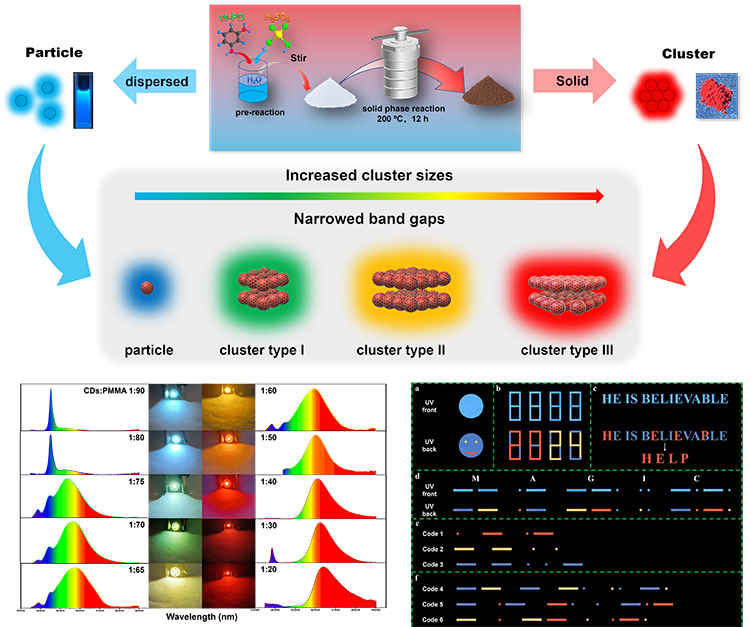
The research team began by synthesizing CDs from phenylenediamine using a straightforward solid-state thermal process—one robust enough to scale up to hectogram quantities without compromising quality. This simplicity, however, belied the structural precision of the resulting nanomaterials. The authors used transmission electron microscopy which showed uniformly shaped, quasi-spherical nanoparticles averaging 2.4 nm in diameter. High-resolution imaging further confirmed the presence of defined lattice fringes, offering clear evidence of internal order. What stood out, though, was the surface chemistry. FTIR and XPS analyses showed the presence of ─OH, ─NH₂, ─COOH, and ─SO₃H groups—features that strongly pointed to the possibility of directional hydrogen bonding. This, the team hypothesized, could be the key to modulating aggregation without inducing quenching.
To examine how environmental context influences photoluminescence, the authors compared water and formamide as solvents and found that in water, CDs exhibited strong blue emission that remained stable even across a wide concentration range. The lack of spectral shift suggested minimal aggregation—likely because water’s high hydrogen-bonding capacity disrupted interactions between particles. In formamide, however, the behavior shifted dramatically. According to the authors, as concentration increased, the initial blue luminescence gradually gave way to longer-wavelength red emissions, ranging from ~520 nm to beyond 660 nm. The red shift pointed clearly toward the progressive formation of aggregated clusters. To study this transition in greater detail, the team turned to spectral deconvolution techniques. These analyses revealed two distinct types of emissions: one associated with isolated CDs and the other with aggregates. At low concentrations, blue “particle” emissions dominated. But as concentration rose, red “cluster” emissions began to take over. Time-resolved fluorescence measurements provided further support—showing that the lifetime of red emissions was notably shorter, consistent with increased nonradiative decay due to particle proximity and FRET effects. Moreover, using microscopy added a visual dimension to this evolving picture where they found at lower concentrations, CDs remained individually dispersed and as concentration increased, however, they began forming organized clusters—starting in the 16–19 nm range and growing to over 100 nm. These structural changes echoed the spectral shifts, strengthening the case for a hierarchical, hydrogen bond-driven self-assembly process. Solvent tests extended the narrative: polar aprotic solvents like DMF and DMSO supported gradual clustering, while nonpolar solvents caused rapid aggregation and loss of tunability.
Finally, by embedding the CDs in PMMA films, the Yunnan University scientists demonstrated practical control over emission color based on both concentration and observation direction. The films could shift visually from blue to red simply by adjusting material ratios—a clear powerful display of how nanoscale hydrogen bonds can dictate macroscale optical behavior.
In conclusion, the new study by Professor Zhili Peng and colleagues presents a notable shift in how CDs might be integrated into solid-state technologies. The researchers successfully turn aggregation into a controllable advantage. By utilizing hydrogen bonding to mediate the assembly of CDs, they induce a striking transition in emission—from bright blue to vivid red—without altering the chemical core. This mechanism, simple in principle yet powerful in effect, opens the door to customizable optical materials for use in devices like tunable LEDs, anti-counterfeiting surfaces, and emissive coatings. What’s particularly intriguing is the emergence of dual-emission behavior that depends not just on concentration but also on geometry and directionality. This spatial sensitivity allows for clever optical encryption schemes. Rather than relying on unstable fluorophores or elaborate photonic structures, the system uses robust, thermally stable CDs whose emission can be selectively activated or suppressed by merely changing the viewing angle or excitation direction. In practical demonstrations, encrypted patterns appear to display one image when viewed head-on and an entirely different one when illuminated from behind—a surprisingly minimal setup with sophisticated output. Indeed, the new innovation has potential impact in fields like wearable tech, adaptive displays, biosensing platforms, and secure labeling—anywhere light needs to carry meaning that changes with perspective.

Reference
Ji, Chunyu & Zeng, Fanhao & Xu, Wenjun & Zhu, Minjie & Yu, Hongchun & Yang, Han & Peng, Zhili. (2025). Hydrogen Bond‐Mediated Self‐Assembly of Carbon Dots Enabling Precise Tuning of Particle and Cluster Luminescence for Advanced Optoelectronic Applications. Advanced Materials. 37. 10.1002/adma.202414450.