Advances in Engineering Advances in Engineering features breaking research judged by Advances in Engineering advisory team to be of key importance in the Engineering field. Papers are selected from over 10,000 published each week from most peer reviewed journals.

Significance
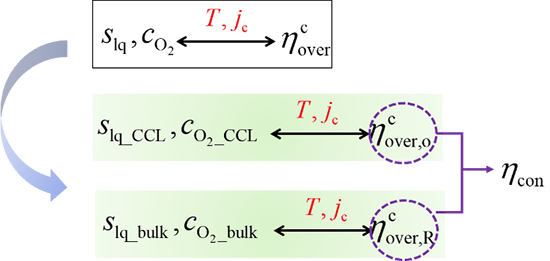
Proton exchange membrane fuel cells (PEMFCs) have emerged as one of the most credible routes toward decarbonizing transport and distributed power. Their appeal lies in the quiet elegance of the chemistry—hydrogen split and recombined to generate electricity with only water as a by-product. Yet translating that clean simplicity into high-power systems has proven far from straightforward. For heavy-duty trucks, ships, and stationary units operating above the 200 kW range, engineers can no longer rely on the compact cells that perform so well in the lab. Scaling up the active area introduces a cascade of design complications that are neither linear nor intuitive. As the flow field enlarges, the distribution of reactants becomes uneven, and subtle imbalances in gas flow or water content can spiral into major performance losses. Flooding in one region and drying in another often coexist, creating voltage irregularities that limit both durability and output. In principle, enlarging the active area should be simple geometry; in practice, it exposes the coupled nature of transport, electrochemistry, and heat generation in ways that smaller systems never reveal. Most progress previously come from component-level innovation—membranes that hold water better, catalysts with optimized pore structures, or diffusion layers engineered for faster drainage. But the collective behavior of these components at large scale remains poorly understood. The geometry of the main flow channels—how gases enter, react, and exit—dominates the overall response. Conventional designs like parallel or serpentine channels cannot be magnified proportionally; pressure losses and diffusion limits grow faster than area. Without a clear quantitative grasp of how factors such as channel length, branching, or rib width shape activation, ohmic, and concentration losses, truly rational design remains out of reach. To this account, new research paper published in Applied Energy and conducted by Assistant Prof. Zhuo Zhang, Dr. Hong-Bing Quan, Dr. Sai-Jie Cai, Dr. Zheng-Dao Li, and Professor Wen-Quan Tao from the Key Laboratory of Thermo-Fluid Science & Engineering of MOE at Xi’an Jiaotong University, the researchers developed two interconnected models: a three-dimensional two-phase computational framework that couples electrochemical reactions with transport phenomena, and a generalized analytical model for extracting concentration losses directly from simulation data.
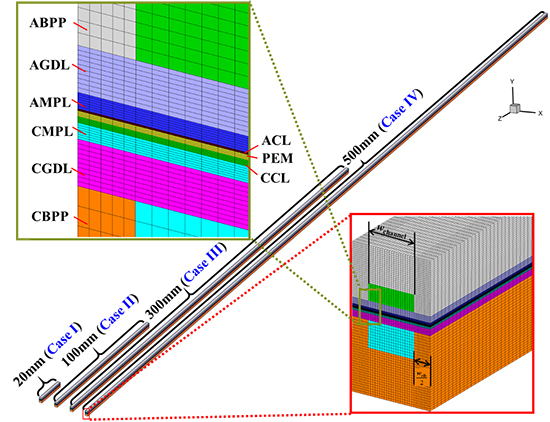
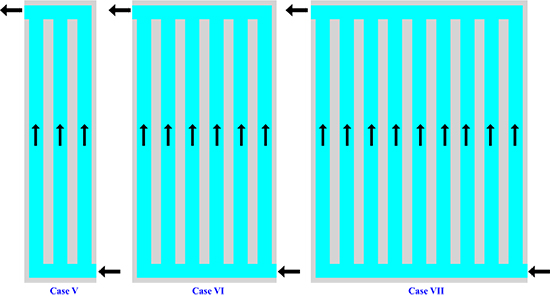
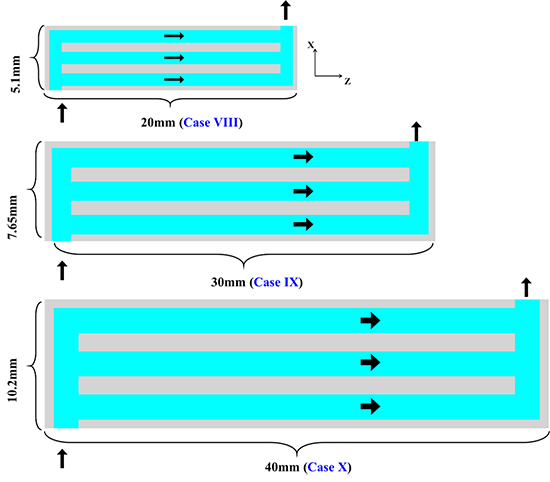
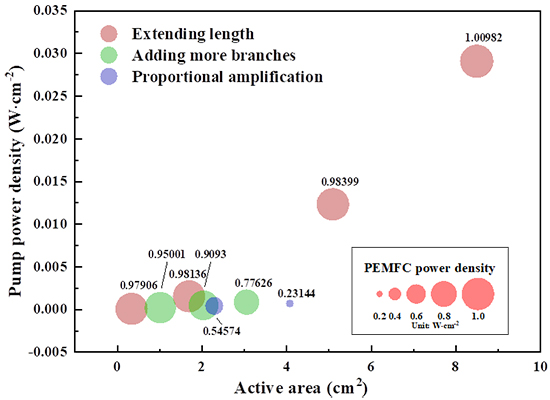
The authors constructed eleven computational cases that represents systematic variations in four structural factors: channel length, number of channel branches, scaling ratio, and channel-to-rib (C/R) ratio to dissect the effects of geometric scaling. A three-dimensional two-phase model was implemented in ANSYS FLUENT with user-defined functions to capture the coupled fields of gas flow, electrochemical reaction, water transport, and heat dissipation. Each simulation incorporated realistic physical parameters—porosities, layer thicknesses, and boundary conditions derived from validated experiments using a 25 cm² serpentine PEMFC cell. The close agreement between measured and simulated polarization curves, with a deviation below 2%, confirmed the reliability of the model. The team showed that extending the flow-channel length moderately enhances performance, largely by raising the bulk oxygen concentration through higher inlet pressure, though excessive elongation increases pump power exponentially beyond 100 mm. The associated improvement in power density ranged between 0.5 % and 3.4 %, demonstrating diminishing returns once viscous losses dominate. On the other hand, increasing the number of parallel branches from three to nine caused clear performance degradation—up to 18 % at high current densities because of the uneven flow distribution and localized oxygen starvation near the channel junctions. The authors confirmed using flow visualization that back-flow zones and pressure imbalances intensified with each added branch, raising ohmic and concentration losses. The proportional amplification of the entire flow field, a seemingly intuitive scaling method, proved the most detrimental. Doubling the geometric scale reduced the power density by more than 70 % and substantially raised both ohmic and concentration losses. The expanded under-rib distance amplified mass-transfer resistance, starving the catalyst layer of reactants and producing steep oxygen concentration gradients. In this case, the concentration loss contribution exceeded 80% of total voltage decline, identifying mass transport as the dominant limiting mechanism. Finally, varying the channel-to-rib ratio indicated that wider channels (larger C/R values) facilitate gas access and water evacuation, thereby improving output performance, whereas excessive rib width suppresses under-land diffusion and elevates local overpotentials. Throughout all cases, the newly introduced method for isolating concentration loss enabled a clear quantification of how structural modifications redistribute the three fundamental voltage losses. Collectively, these results established that channel branching is a more sustainable scaling strategy than proportional amplification, balancing modest performance penalties with manageable pressure drops—an insight directly transferable to large-area fuel-cell stack designs.
In conclusion, the work of Assistant Prof. Zhuo Zhang, Professor Wen-Quan Tao and colleagues successfully developed a novel generalizable method that can quantify concentration losses based on detailed three-dimensional multiphase simulations, and can provide a diagnostic lens to dissect the interplay among electrochemical kinetics, mass transport, and heat generation during geometric magnification. The researchers identified which scaling path offers optimal trade-offs between efficiency and manufacturability, ultimately guiding the rational design of large-area flow fields for high-power PEMFCs. By systematically analyzing three distinct strategies (channel elongation, branch addition, and proportional amplification). It delivered a rare quantitative framework for bridging laboratory-scale PEMFC design with commercial high-power systems. Also by introducing a universal approach to calculate concentration loss from multiphase simulation data, the authors provide a diagnostic tool capable of deconstructing how geometry governs electrochemical performance. The study moves beyond qualitative observations—such as “longer channels improve diffusion” or “more branches increase uniformity”—and instead identifies measurable trade-offs among performance, pump power, and internal voltage losses. In particular, the finding that concentration loss accounts for over 80 % of total degradation during area magnification underscores the primacy of mass-transport engineering in the next generation of large-area PEMFCs.
Additionally, the work provides direct design guidance for industrial developers of high-power fuel cells in vehicles, ships, and stationary energy systems. It demonstrates that simply scaling up a small unit cell leads to non-linear deterioration, as proportional magnification simultaneously worsens flow resistance and under-rib starvation. Instead, targeted modifications—such as incrementally adding channel branches while controlling local flow distribution—maintain reactant uniformity with only minor performance penalties. The results also showed a critical design boundary: beyond a channel length of roughly 100 mm, the required pump power rises exponentially, eroding system-level efficiency. The data redefine how engineers should approach the translation from laboratory prototypes to megawatt-scale stacks. Furthermore, the research reframes the mainstream flow field as an integrated thermofluidic network rather than a static geometric pattern. By coupling electrochemical kinetics with flow resistance and water management, it provides a roadmap for concurrent optimization of efficiency and durability. The methodology—linking local mass-transfer metrics with macroscopic voltage losses—can also be extended to other fuel-cell types or electrochemical reactors where scale-up fidelity remains a bottleneck. For the broader energy community, this study represents a shift toward quantitative, mechanism-based design strategies that replace empirical trial-and-error with predictive modeling. The authors’ contribution and framework serve as both a design reference and a conceptual bridge between fundamental thermofluid science and industrial fuel-cell engineering.

Reference
Zhuo Zhang, Hong-Bing Quan, Sai-Jie Cai, Zheng-Dao Li, Wen-Quan Tao, Design strategies for mainstream flow channels in large-area PEMFC: From typical units to large areas, Applied Energy, Volume 388, 2025, 125628,