 Advances in Engineering Advances in Engineering features breaking research judged by Advances in Engineering advisory team to be of key importance in the Engineering field. Papers are selected from over 10,000 published each week from most peer reviewed journals.

Significance
Superconductivity occurs when a material suddenly loses all its electrical resistance below a specific critical temperature (Tc) and behave in a way that seems almost perfect compared to ordinary conductors. This effect has reshaped how we think about current, magnetism, and even quantum coherence. However, to predict when it will occur still a big challenge. For all the theoretical advances since Onnes first observed mercury’s strange behavior in 1911, we still lack a reliable way to anticipate which materials will become superconducting, or how to push Tc higher without years of trial and error. Theories such as BCS and Eliashberg gave us a language for electron–phonon coupling, but they demand inputs that are either experimentally extracted or painfully computed. When one moves from simple crystals to compositionally rich systems like liquid-metal alloys, those equations start to crumble. In practice, running them across thousands of possible compositions is impossible. Now, with modern fabrication and machine learning tools, researchers are looking back again. To this account, new research paper published in Journal of Material Science and led by Mr. Chen Hua & Professor Jing Liu from the University of Chinese Academy of Sciences, researchers applied two high-performance tree-based models—ExtraTrees and Random Forest—for predicting the critical temperature of superconductors directly from chemical formulas. Their optimized ExtraTrees regressor achieved unprecedented accuracy on the large-scale SuperCon dataset. The models revealed In₀․₅Sn₀․₅ as a top-performing liquid-metal superconductor and produced comprehensive Tc maps for over 47,000 alloy compositions.
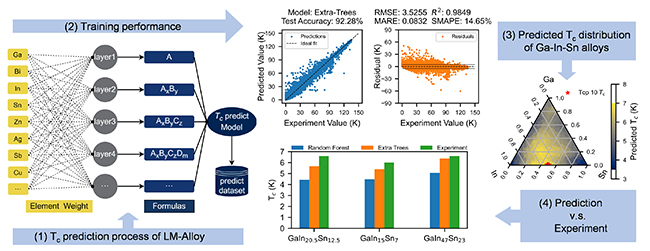
The authors in their study began with rigorous curation of the SuperCon dataset, which contained over 33,000 superconducting entries encompassing metallic and oxide systems. They identified and corrected missing or inconsistent records, standardized formula representations, and removed non-physical or high-pressure data, ultimately yielding approximately 21,000 reliable samples. Each composition was encoded by one-hot vectors corresponding to elemental presence and stoichiometric ratios—an approach that captures compositional diversity without presupposing any particular structural model. They divided processed dataset into training and validation subsets and further evaluated through fivefold cross-validation to ensure model stability. They found among multiple machine-learning algorithms tested—including random forest, XGBoost, CatBoost, and lightGBM—the ExtraTrees regressor emerged as the most accurate. After systematic grid-search optimization of hyperparameters such as tree depth, sample split size, and number of estimators, they found the model achieved a coefficient of determination (R²) of 0.9519 and a root-mean-square error (RMSE) of 6.26 K, surpassing comparable neural-network and gradient-boosting methods. The Random Forest model ranked second with R² = 0.9289, confirming the general robustness of tree-based learners for tabular chemical-composition data. Importantly, the model required no elaborate feature engineering or computationally heavy electronic-structure inputs, underscoring its efficiency.
The authors predicted using the optimized ExtraTrees and Random Forest models, Tc for binary and ternary liquid metal (LM) alloys composed of eight elements common in printable electronics: Ga, Bi, In, Sn, Zn, Ag, Sb, and Cu. Approximately one thousand random compositions were generated for each alloy family to map the Tc landscape. The ExtraTrees model consistently identified In₀․₅Sn₀․₅ as the composition with the highest predicted Tc ≈ 7.01 K, a value strikingly consistent with experimental observations. Validation against known Ga–In–Sn systems revealed mean absolute errors of less than 1 K, confirming the model’s reliability. Extended to a broader chemical space of 2,145 binary and 45,670 ternary alloys spanning 66 metallic elements, the model produced a comprehensive Tc prediction map highlighting numerous previously unreported candidates within the 0–40 K range.
They also evaluated data-augmentation strategies such as simple duplication and SMOTE oversampling for non-superconducting entries and both approaches degraded accuracy, and introduced systematic underestimation of Tc. Likewise, when they converted all compositional data to normalized-atomic-ratio form, improved consistency relative to mixed weight-percent entries. Furthermore, additional evaluations on known Fe-, Cu-, and Ni-based superconductors confirmed that the model retained predictive capability across diverse chemical families, though minor deviations arose for Ni-based compounds due to differing experimental Tc definitions.
In conclusion the study by Mr. Chen Hua & Professor Jing Liu successfully establishes tree-ensemble learning as a reliable, data-efficient route for accelerating the discovery of next-generation superconducting materials. They demonstrated that tree-based ensemble algorithms can accurately predict critical temperatures directly from compositional data. The ExtraTrees model’s high R² value (0.95) and low RMSE (≈6 K) reveal that, even without structural descriptors, chemical composition alone encodes sufficient information for reliable Tc estimation within metallic systems. Their findings challenge the long-standing notion that only detailed quantum-mechanical models can capture superconducting behavior with precision and instead, it highlights the emergent power of data-centric inference when the underlying dataset is carefully curated. For practical materials design, the study offers immediate value and by their identification of In₀․₅Sn₀․₅ as a leading LM superconductor aligns with experimental findings and illustrates the feasibility of using machine learning to guide experimental synthesis and screening. The prediction map encompassing tens of thousands of potential alloys provides a roadmap for future exploration—one that could drastically reduce the time and cost of discovering new superconductors for cryogenic electronics or quantum-device applications. Moreover, the approach is scalable: once extended to incorporate additional descriptors such as lattice parameters, phonon spectra, or electron-phonon coupling constants, the same framework could be applied to oxides, hydrides, and complex multicomponent systems. The implications also extend beyond superconductivity. Additionally, the authors preserved the physical credibility of their predictions by relying solely on verified experimental inputs and rejecting artificial oversampling. This fidelity to data integrity enhances the model’s trustworthiness for experimentalists seeking actionable insights rather than abstract correlations. Future research can be by incorporating structural information and high-pressure data which could refine predictions and enable exploration of unconventional superconductors where composition alone may not suffice. Integration with generative design algorithms or active-learning loops could further automate discovery by continuously retraining on new experimental results. In this way, the workflow pioneered by Chen Hua and Jing Liu forms part of a broader evolution toward intelligent materials design, where computation and experiment inform one another in real time.


Reference
Hua, C., Liu, J. Tree model machine learning to identify liquid metal-based alloy superconductor. J Mater Sci 60, 11857–11877 (2025). https://doi.org/10.1007/s10853-025-11121-
