Advances in Engineering Advances in Engineering features breaking research judged by Advances in Engineering advisory team to be of key importance in the Engineering field. Papers are selected from over 10,000 published each week from most peer reviewed journals.

Significance
Carbon dioxide hydrogenation is a chemical reaction in which carbon dioxide reacts with hydrogen to form reduced carbon-containing products, usually in the presence of a catalyst. The process converts CO₂ into compounds such as methane, carbon monoxide, methanol, or other hydrocarbons by transferring hydrogen atoms to the carbon–oxygen framework. Because CO₂ is kinetically inert, the reaction requires elevated temperatures and catalytically active metal sites that can activate both CO₂ and H₂, and enable breaking bond and formation along controlled reaction pathways. Adsorbents often lack catalytic function, while active metals tend to lose dispersion under the thermal demands of methanation. That tension hasn’t gone away. Metal–organic frameworks have been explored extensively as CO₂ adsorbents because their pore structures and metal centers can be tuned with some precision. At the same time, the same frameworks can act as structured precursors for metal nanoparticles once their organic components decompose. Yet these two uses pull in different directions. Frameworks that collapse readily under heat can generate active metal species, but they don’t persist as supports. Frameworks that remain intact often resist forming catalytically useful metals and the mismatch explains why integrated capture–conversion materials remain more a conceptual target than a routine reality. MOF-74 materials, built from divalent metal nodes and dobdc linkers, occupy a useful middle ground. Certain metal variants adsorb CO₂ strongly, while others undergo predictable structural breakdown when heated. Still, combining these traits within a single composition hasn’t been straightforward. Mixed-metal synthesis routes exist, but they introduce complexity in metal distribution and decomposition behavior that’s hard to control. When metals share a framework, their thermal and chemical roles can interfere rather than cooperate and this is a limitation of chemical integration at the molecular scale. A simpler idea is physical separation paired with thermal proximity. If one MOF serves mainly as a metal precursor and another as a thermally stable host, the interface between them could matter more than atomic-level mixing. That possibility hasn’t been examined carefully. A recent research paper published in ACS Omega and conducted by Dr. Shunsaku Yasumura, Dr. Mone Yamazaki, and led by Professor Masaru Ogura from the Institute of Industrial Science at the University of Tokyo, the researchers developed MOF-derived CO₂ hydrogenation catalysts by physically mixing Ni-MOF-74 and Mg-MOF-74 prior to thermal treatment and established a system where Ni-MOF-74 supplies metallic nickel upon decomposition while Mg-MOF-74 remains structurally intact as a support. The new approach yields smaller, better-distributed nickel particles than those formed without the Mg-based framework.
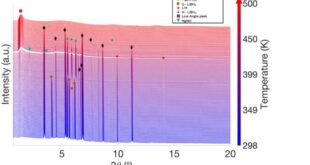
The research team examined how individual MOF-74 variants behave under pretreatment conditions relevant to CO₂ hydrogenation. They heated Ni-, Mg-, and Zn-based frameworks under inert flow and tracked their structural responses using diffraction and thermal analysis and observed that Ni-MOF-74 lost its long-range order at elevated temperature, in contrast Mg-MOF-74 retained its framework despite some loss of crystallinity. This matters because it established Ni-MOF-74 as a metal source and Mg-MOF-74 as a stable solid scaffold. The authors then tested each derived material under CO₂ and hydrogen flow. The study examined conversion as temperature increased and found that only the Ni-derived material exhibited meaningful activity, while Mg- and Zn-derived solids remained largely inert. That result wasn’t surprising, but it set a baseline. The researchers followed this by probing the chemical state of nickel before and after pretreatment. They showed that coordinated Ni²⁺ species converted into metallic clusters once the framework decomposed, linking thermal collapse directly to active site formation. The logic was explicit: no collapse, no metal, no reaction. The investigators conducted physical mixing of Ni-MOF-74 with Mg-MOF-74 at controlled ratios before thermal treatment and examined how these mixtures behaved catalytically after pretreatment. Despite Mg-MOF-74 being catalytically inactive on its own, mixtures displayed higher CO₂ conversion than the Ni-only system. The researchers observed a composition window where this effect peaked, indicating that dilution alone couldn’t explain the behavior.
The authors performed microscopy and observed that nickel particles formed on the mixed material were smaller and more uniformly distributed than those generated from Ni-MOF-74 alone and this matters because particle size connects directly to surface availability and stability. They linked dispersion to the presence of the Mg-based framework, which remained structurally intact during heating and constrained nickel aggregation spatially. Plus, the researchers conducted molecular dynamics simulations and showed that Ni-MOF-74 alone collapsed into aggregated metal clusters, while Ni species in contact with Mg-MOF-74 remained more dispersed during decomposition. The causal chain was clear: Mg-MOF-74 doesn’t supply active sites, but it limits how those sites coalesce when nickel forms. Finally, the study examined catalytic behavior over extended operation and observed stable conversion and selectivity over many hours. This durability mattered because it tied structural arguments to sustained function rather than short-term performance.
To summarize, the new work of Professor Masaru Ogura and colleagues successfully demonstrated that physical proximity can substitute for chemical integration when designing multifunctional catalytic systems. The new findings show that roles traditionally forced into a single material can be split across components, provided their thermal behaviors complement each other. The work reshapes how MOF-derived catalysts can be thought about and instead of asking whether a single framework can adsorb CO₂ and generate active metals simultaneously, the study shows that a stable framework can govern metal evolution indirectly. Mg-MOF-74 doesn’t participate electronically in the reaction, but it shapes the environment where nickel forms. That distinction matters because it broadens the design space and supports don’t need catalytic activity to influence outcomes; they need structural persistence under relevant conditions. We can think of important implications for systems that couple capture and conversion steps temporally or spatially. If adsorption and reaction occur sequentially, materials that remain intact during one phase but accommodate metal restructuring during another become valuable. The work suggests that chemical looping or cyclic operation could benefit from supports that don’t collapse each time temperature swings. That’s a conditional implication, but it’s grounded in the observed stability of the Mg-based framework. Equally important is the showcase that durability and dispersion can be tuned without complex synthesis. For catalyst design, the message is simple: physical mixing should be exploited. If future systems build on that logic, they’ll likely do so by pairing decomposition-prone precursors with frameworks that don’t give way under heat.

Reference
Yasumura, Shunsaku & Yamazaki, Mone & Ogura, Masaru. (2025). CO2 Hydrogenation over MOF-74-Based Catalysts: Role of Physical Mixing and Mg-MOF-74 as a Support. ACS Omega. 10. 10.1021/acsomega.5c04141.
Go to Journal of ACS Omega