Advances in Engineering Advances in Engineering features breaking research judged by Advances in Engineering advisory team to be of key importance in the Engineering field. Papers are selected from over 10,000 published each week from most peer reviewed journals.

Significance
Thermal energy storage based on phase change materials play a major role in polymer chemistry, heat transfer, and safety engineering. Organic systems, especially polyethylene glycol derivatives, are appealing because they combine predictable transition temperatures with chemical stability and low supercooling. However, that promise hasn’t translated cleanly into demanding engineering settings because of two limitations. The first is leakage, when PEG-based materials cross their transition window, molecular mobility increases enough that macroscopic flow becomes unavoidable unless an external scaffold intervenes. The second is fire behavior because organic backbones don’t tolerate high heat or open flame, and conventional strategies to address that vulnerability often introduce new penalties elsewhere. Extensive research has tried to restrain molten phases through physical confinement. Porous matrices, encapsulation shells, and polymer hosts can suppress flow, but they rely on weak interactions. Under repeated thermal cycling or mechanical stress, those interactions relax, and phase separation follows. A system held together only by physical entrapment carries an inherent instability, especially when the PCM fraction is high. Chemical crosslinking has therefore emerged as an alternative direction. By anchoring phase change segments into a network, researchers have aimed to preserve shape while retaining latent heat. That strategy has produced progress, but it hasn’t resolved the full set of constraints. One difficulty lies in energy density. Introducing rigid junctions into a polymer disrupts chain packing and reduces the enthalpy associated with crystallization. Another issue sits with fire resistance. Many chemically modified solid–solid PCMs were designed with morphology or mechanics in mind, leaving combustion behavior largely unaddressed. External flame retardants can be blended in, however, that approach adds complexity, cost, and in some cases undesirable byproducts during degradation. From a molecular standpoint, the field still lacks a simple way to bind thermal storage, structural integrity, and fire resistance into the same architecture.
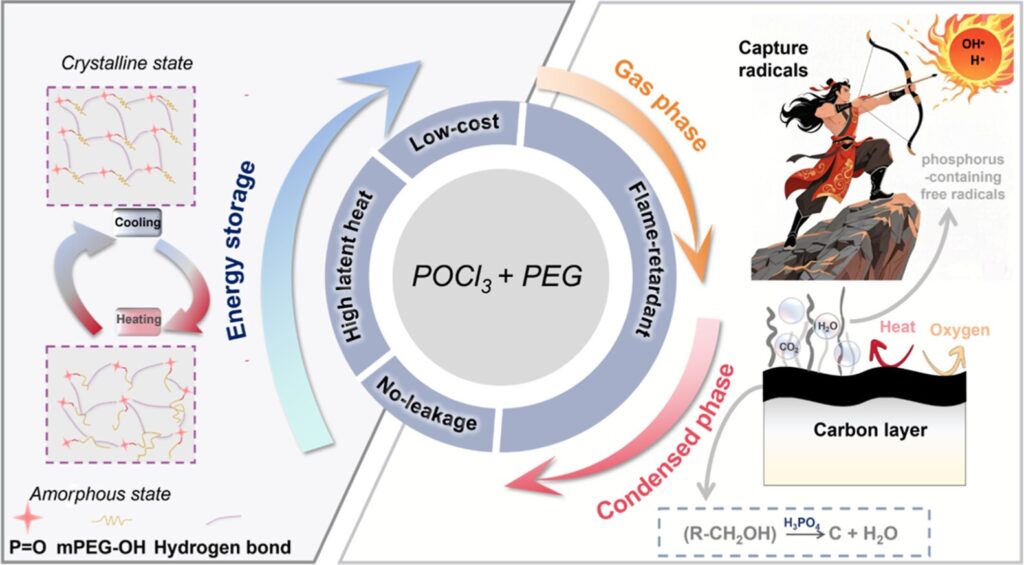
A recent research paper published in ACS Applied Engineering Materials and conducted by Guangyuan Liang, Yitong Cao, Yuanzheng Liu, Guo Li, Long Geng, Jiateng Zhao, and led by Professor Changhui Liu from the School of Low-Carbon Energy and Power Engineering at China University of Mining and Technology, the researchers developed a family of phosphorylated polyethylene glycol solid–solid phase change materials formed through direct reaction with phosphorus oxychloride. The materials rely on phosphate ester formation and hydrogen-bonded networks to maintain solid form while storing substantial latent heat. Phosphorus incorporation provides intrinsic flame suppression without external additives. Transition temperatures and enthalpy are tunable through PEG molecular weight and reaction stoichiometry. The research team reacted molten polyethylene glycol with phosphorus oxychloride under controlled stoichiometry. They adjusted PEG chain length and alcohol-to-reagent ratio to tune network density, then isolated the resulting products through solvent-mediated precipitation. Afterward, they performed spectroscopic analysis which confirmed that PEG hydroxyl groups attacked the phosphorus center, progressively replacing chlorine atoms as the alcohol ratio increased and this substitution pattern mattered because as P–Cl bonds disappeared and phosphate esters formed, terminal hydroxyl groups remained available to interact with the P=O units. The authors also examined how those interactions shaped structure and x-ray diffraction showed that increasing PEG content restored crystalline order toward that of the parent polymer, while lower ratios produced more constrained arrangements. Plus, nuclear magnetic resonance and mass spectrometry aligned with the proposed
substitution scheme, indicating that the reaction produced well-defined phosphorylated PEG species. On top of that, the team performed differential scanning calorimetry which revealed that phase change enthalpy rose with both PEG molecular weight and alcohol ratio. The researchers observed values exceeding 140 J/g in higher-molecular-weight systems, which they linked to longer chains participating more fully in crystallization. At the same time, macroscopic form remained solid above the transition window. That outcome reflects a balance: hydrogen-bonded crosslinks limited flow without fully immobilizing the chains responsible for latent heat storage. Supercooling behavior shifted as well. Longer chains and more uniform hydrogen bonding reduced kinetic barriers to crystallization, narrowing hysteresis during cycling.
Mechanical and rheological measurements reinforced that picture. Compared with neat PEG, the modified materials showed higher viscosity above transition and markedly improved tensile response at room temperature. Thermal cycling tests extended that argument over time and after hundreds of heating and cooling cycles, representative samples retained both transition temperature and enthalpy, which suggested that the hydrogen-bonded framework didn’t reorganize or relax under repeated stress. Thermal stability and leakage resistance followed naturally from the same design. Thermogravimetric analysis showed delayed decomposition relative to unmodified PEG, and infrared imaging during isothermal holds above melting temperature revealed minimal mass loss. The materials softened but didn’t flow and this distinction matters because it allows direct use without encapsulation. Plus, combustion testing explained the role of phosphorus and when exposed to flame, the modified PEGs self-extinguished rapidly, even in molten form. The researchers measured delayed ignition, reduced heat release rates, slower mass loss, and lower oxygen consumption compared with the parent polymer and found those effects align with known phosphate mechanisms, where phosphorus-containing fragments interfere with radical propagation in the gas phase and promote char formation in the condensed phase. The study also explored applied settings to test whether laboratory behavior translated to function. The team integrated selected materials into electronic chip assemblies, protective textiles, and wood structures. In each case, they observed moderated temperature rise and resistance to flame spread. While those demonstrations remain controlled, they provide a coherent link between molecular design and system-level behavior.
The new study of Professor Changhui Liu and colleagues show how molecular architecture can be used to align thermal storage, mechanical integrity, and fire behavior in a single system. We can think of many engineering implications and to mention few: leakage is the most obvious example. Outside the lab, PCMs fail all the time simply because they flow when they shouldn’t. Anyone designing heat spreaders, building panels, battery packs, or protective fabrics knows how quickly a “simple” PCM turns into a complicated assembly once you have to cage it. In this case, the material stays solid as it switches phases because the molecular structure restrains large-scale motion. That translates into fewer parts, fewer interfaces, and fewer things that can go wrong during manufacturing or use. Fire behavior and many thermal storage ideas never get past certification because organic PCMs bring flammability into systems that are already thermally stressed. The phosphorus groups suppress burning without relying on additives that can migrate, age, or compromise mechanical integrity. For engineers navigating codes and safety standards, that kind of built-in behavior simplifies the path forward. The thermal performance is also more balanced than what engineers usually have to accept. High latent heat often comes with sluggish heat transfer, while fast thermal response usually means giving up storage capacity. By organizing the polymer chains in a way that helps heat move through the material, the authors’ work eases that tension and this matters in applications like electronics cooling. There’s also real value in how adjustable the system is and changing PEG molecular weight or reaction ratios lets engineers tailer transition temperatures to suit the job at hand, whether that’s data centers, wearable protection, cold-region buildings, or hot enclosures. And finally, the synthesis method is very practical and avoids exotic chemistries and elaborate processing steps which is important from manufacturing perspective.


Reference
Liang, Guangyuan & Cao, Yitong & Liu, Yuanzheng & Li, Guo & Geng, Long & Zhao, Jiateng & Liu, Changhui. (2025). Intrinsic Flame-Retardant Phosphorylated Solid–Solid Organic Phase Change Materials for Safe Thermal Energy Storage. ACS Applied Engineering Materials. 3. 10.1021/acsaenm.5c00548.