Advances in Engineering Advances in Engineering features breaking research judged by Advances in Engineering advisory team to be of key importance in the Engineering field. Papers are selected from over 10,000 published each week from most peer reviewed journals.

Significance
The huge expansion of global digital information has exposed fundamental limitations in conventional data storage technologies. Magnetic, optical, and solid-state media are limited by finite lifetimes, the increase in energy demands, and physical scaling limits that are increasingly misaligned with long-term archival needs. In contrast, DNA has emerged as an attractive alternative storage medium, because of its extraordinary information density, chemical longevity, and compatibility with biological amplification and sequencing workflows. In principle, DNA can preserve encoded information for centuries, provided that its molecular integrity is adequately protected. However, to translate this conceptual promise into a practical storage platform has proven far more challenging than the elegance of the idea might suggest. Scientists focused most their efforts in DNA-based data storage on encoding strategies, error-correction schemes, and sequencing pipelines, while the physical form in which DNA is stored has received limited attention. Artificial DNA, unlike its biological counterpart, lacks enzymatic repair pathways and is therefore vulnerable to hydrolysis, oxidation, and structural degradation under environmental stress. Existing preservation approaches—such as freezing, desiccation, or encapsulation in inorganic matrices—offer partial solutions but tend to trade stability for complexity, cost, or limited loading capacity. A persistent gap remains between chemical robustness, handling simplicity, and high-density storage. Biology can explain the concept because in living cells, long DNA molecules are reversibly compacted into dense, protected states that permit both stability and controlled access and that regulate accessibility, preserve integrity, and enable function on demand. Translating this principle to artificial DNA storage raises an intriguing question: can reversible DNA condensation be utilized as a physical storage mechanism for digital information? To this end, new research paper published in Chemistry of Materials and conducted by Dr. Anshula Tandon, Dr. Jayeon Lee, Dr. Yeonju Nam, Dr. Seongjun Seo, and led by Professor Sung Ha Park from the Sungkyunkwan University, the researchers developed a reversible, surfactant-based strategy for compacting DNA into dense, stable assemblies and releasing it on demand using cyclodextrins. They demonstrated that both natural and information-encoding synthetic DNA can be stored in this compacted state while preserving structural and informational integrity..
The research team examined two DNA systems in parallel: fragmented salmon genomic DNA as a representative natural duplex, and short synthetic strands designed to encode digital image data. In aqueous buffer, both DNA types were exposed to cetyltrimethylammonium bromide or chloride, whose positively charged headgroups neutralize the phosphate backbone and drive a transition from extended coils to dense globular assemblies. The team observed such process yielded insoluble DNA–surfactant complexes that could be physically isolated as compact pellets, effectively separating stored DNA from the surrounding solution. The authors quantified the extent of compaction spectroscopically by monitoring the reduction of ultraviolet absorbance associated with base stacking in free DNA. As surfactant concentration increased, the absorbance dropped sharply, indicating near-complete removal of DNA from solution. Importantly, this transition occurred at well-defined association thresholds that depended on the surfactant counterion, revealing meaningful differences in compaction efficiency and complex stability. They achieved reversal of compaction through the introduction of hydroxypropyl-β-cyclodextrin, a host molecule capable of sequestering the hydrophobic tails of the surfactants. Upon addition, the cyclodextrin disrupted surfactant assemblies, liberated DNA, and restored solubility without altering DNA concentration or temperature. The recovery of DNA was again verified spectroscopically, with absorbance profiles returning close to those of untreated controls. Moreover, they also subjected compacted DNA samples to accelerated aging under elevated temperature and humidity to test whether compaction offered genuine protection and found that even after prolonged exposure, a substantial fraction of the stored DNA could be recovered upon decompaction, which demonstrate that the compacted state conferred meaningful resistance to degradation. This protective effect was consistently stronger for bromide-based surfactant complexes, reflecting their greater structural cohesion. Furthermore, they tested synthetic DNA encoding a binary image and found after compaction, storage, decompaction, amplification, and sequencing, the recovered strands retained high sequence identity, with only minor errors attributable to standard sequencing limitations rather than storage failure. Notably, the encoded information remained readable even after thermal aging, underscoring the compatibility of this physical storage strategy with established DNA reading workflows.
In conclusion, the new work of Professor Sung Ha Park and colleagues provided a chemically simple, scalable physical storage medium compatible with standard DNA amplification and sequencing. Indeed, Sungkyunkwan University scientists establishes a materials-driven pathway toward practical archival storage by demonstrating that reversible compaction can stabilize DNA under harsh conditions while remaining fully compatible with sequencing-based retrieval. The implications extend beyond data storage alone and the ability to toggle DNA between dense, protected states and accessible, solution-phase forms mirrors biological strategies for genome management, which indicate broader relevance for nucleic-acid handling and preservation. From a technological standpoint, the high DNA loading capacity achievable through compaction directly addresses one of the central bottlenecks limiting current storage platforms. At the same time, the demonstrated tolerance to heat and humidity speaks to real-world deployment scenarios where refrigeration or inert atmospheres may be impractical.
It is noteworthy to mention the new approach demonstrated preservation of informational fidelity. The successful recovery and sequencing of image-encoded DNA after storage provides a concrete proof that chemical compaction does not inherently compromise data integrity. This novel finding challenges the assumption that robust protection must come at the expense of accessibility or accuracy. Future work should explore scaling, automation, and integration with synthesis and sequencing pipelines and while optimization remains necessary, especially for large and diverse DNA libraries, the novel framework developed by the authors provide an excellent chemically grounded alternative to existing storage paradigms. In a nutshell, the study opens a new direction for the design of long-term, high-density storage systems by treating DNA as a responsive material whose conformation can be engineered.
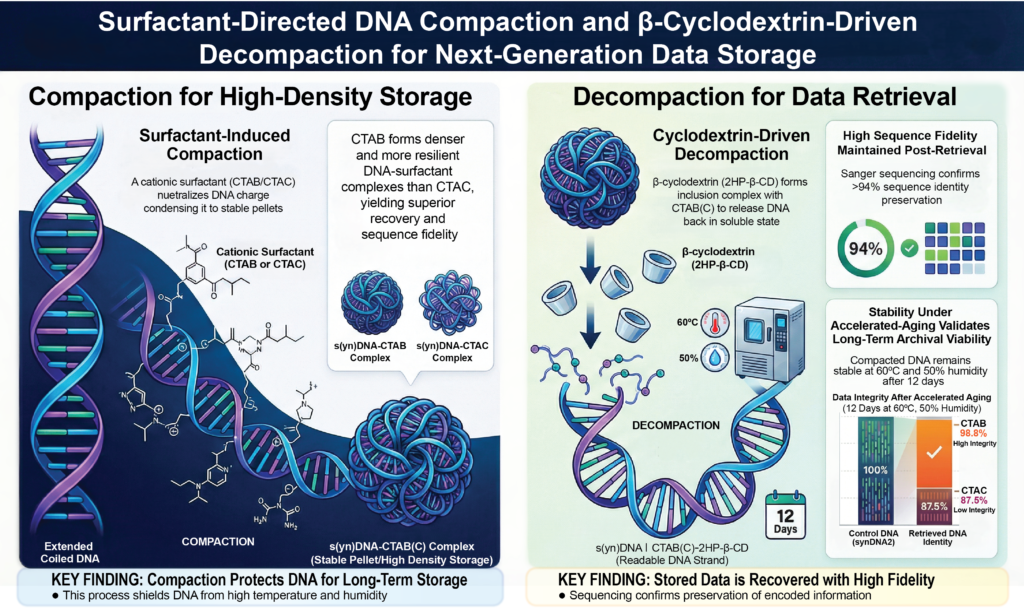
This figure illustrates a reversible DNA compaction-decompaction cycle for next-generation data storage. The left panel depicts the compaction phase, where cationic surfactants (CTAB or CTAC) neutralize DNA’s negative charges, condensing extended DNA molecules into stable, high-density pellets. The chemical structure reveals the surfactant’s cationic head and hydrophobic tail, which self-assemble around DNA to reduce electrostatic repulsion. A key comparison highlights that CTAB forms denser and more resilient DNA-surfactant complexes than CTAC, yielding superior recovery and sequence fidelity—a critical advantage stemming from bromide’s larger ionic radius and stronger micelle-DNA interactions. This compaction process protects DNA from high temperature and humidity, enabling long-term storage.
The right panel demonstrates the decompaction process, where β-cyclodextrin (2HP-β-CD) releases DNA by forming inclusion complexes with the surfactant, restoring the DNA to soluble form. Three major outcomes validate the approach: Sanger sequencing confirms >94% sequence identity preservation, accelerated-aging tests at 60°C and 50% humidity for 12 days demonstrate remarkable stability, and comparative analysis shows CTAB-treated DNA maintains ~100% integrity versus CTAC’s lower performance (~87.5%). Together, these findings confirm that compacted DNA can be reliably recovered with high fidelity, preserving all encoded information—establishing surfactant-mediated compaction as a practical, reversible, and thermally resilient platform for DNA-based data storage and retrieval.
Reference
Tandon, Anshula & Lee, Jayeon & Nam, Yeonju & Seo, Seongjun & Park, Sung. (2025). Surfactant-Directed DNA Compaction and β-Cyclodextrin-Driven Decompaction for Next-Generation Data Storage. Chemistry of Materials. 37. 10.1021/acs.chemmater.5c00330.