Advances in Engineering Advances in Engineering features breaking research judged by Advances in Engineering advisory team to be of key importance in the Engineering field. Papers are selected from over 10,000 published each week from most peer reviewed journals.

Significance
The optical properties of metal halide perovskite quantum dots (QDs) matches and sometimes even surpasses what more established semiconductor nanocrystals can do. That strength has never been the main obstacle. What the field keeps running into is that high brightness and stability rarely survives real manufacturing conditions. Moisture, heat, moving ions, and slow chemical changes under stress might be handled one at a time, but taken together they make it difficult to produce something that lasts. Embedding perovskite QDs in polymer matrices has seemed like a reasonable way forward. Polymers physically separate QDs particles, limit ion motion, and shield them from air and water. They also make shaping possible—films, fibers, molded parts—using tools already common in manufacturing. Still, this strategy has not settled as cleanly as it first appears. Many composite approaches start with solution-synthesized perovskite QDs that are later mixed into polymers. Solvent traces linger. Aggregation creeps in during blending. Formation chemistry and final shaping remain disconnected steps. Solvent-based in situ methods try to merge these stages, but polarity mismatch between perovskite precursors and polymer hosts complicates nucleation. What forms is often uneven, both structurally and optically. These unresolved tensions explain why polymer–perovskite composites continue to look promising on paper while remaining awkward to scale in practice. A deeper issue sits beneath these technical obstacles. Conventional perovskite synthesis assumes a liquid reaction environment in which diffusion, solvation, and ligand exchange govern nucleation and growth. Polymer melts do not behave this way. Their viscosity, segmental motion, and mechanical shear redefine reaction kinetics and transport entirely. Treating the polymer as a passive container overlooks the fact that it actively shapes precursor mobility, reaction pathways, and defect formation. Without addressing this mismatch directly, scaling remains more rhetorical than real.
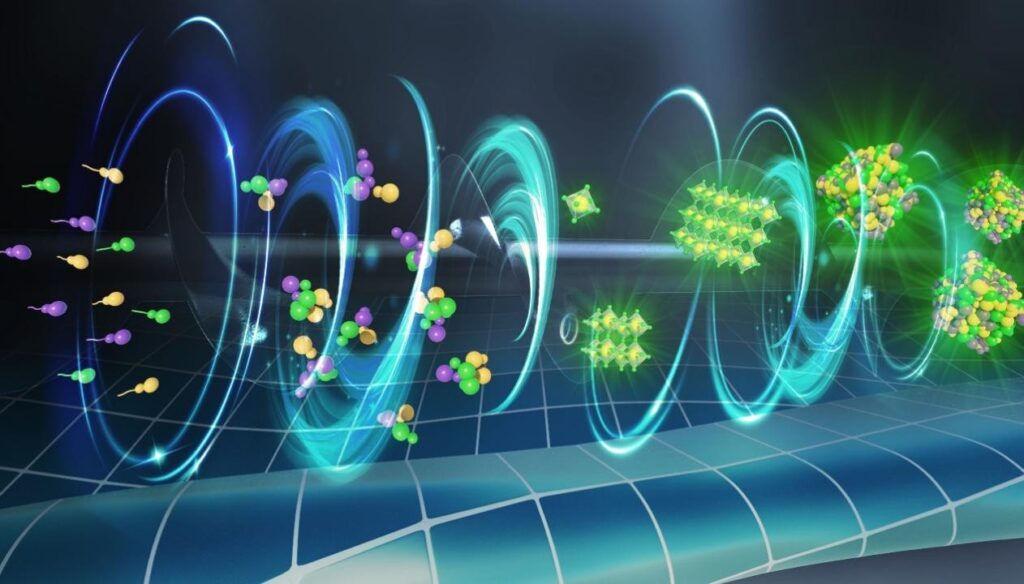
A recent research paper published in Advanced Materials and conducted by Dr. Wenxuan Fan, Dr. Shalong Wang, Dr. Zhi Yang, Dr. Jisong Yao, Dr. Leimeng Xu, and led by Professor Jizhong Song from the Zhengzhou University, the researchers developed a solvent-free, extrusion-based strategy that forms perovskite QDs directly inside molten polymers. The approach couples precursor molecular design with mechanical shear to drive ionic recombination during continuous processing. Unlike prior composite methods, synthesis, dispersion, and shaping occur in a single manufacturing step. Under the synergistic effect of high-temperature environment and mechanical shear force, the precursor salts gradually dissociate into cesium ions, lead ions, and halogen ions. Immediately afterwards, these ions recombine through ionic bonds to in-situ generate plastic perovskite QDs with excellent properties. This method not only achieves the uniform dispersion of QDs in the polymer matrix but also demonstrates many remarkable advantages. For example, it does not require the use of organic solvents, has a simple operation process (only raw materials need to be loaded), and is suitable for continuous production. It provides a practical technical path for the transition of perovskite QDs from laboratory research to industrial application. The investigators selected cesium and lead stearates specifically because their hydrocarbon chains remain compatible with organic polymer environments, avoiding the phase separation that plagues ionic salts. To supply halide ions, the authors performed a comparative evaluation of organic bromine sources and identified triphenylphosphonium bromide as uniquely effective under melt conditions.
The study examined this choice using both theoretical and experimental reasoning. Density functional theory (DFT) calculations enabled the researchers to compare dissociation energetics across bromine salts, revealing that steric accessibility around the phosphorus center controls bromide release. Hydrogen-substituted phosphonium salts dissociate more readily, a detail that becomes decisive in viscous polymer melts where diffusion remains limited. The researchers observed that alternative bromine sources, although chemically similar on paper, fail to trigger perovskite formation under shear, reflecting how small molecular design decisions propagate into macroscopic processing outcomes. The authors performed continuous in situ reactions above the polymer melting temperature using single- and twin-screw extrusion and found that mechanical shear fractured precursor aggregates, promoted ionic contact, and enabled recombination into perovskite lattices without solvent mediation. They also conducted chemical and structural analyses that confirmed genuine lattice formation. Moreover, transmission electron microscopy revealed nanocrystals embedded within amorphous polymer domains, and spectroscopic shifts in core-level binding energies verified ionic rebonding rather than physical mixing.
Optical characterization tied these structural features directly to performance. The researchers observed narrow emission bandwidths and high radiative efficiency, consistent with limited aggregation and reduced nonradiative loss channels. Ultrafast spectroscopy allowed the team to compare carrier dynamics against solution-synthesized analogues, exposing slower spectral evolution that aligns with suppressed defect-assisted relaxation. At the same time, polymer confinement imposed limits on crystal growth, trading size tunability for spatial uniformity.
Plastic perovskite QDs fabricated via various advanced techniques, injection molding, casting molding, blow molding, and melt spinning, can be directly transformed into a wide array of light-emitting forms. These forms encompass millimeter-scale light-emitting plates, 0.1-millimeter-scale light-emitting films, 10-micrometer-scale ultra-thin light-emitting films, and micrometer-scale light-emitting filaments. This material boasts remarkable advantages, including rich colors, diverse forms, and a comprehensive range of varieties, and can accurately fulfill the diversified requirements of the market. The authors demonstrated that QDs can be retained in different polymer processing techniques, each of which brings about distinct thermal and mechanical histories.. Application-level tests, ranging from X-ray scintillation to wearable signaling fabrics, emerged not as isolated demonstrations but as extensions of the same material logic. The researchers observed that stability under light, heat, and water exposure traced back to dispersion and encapsulation achieved during synthesis.
To summarize, the work from Professor Jizhong Song’s group addresses a practical problem that many of us run into when thinking about perovskites beyond the lab. Instead of handling QDs as delicate components added after the fact, the study shows that they can form and persist inside polymer processing environments that engineers already use. Optical behavior ends up linked to choices that feel familiar such as precursor chemistry, melt conditions, shear. Stability, which is often chased through coatings or external barriers, comes from the location and manner of nucleation itself. That shift changes how one thinks about reliability during shaping, scaling, and repeated processing. Polymer matrices restrict aggregation and buffer environmental exposure, but they also influence electronic relaxation pathways. This dual role complicates simple optimization. Increasing polymer rigidity may suppress ion migration yet hinder precursor mixing. Raising processing temperature accelerates reaction kinetics but risks halide volatility. The value of the present framework is in making such trade-offs explicit and adjustable within a continuous process. From an applications standpoint, the demonstrated compatibility with extrusion-based manufacturing lowers barriers for integration into lighting, imaging, display backlights, and functional textiles. These are not speculative targets; they align with existing polymer processing infrastructure. Still, translation remains bounded. Long-term mechanical fatigue, compositional drift under repeated heating, and lead management under regulatory pressure all remain open questions. Indeed, the work narrows the gap between laboratory proof and system-level testing by embedding synthesis within realistic processing conditions.
In Situ Formation of Luminescent Perovskite Quantum Dot/Polymer Composites: Scalable Synthesis, Continuous Processing and Functional Applications

Reference
Fan, Wenxuan & Wang, Shalong & Yang, Zhi & Yao, Jisong & Xu, Leimeng & Song, Jizhong. (2025). In Situ Formation of Luminescent Perovskite Quantum Dot/Polymer Composites: Scalable Synthesis, Continuous Processing and Functional Applications. Advanced Materials. 2025. 37. 2505600. DOI: 10.1002/adma.202505600.