Advances in Engineering Advances in Engineering features breaking research judged by Advances in Engineering advisory team to be of key importance in the Engineering field. Papers are selected from over 10,000 published each week from most peer reviewed journals.

Significance
Current through a room-temperature gas sensor becomes difficult to regulate when adsorption, charge transfer, and carrier transport all change with surface polarization and layer position rather than with molecular identity alone. in a recent research paper published in Langmuir, Peng Tang, Keyan Han and Professor Tong Chen from the Jiangxi University of Science and Technology together with Dr. Zejiang Peng from the Jiangxi University of Finance and Economics and Professor Xianbo Xiao from Jiangxi University of Chinese Medicine, developed a first-principles sensing framework for bilayer ferroelectric In2Se3 that combines structural stability analysis, adsorption calculations, and NEGF-based transport modeling within an FET device architecture. They identified the stable A2 bilayer stacking, mapped layer-specific adsorption of NO, NO2, and NH3, and showed that the bottom and interlayer regions produce distinct electronic responses, including NH3 chemisorption with In−N bond formation. They also built a gate-tunable transport model showing high zero-bias sensitivity to NO2 and NH3, stronger NO response at 2 V gate bias, and pronounced NO2 selectivity at 3 V. The new study frames NO and NO2 as pollutants tied to industrial leakage and atmospheric chemistry, and NH3 as relevant to agricultural emissions and diagnostic use. That practical demand places unusual weight on room-temperature sensitivity and selectivity, because the sensor must distinguish chemically related species without relying on thermal activation as the main control knob.
Ferroelectric bilayers become interesting because out-of-plane polarization directly modifies the surface electronic environment and a polarized bilayer can redistribute charge internally, alter adsorption energetics from one layer region to another, and couple molecular dipoles to a pre-existing electric field inside the substrate. Prior work on In2Se3 gas sensing had concentrated mainly on monolayers, even though a bilayer should not be expected to behave as a simple doubled monolayer. Adding a second ferroelectric sheet changes stacking, screening, interface charge, and spontaneous polarization coupling. A multilayer ferroelectric system can, in principle, produce adsorption asymmetry and transport asymmetry at the same time. That possibility had not been examined in sufficient detail for bilayer In2Se3, and the paper sets out to resolve exactly that gap.
The study asked how stacking stability, interfacial charge redistribution, adsorption site preference, and gate-controlled transport fit into one coherent sensing picture for NO, NO2, and NH3. The researchers examined six stacking arrangements with different polarization orientations and lateral registries, and binding-energy analysis identified A2 as the most stable configuration. In A2-stacked bilayer In2Se3, the interlayer coupling remains weak in the van der Waals sense, yet the interface does not become electronically inert. The calculated charge-density redistribution shows electron accumulation in the top layer and depletion in the bottom layer, which the paper attributes to screening at the homopolar interface and to a head-to-tail dipole arrangement that drives electrons upward.
The team examined top, interlayer, and bottom adsorption regions for NO, NO2, and NH3 and selected the most stable configurations from the optimized set. NH3 behaved in the most distinctive manner. On the interlayer and bottom sites it formed In−N covalent bonds, induced lattice distortion, and showed chemisorption with relatively strong adsorption energies. NO and NO2 remained physisorbed in the reported stable configurations, yet their adsorption was still strongly site dependent. The bottom layer generally produced stronger adsorption than the top layer because molecular dipoles coupled more effectively to the ferroelectric polarization there. Recovery-time analysis then linked adsorption strength to operational reuse. NO and NO2 at the bottom layer had very rapid recovery at room temperature, and even the chemically bound NH3 state at the bottom layer gave a recovery time of 27.9 s. The paper also reports a sharp drop in NH3 recovery time under moderate heating, reaching milliseconds at 400 K and tens of microseconds at 500 K. The electronic-structure analysis explains why these gases do not perturb the device in the same fashion. NO introduced impurity states and drove the gap to zero, producing a metallization tendency. NO2 also reduced the gap to zero through hybridization and impurity-state formation across different sites. NH3 behaved differently: on the top layer the system remained semiconducting with a 0.83 eV gap, whereas interlayer and bottom adsorption pushed the band edges across the Fermi level and again produced gap closure. The absence of a strong NH3 molecular peak near the Fermi level in the selected window led the authors to interpret the effect as indirect charge-transfer modulation rather than simple band insertion by the molecule itself. Bottom-layer adsorption also produced the largest work-function shifts.
Transport calculations integrated these findings into a device configuration. The authors found that, in the FET geometry, NO2 and NH₃ induced substantial current enhancements at zero gate voltage, yielding sensitivities of 163% for NO2 and 108% for NH3. NO exhibited a much weaker response at zero gate bias, yet became significantly more responsive under gate modulation: at a gate voltage of 2 V and a bias voltage of 1 V, its sensitivity reached 101%, representing a 2.6-fold increase relative to the zero-gate value reported in the paper. Increasing the gate voltage to 3 V reorganized the sensing selectivity such that NO2 dominated, with a sensitivity of 86% compared to 26% for NO and 6% for NH3. NO2 and NH3 generated more delocalized conduction pathways at zero gate bias, whereas NO did not. At 2 V gate voltage, NO began to strongly reshape the transmission window; at 3 V gate voltage, NO2 emerged as the gas species that most heavily populated the bias window with transport-active states.
The bilayer does not act as a passive support for molecular binding and its internal polarization already sorts charge across the two sheets, so adsorption modifies transport within a preorganized asymmetric electronic environment. Gate bias then adds a second level of control by selecting which adsorption-induced states become most relevant to conduction. That shift in design logic matters beyond this single material. Many gas-sensing discussions separate sensitivity from selectivity, as though one is supplied by the adsorbent and the other must be engineered later through arrays, functionalization, or operating temperature. The study instead treats selectivity as something that can be tuned electrically within a single material platform. The same ferroelectric bilayer can express one response profile at zero gate bias, where NO2 and NH3 dominate, and a different profile at positive gate bias, where NO becomes much more visible or NO2 becomes markedly preferred.
NH3 does not just adsorb more strongly than the other gases at selected positions; it changes character, moving into chemisorption at the interlayer and bottom regions and reshaping the local lattice through In−N bond formation. NO and NO2, by comparison, keep the interaction in the physisorption range in the reported stable states, yet still alter transport strongly through hybridization and impurity-state formation. The comparison makes clear that different adsorption pathways can still lead to a strong sensing response. On a polarized bilayer, different gases can reach a comparable transport consequence through different microscopic routes. One uses bond formation and indirect charge redistribution, another uses gap closure and transport-state insertion. The sensor remains effective because the readout is tied to the electronic aftermath of adsorption rather than to adsorption taxonomy alone.
The new work also clarifies what multilayer ferroelectric architectures can add to gas sensing. That is a meaningful step because the bilayer introduces an internal interface, and that interface produces screening-driven charge separation before gate modulation is even applied. For device design, this means that thickness in a ferroelectric 2D material is not just a geometric parameter; it can become an active variable in how adsorption sites differ, how work functions shift, and how transport pathways open under bias. One important implication from the work of Professor Tong Chen and colleagues is that bilayer ferroelectric semiconductors can, in principle, operate as room-temperature gas sensors whose response can be reshaped electrically, and bilayer In2Se3 offers a concrete theoretical example of how that can be achieved for NO, NO2, and NH3. The study is especially useful because it connects stable stacking, charge redistribution, adsorption energetics, recovery behavior, and transport selectivity in one line of analysis. That kind of continuity is what makes the study useful for future sensor design grounded in ferroelectric multilayers rather than in surface chemistry alone.
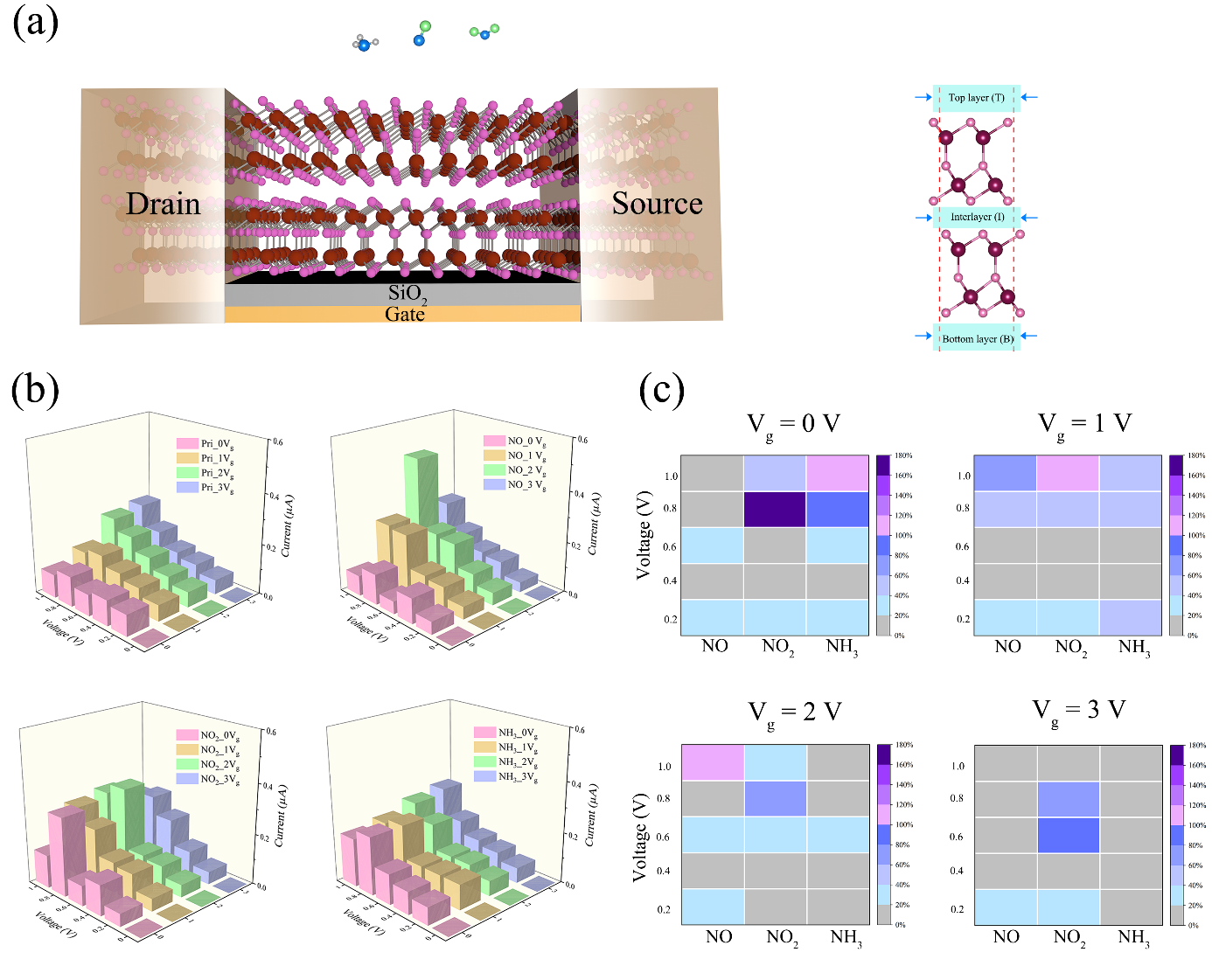
Figure: (a) Schematic diagram of a FET-type gas sensor based on bilayer In2Se3. (b) I−V curves of gas sensors based on bilayer In2Se3 detecting NO, NO2, and NH3 molecules under different gate voltages. (c) Variation patterns of sensitivity for NO, NO2, and NH3 adsorption systems under different gate voltages (Vg) as a function of bias voltage (Vb).


Reference
Tang P, Peng Z, Han K, Xiao X, Chen T. Gate-Tunable Bilayer In2Se3-Based Room-Temperature Gas Sensor with Ultrahigh Sensitivity and Selectivity for NO, NO2, and NH3. Langmuir. 2025;41(45):30468-30478. doi: 10.1021/acs.langmuir.5c04115.