 Advances in Engineering Advances in Engineering features breaking research judged by Advances in Engineering advisory team to be of key importance in the Engineering field. Papers are selected from over 10,000 published each week from most peer reviewed journals.

Significance
Under fast drying, binders in a negative electrode can drift toward the evaporating surface, leaving the interior and the current-collector interface with a very different local composition from the one intended in the slurry. That redistribution matters because polymer binder, even at very low volume fraction, governs much more than simple particle adhesion. In graphitic Li-ion negative electrodes it shapes cohesion of the coating, contact across the conductive carbon network, ionic access through the pore space, and the interfacial conditions under which graphite later undergoes Li intercalation and solid-electrolyte interphase formation. The scientific difficulty has been that these effects are driven by a phase that is sparse, chemically soft, morphologically diffuse, and hard to separate visually from the surrounding carbon-rich matrix. Binder chemistry has been studied extensively; binder geography inside the electrode has been much harder to pin down.
That problem becomes sharper for the aqueous binder system built from carboxymethyl cellulose and styrene butadiene rubber. This CMC/SBR combination became standard in industrial graphite and graphite/silicon negative electrodes because water processing lowers manufacturing burden and avoids N-methyl pyrrolidone, yet the same binder pair lacks the sort of covalently bound marker elements that make PVDF easier to track by routine electron microscopy and X-ray methods. Conventional SEM struggles because these binders do not present a clean, self-evident morphology. A few routes had been used before, including spectroscopic or mass-spectrometric methods, and osmium staining had shown that SBR migration could be followed, but that route relies on a reagent whose toxicity keeps it out of ordinary laboratory use. The broader field was left in an awkward position: binder placement was clearly important, yet mapping it under realistic electrode compositions and processing conditions remained too cumbersome or too specialised for routine optimization. In a recent research paper published in Nature Communications, Dr. Stanislaw Zankowski, Dr. Samuel Wheeler, Dr. Thomas Barthelay, Dr. Wai Man Chan, Dr. Michael Metzler, and led by Professor Patrick Grant from University of Oxford, developed two accessible chemical staining methods that mark CMC with silver and SBR with bromine so those binders can be mapped in Li-ion negative electrodes by EDX, BEI, and EsB. They paired that chemistry with profiling and imaging strategies that recover through-thickness binder gradients, distinguish SBR by beam-induced bromine outgassing, and visualize nanoscale CMC surface films across graphitic electrodes. The method was then used to guide manufacturing changes in slurry mixing and phase inversion, linking binder distribution directly to electrical, ionic, and mechanical electrode properties.
The researchers built their staining strategy around the functional groups already present in the binders. Silver ions were used to bind the carboxyl groups of CMC, forming an insoluble Ag-CMC complex, and bromine vapour was used to brominate the aliphatic unsaturation in SBR. They did not treat that chemistry as an assumption. ATR-IR, XPS, and EDX were brought in to verify the underlying reactions, and the selectivity check was pushed through pure binder films, graphite, conductive carbon, and mixed electrodes spanning the full CMC:SBR ratio range. That choice matters because a mapping method is only as useful as its chemical specificity. Here, silver tracked CMC strongly, bromine tracked SBR strongly, and the residual side reactions could be interpreted rather than ignored: Ag interacted to some degree with leftover SBR polymerisation reagents, and bromine also generated superficial NaBr on CMC. In practical terms, those side paths did not erase selectivity; they made the chemistry legible enough to use quantitatively. They then moved to a deliberately engineered bi-layer graphite electrode with a fourfold difference in binder fraction across thickness. That model system let them ask a very direct question: could the staining read out a known distribution with believable fidelity? Both Ag- and Br-based measurements recovered the rich and lean layers, and the brominated system gained an extra analytical feature because Br attached to SBR outgassed progressively under the electron beam. The team turned that behaviour into a second form of confirmation, using the differential Br loss to verify the spatial profile obtained from absolute Br maps. EDX gave the more quantitative readout, BEI gave much faster profiling, and the contrast between those modes reflects sensible measurement logic rather than inconsistency: one route privileges accuracy, the other speed.
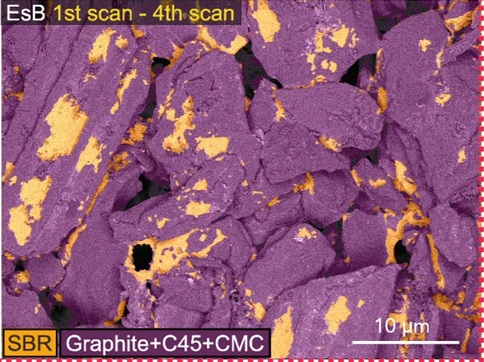
The most interesting part arrives when staining is combined with EsB imaging. By stepping the beam energy downward, they were able to separate three binder-associated morphologies inside graphitic electrodes: micron-scale CMC/C45 agglomerates linked to longer-range electronic connectivity, SBR-rich nanoparticle clusters mixed with CMC and C45 that impart mechanical cohesion, and a very thin CMC film coating graphitic surfaces. Monte Carlo simulations, paired with the voltage-dependent imaging contrast, placed that conformal CMC layer in the 10–15 nm range. That is a striking result because nanoscale binder films on active particles had largely been inferred before this. Here they become visible across electrode-scale regions rather than only at isolated microscopic locations. The form of the CMC layer also explains why ordinary secondary-electron imaging had failed to distinguish it: a film this thin simply follows the graphite topography too closely to announce itself morphologically.
Top-surface imaging and post-calendering imaging then changed the story from static visualization to process physics. In uncalendered electrodes, CMC nearly fully coated graphite, with SBR appearing as island-like nanoparticulate patches covering roughly 8–9% of the apparent graphite surface and mixed SBR/CMC agglomerates adding more local coverage. After hot calendering, the continuous CMC film fractured and partly delaminated, leaving only about 32% coverage within the electrode and about 21% on the roller-exposed top surface. Commercial graphitic electrodes showed the same fractured morphology with more than 60% of graphitic surface left bare. The mechanical brittleness of dried CMC makes that outcome intelligible: compression improves packing, but it also breaks a film that had previously spread across the particle surface. The authors then used the staining method as a manufacturing tool rather than only a characterization tool. Raising the initial CMC concentration during the first slurry-mixing step sharply reduced large carbon-binder-domain agglomerates and lowered electronic resistivity by about 14% in both uncalendered and calendered coatings. In a second application, they tested phase inversion before high-temperature drying. Isopropanol drove binder toward the electrode top by forming a dense skin layer, whereas acetone shifted binder toward the current collector, improved bend tolerance, and lowered pore ionic resistance by about 40% without changing the already low electronic contact resistance. Acetone’s lower viscosity and apparently faster precipitation of CMC gave the process a different transport pathway during drying, and that difference translated directly into a different electrode architecture. To summarize, Professor Patrick Grant and colleagues developed a new staining protocol and new water-processable binders in negative electrodes. Once CMC and SBR become traceable with ordinary electron-microscopy infrastructure, binder distribution is no longer a hidden variable that must be inferred from electrochemistry or bulk mechanics. It becomes a design parameter with measurable thickness profiles, surface coverage statistics, and visible local morphologies. That shift is methodologically important because electrode optimization often concentrates on composition, porosity, particle size, or calendering pressure, even when the real determinant may be where the binder ended up after those operations.
The authors’ observations on graphitic surface coverage are especially consequential. A near-continuous CMC film in the pristine state, followed by extensive shattering after calendering, changes the way one thinks about the active surface presented to the electrolyte. The electrode is not simply a packed ensemble of graphite particles plus a small amount of binder. It is a surface mosaic in which conductive regions, ionically resistive CMC patches, and thicker SBR agglomerates are distributed heterogeneously and then rearranged again by compression. That picture gives a more concrete basis for interpreting rate behaviour, local current density, and interphase formation on graphite. It also gives a plausible structural route linking excess SBR or broken CMC coverage to the cycling phenomena discussed by the authors, including changes in internal resistance, SEI uniformity, and local conditions favourable for Li plating.
There is also a clear manufacturing implication. Two interventions that might look modest on paper—changing the initial CMC concentration during slurry preparation, and inserting an acetone phase-inversion step before drying—produced measurable changes in electronic resistivity, ionic resistance, and mechanical integrity once binder placement was actually examined. That matters because it argues for a different optimization logic. Instead of tuning processing conditions only until a final electrochemical metric improves, one can tune them toward a desired binder architecture: fewer oversized CBD agglomerates, less top-surface pore blocking, more binder near the current collector when adhesion is needed, or more uniform CMC coverage when interfacial stabilization is the aim. A method that reveals structure at those scales can serve both discovery and process control. Plus, the demonstrated compatibility with micro-Si and SiOx electrodes broadens that relevance. Silicon-containing negative electrodes place unusual demands on binders because surface chemistry and mechanical change are both severe, and the paper’s discussion makes clear why maximizing CMC coverage may be especially valuable there. At the same time, the study keeps its claims grounded in what was actually shown: the staining chemistry is tied to carboxylate and aliphatic C=C functionality, making it naturally suited to CMC, SBR, alginates, and polyacrylates. For industrial use, BEI-based screening appears particularly practical because it can provide a rapid check on binder-related features such as CBD clustering without the full burden of long cross-sectional analysis. That combination of chemical selectivity, spatial range, and operational simplicity is what gives the method its staying power.


Reference
Stanislaw P. Zankowski, Samuel Wheeler, Thomas Barthelay, Wai Man Chan, Michael Metzler, Patrick S. Grant. Chemical staining for fundamental studies and optimization of binders in Li-ion battery negative electrodes. Nature Communications, 2026; 17 (1) DOI: 10.1038/s41467-026-69002-1
Go to Nature Communications