Advances in Engineering Advances in Engineering features breaking research judged by Advances in Engineering advisory team to be of key importance in the Engineering field. Papers are selected from over 10,000 published each week from most peer reviewed journals.

Significance
Friction ceases to follow load in any simple way once sliding starts to reorganize the internal state of the interface itself. That is the scientific tension driving this study. Classical tribology is built around Amontons’ law, where increasing normal load is expected to increase friction monotonically. Yet that empirical relation says little about cases in which the interface carries its own evolving order parameter, and magnetic systems are a particularly sharp example because dissipation can arise from configurational rearrangement rather than from abrasion or plastic contact. The unresolved issue has not been whether magnetic order can matter for friction in principle. Theory and numerical work had already tied magnetic ordering to frictional response, and scanning-probe experiments had revealed exchange forces and even single-spin dynamics. The harder problem was experimental access to collective spin rearrangements in two laterally aligned magnetic lattices moving past one another under controlled, commensurate conditions. Tip-based geometries are highly localized by construction, so they do not naturally expose the spatially correlated reordering that extended interfaces can sustain. In a recent research paper published in Nature Materials, Dr. Hongri Gu, Dr. Anton Lüders & Professor Clemens Bechinger from the University of Konstanz in Germany, developed a spatially resolved magnetic sliding platform made from a commensurate rotor array moving above a fixed magnetic substrate, allowing simultaneous measurement of lateral force and collective rotor orientation. They coupled that platform to molecular-dynamics simulations that retain all 7 × 7 rotational degrees of freedom. They also derived a reduced overdamped two-sublattice model with collective angles φ and ϑ that reproduces the friction peak, the order crossover, and the hysteretic dissipation mechanism. What is technically new here is the direct experimental linkage of collective ferromagnetic–antiferromagnetic switching, hysteretic torque cycles, and non-monotonic contactless friction in an extended sliding magnetic lattice.
The measurements immediately showed that the mean lateral sliding force does not decline smoothly with decreasing magnetic load. As h increased, the effective magnetic attraction between the layers fell monotonically, yet the averaged friction developed a clear maximum around h ≈ 9.0 mm. To connect that anomaly to the state of the slider, the authors introduced a displacement-dependent order parameter, Σ(Δx), based on the relative orientation of neighbouring moments along y. In that representation, Σ = +1 corresponds to ferromagnetic alignment and Σ = −1 to antiferromagnetic alignment. Averaged over integer lattice spacings, ⟨Σ⟩ evolved gradually from ferromagnetic to antiferromagnetic character as h increased, and the point where ⟨Σ⟩ passed through zero coincided with the friction maximum. That coincidence matters because it ties dissipation to a regime where ordered states compete rather than to the magnitude of magnetic attraction alone. The dynamical picture across the three regimes is clean. At small h, the substrate field dominates, every rotor feels nearly the same driving field under commensurate sliding, and the array rotates collectively in a ferromagnetic mode. At large h, intralayer coupling takes over and the slider adopts antiferromagnetic order along y, with only slight collective wiggling during translation. The intermediate regime is different in character. There, interlayer and intralayer interactions become comparable, and the rotors switch discontinuously between ferromagnetic and antiferromagnetic arrangements during sliding. This is exactly the sort of configurational instability that a localized probe would struggle to capture. Here it can be seen directly in the tracked rotor angles and in the oscillatory evolution of the order parameter. Molecular-dynamics simulations that model the magnets as point dipoles reproduced the same regime structure and the same displacement-dependent ordering behaviour, which is important because it shows that the observed frictional anomaly follows from the magnetic interactions encoded in the system rather than from an idiosyncratic detail of the apparatus.
The force traces sharpen that interpretation. The measured lateral force contains a mechanical part from the brass rollers and a magnetic part associated with energy dissipated as the moments rotate against shaft friction under the substrate field. After separating those contributions, the authors found that the mean magnetic friction is nearly absent in the ferromagnetic and antiferromagnetic regimes. In those limits, the force oscillates roughly symmetrically around the mechanical baseline over each lattice period, so the positive and negative magnetic contributions largely cancel in the average. The competing regime breaks that symmetry. There, the lateral force no longer oscillates around the mechanical contribution in a balanced way, and a substantial mean magnetic friction emerges. That asymmetry is the central observation, because it shows that dissipation is tied to the path taken through configuration space during sliding, not merely to the existence of a magnetic coupling. Starting from the slider Hamiltonian, the authors showed that the averaged dissipation rate in steady sliding is governed by the product of substrate-induced torques and rotor angular velocities. They then reduced the full array to a two-sublattice overdamped model with two collective angles, φ and ϑ, representing the ferromagnetic or antiferromagnetic sectors of the slider. That reduction is scientifically useful because the experiments had already shown that the slider spends most of its time near those two ordered states, so the simplified description keeps the part of the dynamics that actually carries the dissipation. In the substrate-dominated regime, the summed torque varies smoothly and symmetrically over a lattice period, giving almost zero average magnetic friction. At intermediate spacing, the torque cycle becomes asymmetric, generating strong magnetic friction. At large h, both torque and angular velocity become small, so the magnetic contribution again fades. When the authors plotted torque against the angle of the slider magnetization, hysteresis loops appeared, and the loop area tracked the dissipated energy. The non-monotonic friction peak is, in that sense, a hysteretic many-body effect produced by collective switching between ferromagnetic and antiferromagnetic order during sliding.
Professor Clemens Bechinger and colleagues demonstrated that the measured force becomes a readout of collective order reconstruction under drive. The interfacial state is not a passive background; it is the dissipative object. Once that point is established experimentally, friction can no longer be treated as a scalar output determined solely by how hard two bodies are pressed together. It becomes a dynamical observable tied to internal symmetry, competing interactions, and the route by which the interface moves through metastable configurations. That conceptual shift is already implicit in earlier theoretical discussions of friction near ordering transitions, but this study gives it direct experimental form in a spatially resolved sliding lattice.
Another important feature is the scale-free character of the framework developed here. The authors make the point that the governing equations are dimensionless in the relevant sense, which is why a millimetre-scale rotor array can still capture the same class of physics expected in atomic or nanoscale magnetic interfaces. That matters because it turns the experiment into more than a macroscopic analogy. It becomes a controllable platform for isolating how interlayer coupling, intralayer coupling, commensurability, and overdamped collective motion cooperate to generate dissipation. The two-sublattice model reinforces that generality. By reducing the full many-rotor system to a small set of collective variables without losing the friction peak or its link to hysteresis, the authors identify the minimal mechanism: competing ordered states, a sliding-induced rotating substrate field, and a dissipative path that does not retrace itself over a cycle.
The consequences extend naturally to other ordered systems discussed in the article. The authors connect their findings to low-dimensional magnets, spintronic materials, XY-type systems, layered or twisted two-dimensional magnets with competing intra- and interlayer exchange, ferroelectric tribology, and patterned non-contact magnetic films. The common requirement is not a specific material chemistry. It is a regime in which interactions within a layer can compete with interactions across an interface, allowing sliding to trigger repeated reorganization of the internal order. In such systems, friction peaks need not signal stronger contact in the ordinary sense; they can mark active switching, repeated nucleation and annihilation of domains, or related hysteretic reconfiguration. That is a useful design lesson because it shifts friction control away from roughness engineering and surface chemistry toward deliberate management of collective internal degrees of freedom. The new study establishes a clear route to wear-free, contactless friction tuning through magnetic order, plus a physically transparent mechanism for why the maximum dissipation appears at intermediate coupling rather than at the largest load. It also frames friction as a possible sensing modality for magnetic order, since the force anomaly maps directly onto the crossover from ferromagnetic to antiferromagnetic organization and onto the associated hysteresis. At larger scales, the authors point to coated sliders, patterned magnetic interfaces, and programmable friction metamaterials as settings where arranged micromagnets could encode dissipative response by design. That proposal carries weight because the experiment already demonstrates the underlying principle in an interface where friction is generated by internal reorientation alone.
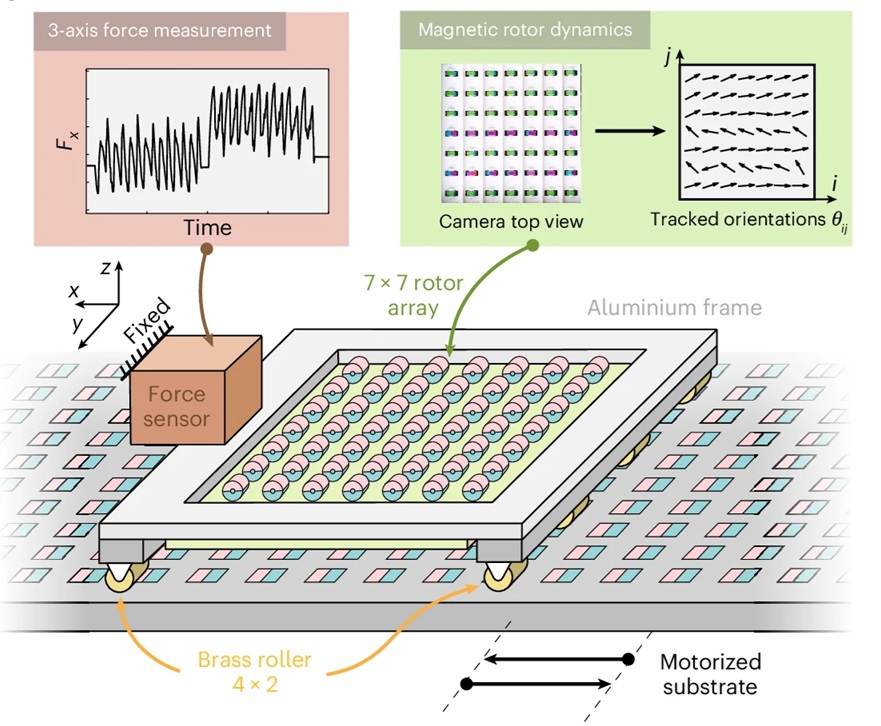
Image Credit: Nature Materials, 2026; DOI: 10.1038/s41563-026-02538-1

Reference
Hongri Gu, Anton Lüders, Clemens Bechinger. Non-monotonic magnetic friction from collective rotor dynamics. Nature Materials, 2026; DOI: 10.1038/s41563-026-02538-1
Go to Nature Materials,