 Advances in Engineering Advances in Engineering features breaking research judged by Advances in Engineering advisory team to be of key importance in the Engineering field. Papers are selected from over 10,000 published each week from most peer reviewed journals.

Significance
Metal–organic cages assembled from square-planar Pd(II) are important in supramolecular chemistry because their structures are governed as much by geometry as by coordination chemistry. When ligands bind reversibly and metals exchange partners readily, assemblies often explore a wide configurational space before settling into thermodynamic minima. That freedom, while attractive conceptually, becomes a liability when the number of possible configurations grows rapidly with nuclearity. For heteroleptic cages in particular, the problem is not only how to assemble a single architecture, but also how to prevent the system from drifting into self-sorted homoleptic species or broad statistical mixtures that resist clean characterization.
Most prior approaches that tried to control configuration in metal–organic cages rely on ligand asymmetry, steric blocking, or directional constraints built directly into ligand backbones and these strategies can be effective for low-nuclearity systems, especially Pd₂L₄ motifs, where cis, trans, and related arrangements can be biased through local geometric features. Scaling those ideas to larger polyhedral cages introduces new complications. As the number of edges increases, so does the number of ways distinct ligands can be distributed across them, and local steric arguments lose clarity when applied globally. In high-nuclearity heteroleptic cages, even modest asymmetry can generate an overwhelming combinatorial problem.
Another unresolved difficulty lies in distinguishing steric crowding from more distributed geometric strain. Bulky substituents can disrupt local coordination environments, but they don’t necessarily alter the overall balance between competing configurations if strain is shared across the framework. This raises an important question: can we guide configuration selection by a simple, quantifiable geometric parameter instead of ad hoc steric decoration or ligand-specific effects.
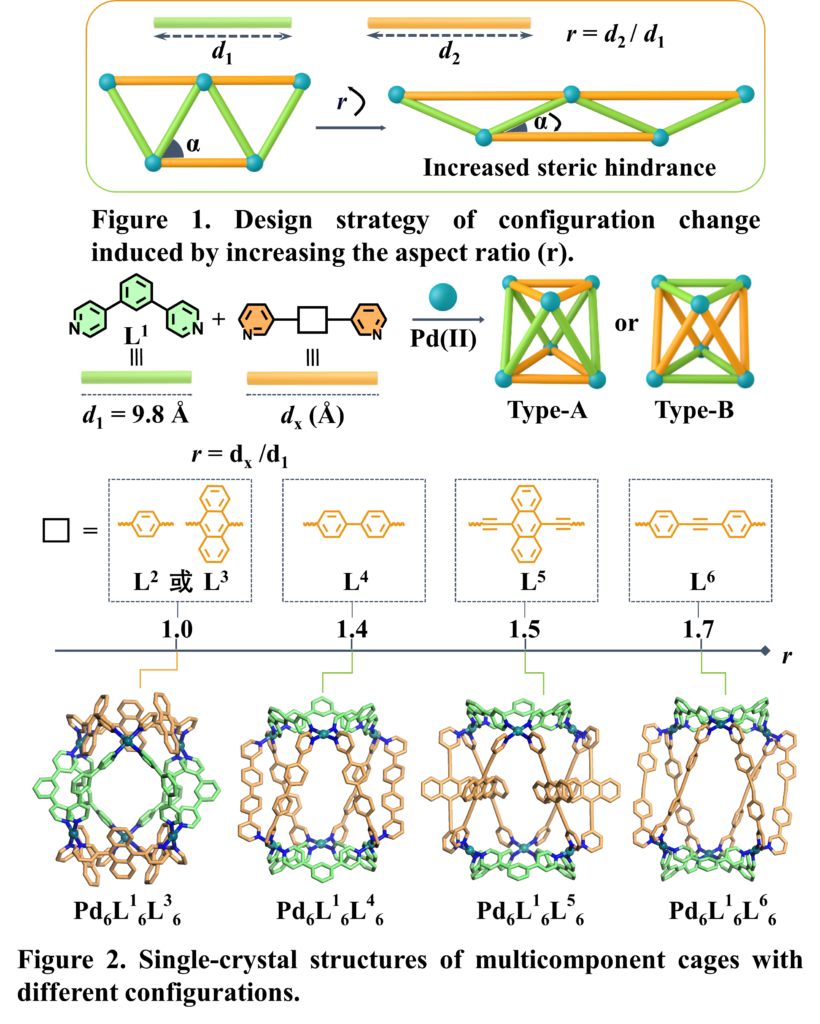
In a recent research paper published in Angewandte Chemie International Edition, a research team (Ziteng Guo, Hao Yu, Ningxu Han, Xinrui Zhang, Junjuan Shi) led by Professor Ming Wang from the State Key Laboratory of Supramolecular Structure and Materials, College of Chemistry at Jilin University, developed a geometric strategy to control configurations in heteroleptic Pd₆ cages by tuning the ratio of ligand coordination lengths. They established that small changes in this ratio switch thermodynamic preference between two dominant cage arrangements and the approach decouples global configuration control from steric bulk or ligand asymmetry and also provides a general design rule based on distributed strain instead of local chemical modification.
The research team designed a family of ditopic ligands whose primary difference lay in the distance between coordinating nitrogen atoms, while preserving comparable binding motifs. The investigators then combined pairs of these ligands with Pd(II) under identical stoichiometric conditions, forcing the system to choose how to distribute two ligand types across the edges of an octahedral Pd₆ framework. The authors treated ligand length ratio as the main experimental variable and first examined assemblies in which the two ligands possessed nearly identical coordination lengths. Under these conditions, the system consistently converged on a single, highly symmetric configuration despite the large number of theoretically accessible alternatives and structural analysis showed that this arrangement minimized angular distortion within triangular Pd₃ subunits, which allowed the cage to accommodate both ligand types without concentrating strain. The preference didn’t arise from kinetic trapping; repeated equilibration led back to the same configuration, and indicated a thermodynamic bias.
Afterward, the authors tested the increase in the length of one ligand relative to the other and found that the behavior changed sharply. They also examined ratios exceeding unity by introducing additional spacers into one ligand while leaving the partner unchanged and observed that beyond a threshold ratio, the previously favored configuration no longer dominated. Instead, the cage reorganized into an alternative arrangement that redistributed longer ligands in a way that relieved angular mismatch across the framework. Moreover, their crystallographic data showed that this new configuration tolerated distorted triangular subunits more evenly, avoiding localized congestion. On top of that, the investigators extended this analysis across multiple ligand pairs spanning a range of length ratios. Each system converged reproducibly on one of two configurations, with the crossover occurring within a narrow ratio window and this allowed the authors to associate configuration selection directly with geometric mismatch. Also, the team tested whether added steric bulk alone could override this trend and by appending large substituents to ligands without altering their effective coordination length, the authors found that the same length-ratio rule still remained valid. The cages adopted the same configurations as their less bulky counterparts, demonstrating that global geometric balance outweighed local steric crowding.
In conclusion, the new work of Professor Ming Wang and co-workers demonstrated that adjusting ligand length altered how strain accumulated across the cage, and the system responded by selecting the configuration that distributed that strain most evenly. The implications of this work extend beyond the specific Pd₆ cages examined. By identifying ligand length ratio as a governing variable, the study reframes configurational control as a problem of mechanical balance rather than chemical fine-tuning. This shift matters because geometric parameters can often be adjusted continuously and predicted more readily than steric or electronic effects that depend on local interactions.
It is worth mentioning that the new findings suggest to supramolecular chemists who work with heteroleptic assemblies that complexity doesn’t inevitably lead to configurational disorder and even systems with dozens of possible isomers can be biased toward a small subset if strain is managed coherently at the framework level. That principle could guide the design of cages intended to host guests, catalyze reactions, or respond to external stimuli, where a single, well-defined configuration is often necessary for function. The work also clarifies the limits of steric design. Bulky groups may influence solubility, rigidity, or local conformations, but they don’t necessarily control global configuration unless they alter how edges compete geometrically. This distinction helps explain why some earlier strategies succeeded in small systems yet failed when extended to larger architectures. It also provides a diagnostic tool: when configurational outcomes resist steric modification, attention should turn to relative dimensions instead.
Furthermore, the study aligns synthetic cage chemistry more closely with ideas from structural biology, where small mismatches in length or angle can propagate through assemblies and dictate global form. While the present work focuses on Pd(II) systems, the underlying argument should remain valid for other metal–ligand frameworks that rely on reversible coordination. Whether similar length-driven modulation can operate in cages with different topologies or metals remains an open but testable question. In summary, the study by Professor Ming Wang and co-workers study advances geometry-based design principle showing that the relative coordination length of ligands—expressed as a ligand length ratio—can deterministically bias the thermodynamic configuration of high-nuclearity heteroleptic Pd₆ cages.



Reference
Guo Z, Yu H, Han N, Zhang X, Shi J, Wang M. Length Ratio-Driven Configurational Modulation of Heteroleptic Pd6L6L’6 Cages. Angew Chem Int Ed Engl. 2025 Aug 18;64(34):e202508367. doi: 10.1002/anie.202508367.
Go to Angewandte Chemie International Edition