Advances in Engineering Advances in Engineering features breaking research judged by Advances in Engineering advisory team to be of key importance in the Engineering field. Papers are selected from over 10,000 published each week from most peer reviewed journals.

Significance
Cracks in conventional carbon-fiber composites tend to run once local stress concentrates, because the fiber phase is strong but anisotropic and the usual thermoset matrix has little capacity to deform, spread load, or dissipate energy before rupture. That combination has given CFRPs a familiar strength profile and, at the same time, a persistent weakness: they resist static load well, yet remain vulnerable when puncture, tearing, or sharp damage pushes the response away from ideal tensile alignment. A second problem follows from the same matrix chemistry because once a conventional cured binder locks into an irreversible network, the composite no longer melts, dissolves, or reprocesses in any useful way, so recovery of intact carbon fiber becomes difficult under mild conditions. The limitation here is not simply to make the matrix stronger but the design of a binder that can absorb and redistribute force during damage and stay stable enough for service and sufficiently dynamic for recovery at the end of use. In a recent research paper published in Composites Part A: Applied Science and Manufacturing, Dr. Shunli Wang, Dr. Yinsheng Li, and Professor Limei Tian from Jilin University and Liaoning Academy of Materials developed a family of polyurethane elastomer networks, WPINn, that combine woven dynamic cross-linkers with multiply hydrogen-bonded hard segments. They identified WPIN0.5 as the most effective composition and used it as a recyclable matrix for carbon-fiber composites containing 65 wt% fiber. Its key feature is the coupling of hierarchical energy dissipation with solvent-assisted matrix removal, and that allows both high tear resistance and recovery of undamaged carbon fiber.
Briefly, the research team prepared a family of polyurethane networks, WPINn, by combining PTMG and IPDI with a woven cross-linker and isophthalic dihydrazide, while varying the woven-cross-linker fraction to generate a controlled series. The authors confirmed network formation spectroscopically and verified complete isocyanate conversion. They also examined morphology with small-angle X-ray scattering and found phase-separated domains whose spacing increased with woven-cross-linker content. That trend proved important because the strongest mechanical response did not come from simply adding more dynamic junctions. The investigators observed that WPIN0.5 reached the highest tensile strength, 78.1 MPa, and the highest toughness, 314.2 MJ m−3, whereas WPIN0.75 lost some strength. The paper links that drop to excessive phase separation and renewed stress concentration. The network benefited from dynamic architecture up to a certain point, then began to lose the balance required for efficient load redistribution.
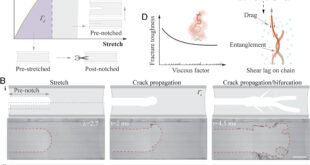
The researchers then addressed damage resistance directly by measuring puncture resistance in a 0.5 mm sheet and recorded a force of 45 N at a displacement of 29 mm, which corresponds to a puncture energy of 0.54 J. They also tested notched specimens and found an elongation at break of 924% with a fracture energy of 223 kJ m−2. Those values align with a response if the network continues to spend mechanical energy during crack growth instead of exhausting that capacity at the moment of crack initiation. Cyclic loading reinforced that interpretation. The study examined hysteresis over successive load-unload cycles from 100% to 900% strain and found increasing dissipation with increasing strain, with low-strain dissipation associated mainly with hydrogen-bond scission and higher-strain dissipation linked to woven-cross-link dissociation.
The authors also constructed control systems. A covalently cross-linked analogue, CPIN0.5, lost elongation and toughness, while a PD-based material with fewer hydrogen-bonding sites showed a much lower fracture strength than WPIN0.5. Those comparisons narrowed the mechanism considerably: the superior response did not arise from polyurethane chemistry in a broad sense, but from the pairing of reversible hydrogen-bond clusters with woven dynamic nodes. The authors supported that reading with calculations. They estimated a binding energy of −45 kcal mol−1 for the multiply hydrogen-bonded hard segments and a much lower value, −27 kcal mol−1, for the PD-based comparison. They also calculated a large interaction energy for the woven cross-linker, −475 kcal mol−1, and argued that force-driven dissociation at those sites contributes heavily to energy consumption during deformation.
The researchers then tested whether a network designed for dissipation could remain stable under conditions that often trouble supramolecular elastomers. Stress-relaxation experiments at 120 °C showed increasing relaxation times as woven-cross-linker content increased, and WPIN0.5 followed Arrhenius behavior with an activation energy of 76 kJ mol−1 across 120–150 °C. After 24 hours in water, the investigators observed little change in the stress-strain curve, and after immersion in several solvents the material retained more than 90% mass following drying. When the team used WPIN0.5 as a carbon-fiber binder at 65 wt% fiber content, the composite reached 442 MPa tensile strength and about 1450 kJ m−2 tear resistance, compared with about 64.6 kJ m−2 for epoxy-CF. They also recovered clean, chemically intact carbon fiber by solvent-assisted separation in DMF and retained high composite strength across three recycling cycles. What stands out here is how effectively the selected composition balances strength, deformability, and reversibility without allowing any one of those features to dominate at the expense of the others.
The research work of Professor Limei Tian and colleagues reports a tough elastomer and a strong composite and changes where fracture resistance in CFRPs can be engineered. Much composite design still relies on the fiber phase for mechanical authority and treats the matrix mainly as an adhesive necessity. The new paper works from a different premise and treats the matrix as a programmable zone for damage management, where the sequence of molecular events under load determines whether a crack remains local or expands into structural failure. The authors’ work also increase understanding on how combining woven cross-links with clustered hydrogen bonds. Dynamic polymers are often discussed as though reversibility alone were sufficient but the findings show for a more disciplined architecture: reversible interactions need hierarchy. Lower-energy events can absorb force early, while stronger or more topologically constrained events remain available as deformation increases. That ordering changes the mechanical outcome because the network does not spend all of its dissipation capacity in a single stage. The composite data reinforce the same point at a larger structural scale. Carbon fiber remains stiff and anisotropic, yet a matrix that can stretch, yield locally, and bridge the flanks of a developing tear changes how damage travels through the laminate. That has practical meaning beyond this single polymer system. If related architectures perform similarly under broader loading histories, designers of protective CFRP systems may have a credible route for improving puncture and tear tolerance without giving up high fiber content. Recycling is equally important here and does not appear as a secondary benefit. A matrix that can be removed under mild solvent-assisted conditions while leaving carbon fiber chemically intact changes the usual end-of-life logic for CFRPs. Solvent handling, part geometry, manufacturing scale, and contamination will still shape how far such a strategy can move into application, and the paper establishes an important point: recyclability and high fracture resistance do not have to be treated as opposing design objectives. That shift in thinking will be important in areas where sharp local loading, accidental impact, and reuse all carry real weight. Protective equipment is one obvious case, but the broader message is more general. Dynamic supramolecular matrices can be designed for both reprocessability as well as mechanical participation in structural defense and this opens a more flexible route for composite design, especially when the matrix is asked to do more than just hold the reinforcement in place.
Reference
Shunli Wang, Yinsheng Li, Limei Tian, High-toughness polyurethane elastomers for recyclable carbon fiber-reinforced composites with excellent tear resistance, Composites Part A: Applied Science and Manufacturing, Volume 198, 2025, 109140,
Go to Journal of Composites Part A: Applied Science and Manufacturing