Advances in Engineering Advances in Engineering features breaking research judged by Advances in Engineering advisory team to be of key importance in the Engineering field. Papers are selected from over 10,000 published each week from most peer reviewed journals.

Significance
A ferroelectric film is a thin deposited layer of a ferroelectric material that exhibits spontaneous, electrically switchable polarization and when a ferroelectric film is bonded to a rigid substrate, the lattice cannot deform freely under electric field, domain walls lose mobility, and the strain that looks accessible on paper collapses in practice. That basic mechanical penalty has haunted thin-film electromechanical materials for years. Bulk ferroelectrics and relaxor-based crystals can generate very large responses, but the same chemistries in film form usually deliver far less, even when the intrinsic structural anisotropy of the crystal would seem to permit much more. In PbTiO3-derived systems, for example, the tetragonal distortion itself implies a large ferroelastic strain reservoir, but thin films rarely access more than a small portion of it because clamping and electrical failure intervene long before full domain reorganization can occur.
That mismatch leaves the field with a design problem and one can identify materials with strong piezoelectric or ferroelastic character, but translating those qualities into sub-100-nm architectures is not a simple matter of shrinking a bulk ceramic. Once the film is epitaxially locked to a substrate, the substrate becomes part of the electromechanical problem. It constrains lattice motion, shifts the balance among allowable domain states, and forces the material to respond through pathways that are mechanically cheaper, not necessarily those that would produce the largest vertical strain. The breakdown field then adds a second limit. Thin films often need much higher electric fields than bulk crystals to generate comparable strain, so even a promising switching pathway becomes less useful if leakage and failure appear first.
That is why mixed-domain and mixed-phase ferroelectrics remain scientifically attractive. They offer a route to large response not by relying only on small linear distortions of an already selected state, but by exploiting field-driven reorganization among ferroelastic configurations that differ more substantially in polarization direction and lattice shape. Earlier work had already shown that strain can stabilize coexisting domain arrangements in tetragonal ferroelectrics, including c/a and a1/a2 motifs, and that local interconversion among them can generate strong actuation. The unresolved point was scale. Nanoscale or highly localized switching is one thing; generating a macroscopic response across a clamped capacitor is another, because the elastic cost of collective rearrangement rises quickly once the whole film tries to participate.
In a recent research paper published in Advanced Materials, Dr. Zishen Tian, Dr. Menglin Zhu, Dr. Jaegyu Kim, Dr. Piush Behera, Dr. Michael Xu, Dr. Thomas Lee, Dr. Ching-Che Lin, Dr. Sreekeerthi Pamula, Dr. Archana Raja, Dr. Hao Pan, Dr. Jieun Kim, and led by Professor James LeBeau and Professor Lane Martin from the Rice University and Massachusetts Institute of Technology developed sub-100-nm epitaxial PbZr0.2Ti0.8O3 films and PbZr0.2Ti0.8O3 /PMN-PT/ PbZr0.2Ti0.8O3 trilayers engineered to use field-driven conversion of a1/a2 superdomains into c/a superdomains as the main actuation pathway. They paired macroscopic electromechanical measurements with operando second-harmonic generation and operando STEM to identify that conversion directly. The distinct advance is the coupling of domain-state design with heterointerface-controlled breakdown management, which allowed the films to move from 1.25% strain in mixed single layers to 2.1% in trilayers while remaining below 100 nm total thickness.
The researchers grew 80 nm PbZr0.2Ti0.8O3 films on DyScO3, GdScO3, and NdScO3 so that epitaxial strain would steer the films into c, c/a, and mixed-domain states, respectively. That choice mattered because it converted substrate selection into a controlled way of tuning the domain-energy hierarchy. The team did not treat strain as background epitaxy; they used it as the variable that determines which domain structures remain available under field. Structural characterization showed exactly that progression, with the NdScO3 case carrying the mixed state composed of c/a and a1/a2 superdomains. In those mixed films, the investigators identified tilted c and a domains inside c/a superdomains and nearly untilted a-domain variants inside a1/a2 regions, with a through-thickness distribution that already hinted at an elastic compromise: c/a structures favored the upper part of the film, while a1/a2 domains persisted closer to the substrate where clamping cost more.
The authors then linked domain architecture to electrical and electromechanical behavior in capacitor form. As the films evolved from c to c/a to mixed-domain configurations, the dielectric constant rose, remnant polarization fell, coercive field dropped, and the macroscopic electromechanical response climbed from 0.2% to 0.3% to 0.6% under the same drive conditions, with deff,33 increasing from 55 to 84 to 170 pm V−1. That progression is not just a catalog of numbers. It shows that mixed-domain order does more than create configurational complexity. It opens a response channel that bypasses part of the usual clamping penalty by allowing field-driven ferroelastic conversion, not just small-signal lattice distortion around a fixed domain population.
To determine what actually moved under bias, the research team combined piezoresponse mapping, operando second-harmonic generation, and operando STEM. Piezoresponse measurements after poling showed a measurable increase in the c/a fraction, which captured the irreversible portion of the conversion. The SHG experiments followed the in-plane a-domain population under applied field and found that SHG intensity dropped as field-induced strain rose, directly tying loss of a-domain volume to actuation. Operando STEM then closed the loop: the investigators watched an a1/a2 region convert under field into a predominantly c/a configuration. That sequence mattered because the mechanism could easily have been misassigned to ordinary polarization switching inside pre-existing c/a stripes. Instead, the paper identifies a more specific event: a1/a2 -to-c/a superdomain interconversion. Once that point became clear, the large response in the mixed films made physical sense.
The researchers also estimated what remained inaccessible. Using lattice parameters from microscopy and domain fractions from piezoresponse data, they argued that full conversion of mixed-domain material toward c/a and then pure c would correspond to a much larger strain ceiling, about 3.5%, while the single-layer films reached about 1.25% at 1 MV cm−1 before leakage and breakdown imposed a stop. That gap is scientifically useful. It shows the response pathway is real, but the field window in a single layer is too narrow to exploit it fully. The trilayer design addressed exactly that bottleneck.
For the multilayer stage, the authors built PbZr0.2Ti0.8O3 /PMN-PT/ PbZr0.2Ti0.8O3 trilayers on NdScO3 while keeping the total thickness at 80 nm and varying the PMN-PT layer thickness. Structural studies showed that these heterostructures preserved mixed-domain character, though the real-space arrangement changed into a more layered distribution, with the top PZT layer carrying mostly c/a plus some a1/a2 character and the bottom layer favoring a1/a2. The team interpreted this asymmetry through depolarization fields and mechanical compliance: the PMN-PT layer altered polarization continuity across interfaces and partly decoupled the upper PZT layer from the substrate’s mechanical grip. Under moderate fields, thinner-PMN-PT trilayers retained electromechanical response close to the mixed single-layer film, while thicker PMN-PT reduced deff,33 because the middle layer itself remained strongly clamped in thin-film form. At high fields, though, the trilayers separated clearly from the single layer. Leakage dropped by orders of magnitude, temperature-dependent transport pointed to interface-controlled barriers consistent with band misalignment, breakdown strength rose from 1.20 MV cm−1 in single-layer PZT to as high as 2.25 MV cm−1 in trilayers, and Smax exceeded 2% for all trilayers, reaching 2.1% in the 37/5/37 design with little fatigue after 109 cycles.
Thin-film electromechanical design often defaults to the assumption that one should search for materials with larger intrinsic coefficients, then fight clamping as a secondary engineering problem. This work turns that logic around. It treats domain accessibility and electrical survivability as the main design variables, and it uses composition, epitaxial strain, superdomain selection, and interface energetics to decide which part of the crystal’s structural anisotropy can actually be used in device form. That is a stronger way of thinking about thin-film piezoceramics, especially when the intrinsic lattice reservoir is large but ordinarily locked behind unfavorable mechanics.
There is also a useful refinement in how ferroelastic response is discussed. The large signal here does not arise from a vague mixed-phase “softness.” It comes from a specific hierarchy of domain states. The a1/a2 superdomains function as a latent structural reservoir; c/a superdomains provide an intermediate state that is electrically and mechanically accessible; multilayer interfaces then widen the usable field range by suppressing leakage and raising breakdown strength. Each design choice changes a different bottleneck. That division of labor matters because it offers a way to generalize the strategy. One does not need every constituent to be a high-response piezoelectric in thin-film form. One layer can stabilize the convertible domain topology, another can alter compliance or interface transport, and the final behavior can exceed what either layer would deliver alone.
If comparable domain-control and interface-control schemes can be reproduced in device-relevant geometries, one can imagine thin-film actuators, transducers, or strain-mediated heterostructures that no longer accept the usual trade-off of compactness in exchange for weak displacement. The fact that the trilayers reached 2.1% strain in sub-100-nm films places these materials in a performance range that invites serious attention for microsystems. At the same time, the paper does not erase all constraints. The theoretical limit remains higher than the measured value, thicker PMN-PT layers already show a penalty in effective response, and the balance among depolarization field, mechanical compliance, and switchable domain volume looks quite delicate. That delicacy is part of the message: high response in clamped films may depend less on finding a single “best” ferroelectric than on building a structure where incompatible requirements are distributed across layers and domain states in a controlled way. Moreover, the interface-controlled leakage behavior, linked in the paper to a band offset of about 0.7 eV, opens a route that extends beyond this specific PZT/PMN-PT pair. Once electrical failure is treated as an interfacial band-engineering problem, electromechanical design can borrow ideas usually associated with transport physics and electronic heterostructures. That is likely where the longer-term value of this study will reside. Its immediate accomplishment is a strong thin-film actuator response; its broader contribution is a disciplined framework for coupling domain thermodynamics, elastic boundary conditions, and interface electronic structure inside the same materials design problem.
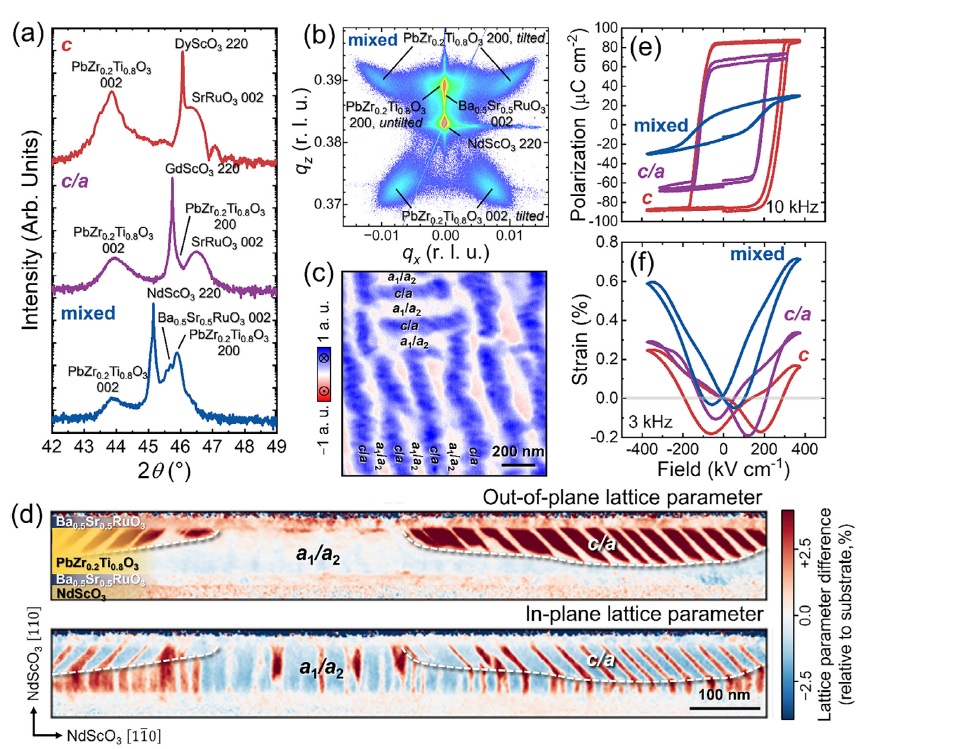
FIGURE: Structuresandpropertiesofc-phase,c/a-phase,andmixed-phasePbZr0.2Ti0.8O3films. Image credit: Adv Mater. 2026 Apr;38(19):e18417. doi: 10.1002/adma.202518417.


Reference
Tian Z, Zhu M, Kim J, Behera P, Xu M, Lee TJ, Lin CC, Pamula S, Raja A, Pan H, Kim J, LeBeau JM, Martin LW. Unleashing the Electromechanical Response of Ferroelastic Domain Reorganization in Mixed-Phase Tetragonal Ferroelectric Multilayers. Adv Mater. 2026 Apr;38(19):e18417. doi: 10.1002/adma.202518417.
Go to Journal of Advanced Materials