 Advances in Engineering Advances in Engineering features breaking research judged by Advances in Engineering advisory team to be of key importance in the Engineering field. Papers are selected from over 10,000 published each week from most peer reviewed journals.

Significance
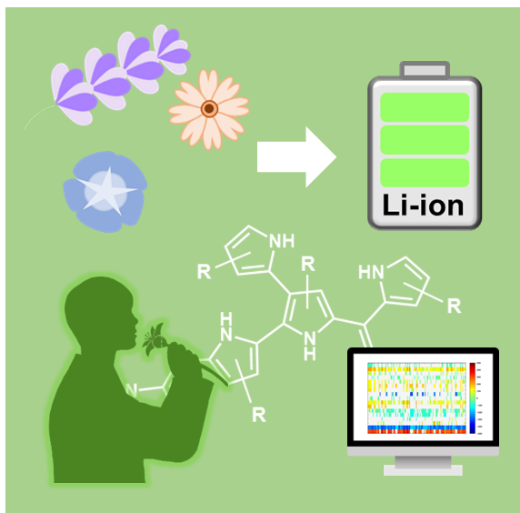
Organic electrode active materials are important in lithium-ion battery research because their redox behavior can be tuned through molecular structure. Organic compounds offer a broad range of possible structures built from lightweight elements, conjugated units, heteroatoms, and functional groups and this makes them attractive for resource-conscious energy-storage systems, especially where metal-free or low-resource electrodes are desired. For instance, in organic anodes, capacity can arise from reactions involving conjugated frameworks, carbonyl groups, heteroaromatic rings, and polymerized structures, which make molecular design critical path toward improved electrochemical performance. The number of possible organic molecules can be large, and only a small number can be synthesized, purchased, processed into electrodes, and tested experimentally. Even when a molecule contains a possible favorable redox-active unit, its actual capacity, stability, and interaction with the electrolyte is hard to predict from simple structural inspection alone. Previous progress in organic anode materials has relied heavily on professional experience and the modification of already familiar active motifs, including conjugated carbonyl compounds and thiophene-based derivatives. Data-driven prediction can widen the search space without making the experimental workload difficult, but its value depends on whether it can guide selection in chemically unfamiliar regions. In a recent research paper published in Journal of Materials Chemistry A, Dr. Haruka Tobita, Dr. Kosuke Sakano, Dr. Hiroaki Imai, and Professor Yuya Oaki from Keio University working together with Dr. Yusuke Yamashita from Pharma Foods International Co., Ltd developed a predictor-assisted exploration strategy for identifying organic lithium-ion battery anode active materials from natural flower-scent compounds.
The researchers began with roughly 2000 flower-scent compounds and narrowed this collection by selecting molecules containing conjugated moieties, since purely aliphatic structures were not expected to provide useful redox activity. The more decisive selection came from two previously constructed capacity-prediction models, G2 and G3, which used sparse modeling for small datasets rather than conventional large-data machine learning. These models had been trained on measured capacities of organic compounds under consistent experimental conditions and incorporated descriptors such as molecular orbital energy levels, molecular weight, carbonyl count, Hansen solubility parameters, and heteroatom-to-carbon ratios. From the 62 candidates, eight commercially available and solid-state-stable molecules were chosen for electrochemical testing.
Among the eight candidates the authors selected by the capacity predictors, they found two compounds stood out electrochemically: 1,4-dichlorobenzene, designated F5, and 6-methyl-2-pyridinecarboxaldehyde, designated F12. After subtracting the contribution from conductive carbon, F5 delivered a corrected specific capacity of 532 mA h g−1, while F12 reached 293 mA h g−1 at 100 mA g−1. Both compounds retained roughly 90% of their capacity over ten cycles, indicating that the redox reactions remained stable enough for the screening purpose and were not immediately dominated by dissolution. The team performed spectroscopic analysis and found for F5, ex situ FT-IR measurements showed that the C–Cl vibration remained after cycling, while the C=C stretching vibration in the benzene ring decreased on discharge and recovered on charge. That pattern supports lithiation and delithiation of the benzene ring rather than simple disappearance of the active material into the electrolyte. Since the measured capacity corresponded to about 2.9 lithium ions per molecule, the interpretation points toward superlithiation of the dichlorobenzene ring. For F12, analogous changes in the pyridine-ring vibration indicated redox activity in the heteroaromatic ring, again accompanied by solid electrolyte interphase (SEI)-related bands.
F5 analogues showed that extending or modifying the substituted aromatic structure changed capacity in a way that could be related to charge delocalization and steric effects. A dichlorobenzene-containing analogue reached 338 mA h g−1, corresponding to reaction with 4.4 lithium ions per molecule, while bulkier halogenated structures did not improve capacity. The design choice of comparing closely related aromatic analogues therefore converted a screening hit into a more chemically readable redox motif.
The researchers focused on F12 series and selected analogues containing nitrogen heteroaromatic rings and formyl groups, with particular interest in polymerizable structures. Pyrrole-2-carboxaldehyde, F12-D, gave a modest monomer capacity of 92.7 mA h g−1, but oxidative polymerization produced pF12-D, a black polymeric material with a specific capacity of 934 mA h g−1 at 100 mA g−1. Its capacity remained stable through ten cycles and did not decrease during a subsequent 100-cycle test at 100 mA g−1. Structural characterization indicated that pF12-D was not a simple linear polypyrrole analogue. Instead, it formed an amorphous conjugated polymer network containing monomeric, dimerized, and trimerized pyrrole-derived units, with formyl, carboxyl, and hydrogen substituents generated through coupled oxidative and side reactions.
The importance of the study of Professor Yuya Oaki and colleagues in engineering is it show us how it changes the route by which organic battery materials can be discovered and refined. The predictor-assisted strategy offers a practical screening route by reducing an unconventional molecular library to a small set of experimentally realistic candidates. For engineering groups working on next-generation electrode materials, this kind of workflow can shorten early-stage discovery, reduce unnecessary experimental screening, and help identify active structures that might not be selected by conventional experience alone. A second application is in the development of metal-free or low-resource electrode systems. The new study shows that small organic molecules from a non-electrochemical source can be converted into meaningful anode candidates, and that structural analogues can then be used to improve performance. This has practical value for battery engineering because it supports a modular design logic: first identify a redox-active molecular unit, then modify its structure, polymerize it, or embed it in a more stable architecture. The progression from low-molecular-weight candidates to a polymeric anode material is especially important, since dissolution and cycling stability are common engineering concerns for organic electrodes.
The polymer result also points toward applications in electrode architecture design. The amorphous conjugated polymer network derived from pyrrole-2-carboxaldehyde combines redox-active heteroaromatic units with a polymerized structure that improves capacity and cycling behavior relative to the monomer. For practical electrode development, such materials could be explored as active anode components in organic or hybrid lithium-ion battery systems, particularly where lightweight composition, molecular tunability, and reduced reliance on inorganic active materials are desired. The work also shows that structurally disordered conjugated polymer networks can be treated as meaningful electrode architectures when their composition and redox behavior are carefully characterized. Furthermore, the new study has applications in materials informatics for energy technologies. The same approach could be adapted to search other unconventional molecular databases for battery, capacitor, catalytic, or energy-conversion materials, provided appropriate predictors and validation experiments are available. Its engineering value is therefore not limited to the specific flower-scent compounds examined. The larger contribution is a practical discovery strategy in which prediction is used to enter a remote chemical space, a small number of candidates are experimentally validated, and chemical design and polymer formation then turn an initial hit into a more useful functional material. This is a realistic route for accelerating materials discovery because it links prediction to available compounds, selective validation, and measurable electrochemical performance.

Reference
Tobita, Haruka & Sakano, Kosuke & Imai, Hiroaki & Yamashita, Yusuke & Oaki, Yuya. (2025). Data-driven finding of organic anode active materials for lithium-ion battery from natural products of flower scent using capacity predictors. Journal of Materials Chemistry A. 13. 10.1039/D5TA03476K.
Go to Journal of