 Advances in Engineering Advances in Engineering features breaking research judged by Advances in Engineering advisory team to be of key importance in the Engineering field. Papers are selected from over 10,000 published each week from most peer reviewed journals.

Significance
Hypergolic hybrid rocket engines depend on direct contact between a solid fuel and a liquid oxidizer to generate ignition without an external ignition source. The material must remain sufficiently stable during preparation, storage, and handling and must also respond almost immediately when exposed to the oxidizer. Hydrogen peroxide-based systems offers clear operational advantages over more toxic and corrosive oxidizers, but its reactivity is strongly tied to concentration. Highly concentrated hydrogen peroxide can support rapid ignition with a broader range of fuels, but its handling and storage risks increase substantially as concentration rises. Lower-concentration hydrogen peroxide, such as 70% H2O2, is therefore attractive from a safety standpoint, but it creates a much more difficult chemical ignition problem. Existing H2O2-based fuel systems have generally achieved short ignition delays with high-concentration peroxide, whereas self-ignition with 70% H2O2 remains uncommon and often too slow for demanding propulsion use. The problem is therefore not simply one of increasing fuel energy, but of controlling the earliest interfacial chemistry between the oxidizer droplet and the solid fuel surface. Borane-containing groups can provide strong reductive and heat-releasing reactivity, while ferrocene can participate in electron-transfer processes that accelerate hydrogen peroxide decomposition and radical formation. Either function alone is useful, but the unresolved design question is whether they can be integrated into one molecular architecture so that peroxide activation and fuel oxidation reinforce each other at the moment of contact.
In a recent research paper published in Journal of Materials Chemistry A, Dr. Haichao Fang, Dr. Mingren Fan, Dr. Linhu Pan, Dr. Ruihui Wang, Professor Yi Wang and Professor Qinghua Zhang from the Northwestern Polytechnical University developed a series of ferrocenyl azole-borane complexes, Fc-4 to Fc-7, that integrate ferrocene with imidazole-borane or triazole-borane units in one molecular fuel system. The technically distinct feature is the coupling of ferrocene-mediated hydrogen peroxide decomposition with borane-driven exothermic radical chemistry. Fc-6 was the most effective member of the series, combining rapid ignition with 70% hydrogen peroxide, strong wettability, favourable calculated specific impulse, and a mechanistically supported dual-pathway ignition process. They also developed an oxidizer-modification strategy in which LiNO3 addition to 70% hydrogen peroxide further shortened ignition delay and improved calculated propulsion performance.
The researchers synthesized four ferrocenyl azole-borane complexes, designated Fc-4 to Fc-7, through a modular route that joined ferrocenyl units with imidazole-borane or triazole-borane motifs. They performed single-crystal diffraction which established the molecular and packing features of Fc-5, Fc-6, and Fc-7. In Fc-6, the crystal arrangement placed ferrocene moieties near the periphery of the three-dimensional packing.
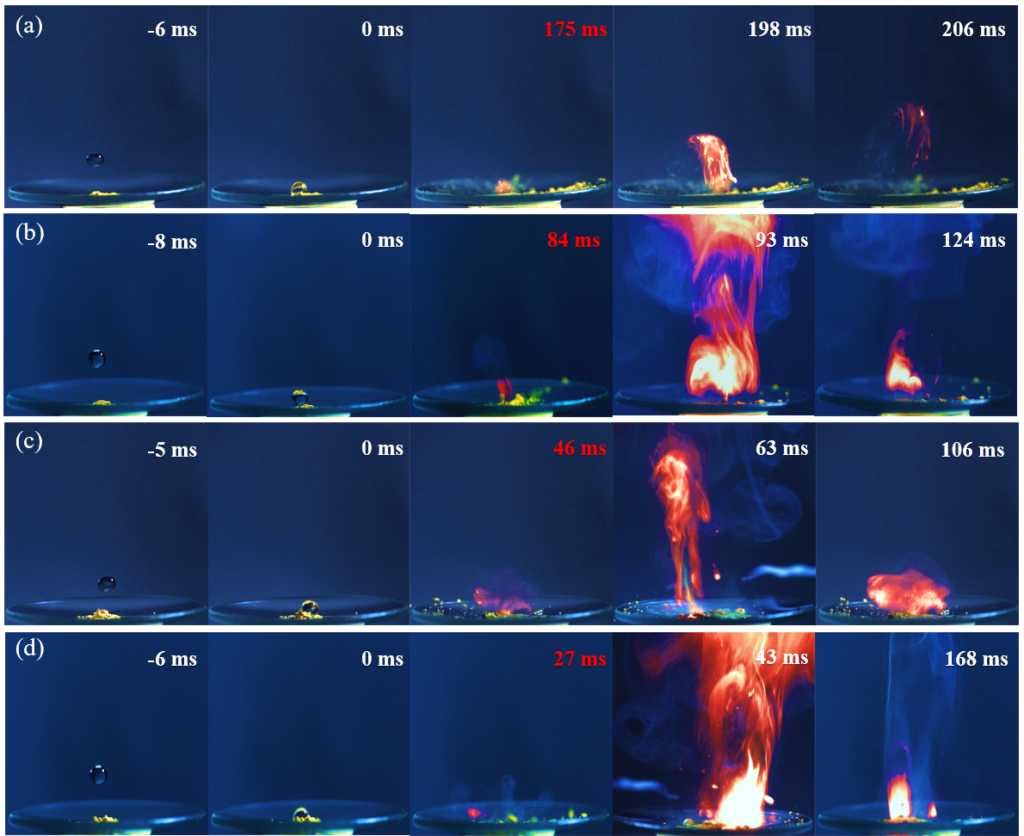
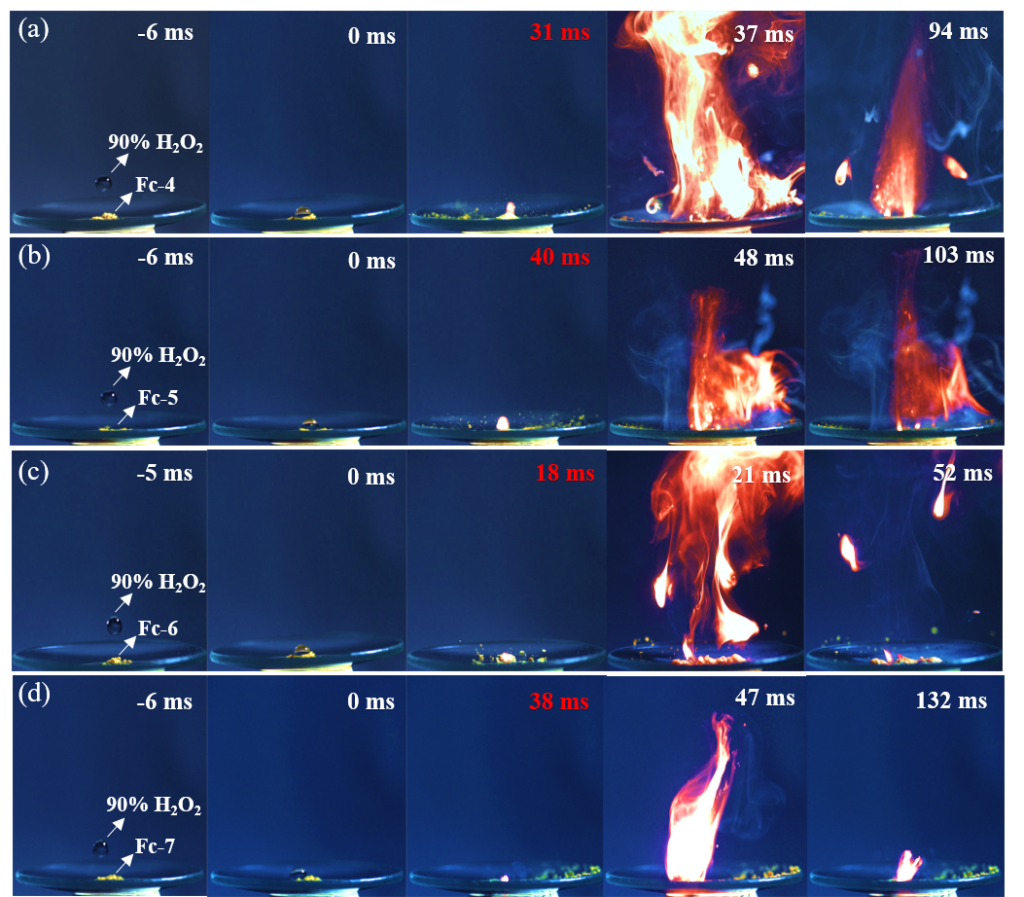
The authors conducted as well thermal analysis and demonstrated none of the four complexes showed major mass loss below 150 °C, which support ambient storage stability under the conditions examined. Their decomposition temperatures then fell between 153 and 202 °C, with Fc-6 showing the lowest value. The authors connected the lower thermal stability of the triazole-containing Fc-6 to its faster reaction behavior, not as a defect, but as part of the intended balance between stability before use and rapid exothermic response after peroxide contact. Additionally, the team performed ignition testing and found with 90% hydrogen peroxide, all four compounds ignited rapidly, with ignition delay times below 40 ms. Fc-6 gave the shortest delay, 18 ms, and reached maximum flame intensity quickly. The same trend became more consequential when the oxidizer concentration was reduced. With 50% and 60% hydrogen peroxide, the materials reacted vigorously but did not produce flame. With 70% hydrogen peroxide, all four complexes achieved self-ignition, but Fc-6 stood apart with a 46 ms ignition delay, while Fc-4, Fc-5, and Fc-7 required much longer delays in the 175–258 ms range. This contrast shows that the triazole-borane structure of Fc-6, its accessible ferrocene component, its relatively labile bonding environment, and its low contact angle work together rather than acting as independent descriptors.
Afterward, they conducted wettability measurements which showed that Fc-6 had a strongly hydrophilic surface, with a contact angle of only 9.7°. Better wetting gives the liquid oxidizer more intimate access to the solid fuel surface, increasing the reactive interfacial area and shortening the time needed for radical generation and heat accumulation. Still, the authors did not reduce ignition performance to wetting alone. Fc-4 and Fc-7 had similar contact angles, yet Fc-4 ignited faster because BH3 is more strongly reducing than BH2CN. The design choice of combining favourable wetting with a reactive borane unit therefore had a direct scientific consequence: it helped Fc-6 convert peroxide contact into rapid flame formation under the weaker oxidizing conditions of 70% hydrogen peroxide. LiNO3 addition to the oxidizer then provided a second route to performance improvement. When the authors incorporated lithium nitrate into 70% hydrogen peroxide, ignition delay times decreased monotonically as LiNO3 content increased up to the solubility-limited 30 wt% level. For Fc-6, the delay decreased from 46 ms with pure 70% hydrogen peroxide to 27 ms with 70% hydrogen peroxide containing 30% LiNO3. The authors also calculated specific impulse using NASA CEA software. Fc-6 gave the highest calculated value among the series, reaching 273.1 s with 90% hydrogen peroxide and 236.2 s with 70% hydrogen peroxide. With 30% LiNO3 in 70% hydrogen peroxide, its calculated specific impulse rose to 249.9 s.
The team performed density functional theory analysis to support the dual-pathway ignition process. In one path, ferrocene promotes hydrogen peroxide decomposition into OH and OOH radicals through electron-transfer chemistry. In the other, the borane-containing fragment reacts vigorously with OH radicals, including attack at electron-deficient boron and subsequent B–H reaction toward boric acid formation. For Fc-6, the calculated sequence involved peroxide-derived radicals attacking the iron center and cyclopentadienyl ring, ring opening and detachment, cleavage leading to triazole-borane release, and continued radical-driven exothermic chemistry. The short ignition delay is therefore best understood as a coupled event: ferrocene rapidly supplies reactive radical species, while the borane unit consumes those species in heat-releasing reactions that bring flammable small molecules to ignition.
The most direct engineering application of the research work of Dr. Haichao Fang et al. is in hydrogen peroxide-based hybrid rocket propulsion, particularly where ignition reliability must be achieved without relying on highly concentrated oxidizers. Fc-6 is especially important from an engineering standpoint because it produced spontaneous ignition with 70% H2O2 at 46 ms, and the delay was further reduced to 27 ms when 30 wt% LiNO3 was added to the peroxide. For propulsion hardware, this points to a possible route toward safer peroxide-fed ignition systems, where the oxidizer concentration is lower but the ignition delay remains practically meaningful. A second application is in the design of non-toxic or lower-toxicity bipropellant systems for aerospace use. The study positions hydrogen peroxide as a preferred green oxidizer compared with oxidizers such as NTO and WFNA, which are associated with volatility, corrosiveness, and toxicity. A fuel that can ignite with 70% H2O2 therefore has value for propulsion concepts where storage safety, handling simplicity, and reduced environmental burden matter. The LiNO3-modified peroxide system adds another engineering dimension because the authors note that LiNO3 can lower the freezing point of the oxidizer, with 30 wt% LiNO3 linked to a freezing point of −40 °C. This makes the approach relevant to propulsion systems exposed to low-temperature environments, including space or high-altitude operating conditions.
The findings also have implications for fuel-grain engineering. The contact-angle measurements showed that Fc-6 had a very low contact angle of 9.7°, indicating strong wetting by the oxidizer mimic. In a practical engine, better wetting can increase the reactive interfacial area between the liquid oxidizer and solid fuel, helping the ignition process begin more uniformly and rapidly. This is useful not only for selecting molecular fuels but also for thinking about pelletized fuels, coatings, composite fuel surfaces, and grain formulations where surface chemistry affects ignition delay and flame development. Another engineering use is for performance screening and formulation optimization. The calculated specific impulse values also showed that Fc-6 retained favourable propulsion performance with the LiNO3-modified 70% H2O2 system. These values suggest that molecular changes in the fuel and additive changes in the oxidizer can be evaluated together, rather than treating ignition delay and propulsion efficiency as separate problems. For H2O2-based propulsion, the study suggests a practical design direction to engineers that fuel chemistry, surface wetting, and oxidizer formulation should be optimized together.



Reference
Fang, Haichao & Fan, Mingren & Pan, Linhu & Wang, Ruihui & Wang, Yi. (2025). Ferrocene-modified azole-borane complexes achieve efficient hypergolic ignition with hydrogen peroxide via dual-pathway mechanism. Journal of Materials Chemistry A. 13. 10.1039/D5TA05914C.
Go to Journal of Materials Chemistry A