Advances in Engineering Advances in Engineering features breaking research judged by Advances in Engineering advisory team to be of key importance in the Engineering field. Papers are selected from over 10,000 published each week from most peer reviewed journals.

Significance
Mechanical metamaterials are increasingly expected to do more than carry load or deform in unusual ways. In many engineered systems, the same structural architecture may need to absorb mechanical energy, guide or block acoustic waves, reduce vibration, and adapt to changing operating conditions. When the same internal structure shapes stiffness, folding motion, energy absorption, and acoustic bandgaps, the material is no longer just a passive assembly of repeating cells and becomes a programmed physical system, with performance set by the precision of the link between geometry and function. The difficulty is that multifunctionality often brings unwanted coupling. A change introduced to improve one response can shift another response at the same time, because both are controlled by overlapping design parameters. Mechanical behavior depends on deformation mode, load path, local hinge or panel response, and the available folding or collapse sequence. Acoustic behavior depends on periodicity, internal pathways, symmetry, and the wave-propagation environment. A geometry selected for energy absorption may not give the desired bandgap; a geometry selected for wave attenuation may impose an unsuitable stiffness. This is why independent programmability remains a demanding problem rather than a simple matter of adding more structural features.
One possible solution is to assign different functions to different sub-units within the same material. That strategy can separate mechanical and acoustic responses to some degree, but it also increases architectural complexity and does not naturally provide post-fabrication tunability. A material whose properties are fixed once fabricated can be carefully designed, but it cannot easily respond to a new directional requirement, a different loading condition, or a changed acoustic target. The unresolved question, therefore, is whether a single structural design can support both independent programming and later reconfiguration without relying on separate functional modules. Origami-inspired metamaterials provide a disciplined way to approach this question because folding kinematics gives the deformation a predictable geometric basis, instead of leaving the response to uncontrolled structural bending or collapse. In a recent research paper published in Composites Part B: Engineering, Dr. Mengyue Li, Professor Jiayao Ma, Dr. Xiao-Lei Tang, Professor Yan-Feng Wang, and Professor Yan Chen from Tianjin University developed a new class of double-tubular origami metamaterials capable of independently programming and tuning mechanical and acoustic properties within a unified folding architecture..
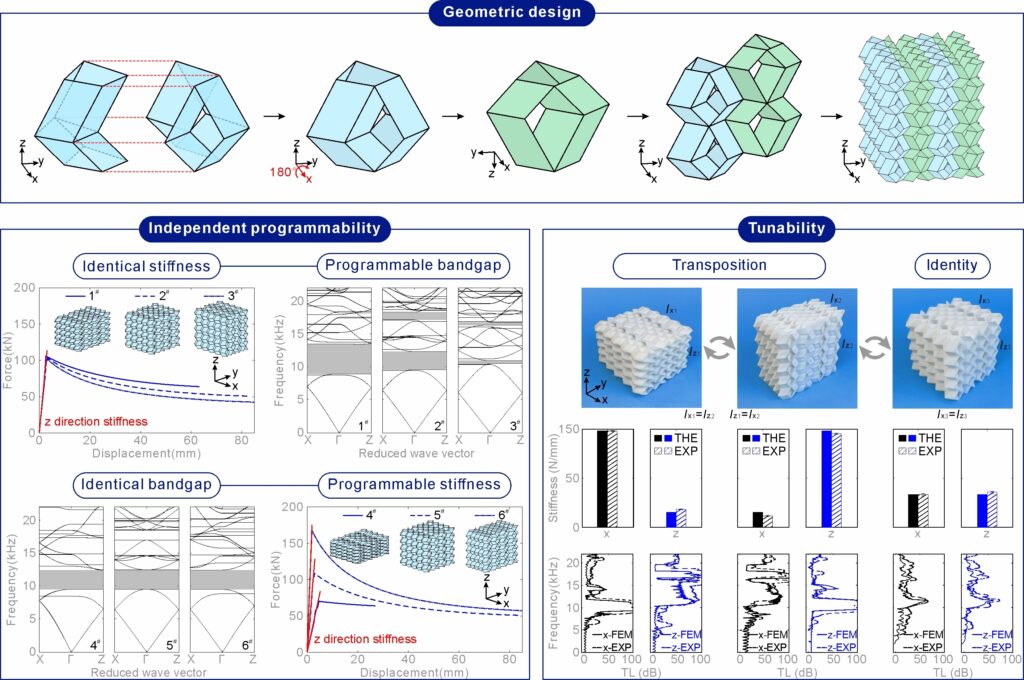
The researchers designed a double-tubular origami unit built from connected parallelogram panels, producing two perpendicular tubular pathways aligned with orthogonal directions. Its motion was formulated as a single-degree-of-freedom rigid folding process, with one dihedral angle used to determine the remaining folding angles and the changing dimensions of the unit cell. By changing the geometric parameters, they identified three kinematic categories. One type is not flat-foldable along either tubular direction, another is flat-foldable along one direction, and the most special case is flat-foldable along both directions. This third configuration, referred to as C3, becomes the decisive design because it has a geometric transposition property: under paired folding states, the dimensions along the two orthogonal directions can be exchanged.
The authors performed mechanical testing and modelling then to clarify how that kinematic structure translates into compression response. They found for the non-flat-foldable and partially flat-foldable designs, compression involved a plateau associated with origami folding until self-locking or full squeezing altered the deformation mode. In the C3 metamaterial, both orthogonal compression directions retained the rigid-origami folding character and produced plateau-type force-displacement behavior. The analytical model treated the creases as elastic-plastic hinges and the panels as rigid, thereby establishing an explicit analytical relationship between folding kinematics, deformation mechanics, and energy absorption performance. Agreement between theory and experiment was close for the tested C3 prototype, with reported errors no larger than 2.5% for stiffness and 5.3% for specific energy absorption.
The analysis treated the panels as sound-hard boundaries and examined wave propagation through the periodic air domain formed by the origami architecture. Complete bandgaps appeared in geometrically symmetric cases, while an asymmetric configuration generated direction-dependent partial bandgaps. For C3 at its symmetric folding state, two complete bandgaps were identified, and the transmission-loss behavior was identical along the two orthogonal directions. The design choice of using a flat-foldable, geometrically transposable C3 unit therefore had a direct scientific consequence: it allowed symmetry, dimensional exchange, and directional acoustic behavior to be connected through the same folding variable.
The team also found that mechanical properties varied strongly with the initial folding angle and sector angle, while acoustic bandgaps followed a different, nonlinear dependence on the same parameters. Because the mapping from design parameters to properties was not one-to-one, the researchers could select configurations that preserved one property while changing another. Under constant stiffness, the frequency range of the complete bandgap changed by up to 10.4 times. In the reverse direction, stiffness changed by up to 16.9 times without altering the complete bandgap, while specific energy absorption varied by 5.4 times under the same bandgap condition. The transposed C3 pairs also showed exchanged mechanical properties between directions, indicating that geometric transposition directly controlled the functional response and was not simply a dimensional symmetry of the folded structure.
The researchers demonstrated post-fabrication tunability using thermoplastic polyurethane prototypes. They mechanically reconfigured the printed metamaterial in fixtures, applied heat treatment, cooled the constrained assembly, and repeated the process to obtain target folding states. A symmetric state gave nearly identical stiffness and transmission-loss behavior along the two directions. Reconfiguration to a general folding state created pronounced directional differences in both force response and acoustic transmission-loss peaks. Reconfiguration to the corresponding transposed state swapped the directional mechanical and acoustic behavior.
Through innovative structural design and theoretical characterization, the double-tubular origami metamaterials break the long-existing bottleneck in multifunctional metamaterials, i.e., different properties are handled by separate material layers. The engineering applications are strongest in systems where mechanical protection and acoustic control must be designed as part of the same structural architecture. A second important application for the study of Tianjin University scientists is in direction-sensitive engineering structures because the C3 design can exchange its mechanical and acoustic behavior between orthogonal directions through geometric transposition, it could be useful in components that experience different loading or noise conditions depending on orientation. For example, an internal panel, isolating block, or modular insert could be configured to provide higher stiffness in one direction while targeting acoustic attenuation in another. The directional mechanical and acoustic responses can be deliberately programmed through the folding state and, in the TPU prototypes, reconfigured after fabrication through thermomechanical treatment. Reconfiguration produced different force responses and transmission-loss peaks along the two axes, while the transposed state swapped those responses.
The findings also have clear implications for adaptive noise-control and vibration-isolation systems. The periodic geometry of the metamaterial controls how sound waves pass through the structure, producing complete or partial bandgaps and measurable transmission loss across selected frequency ranges. Since the same architecture allows mechanical stiffness and acoustic bandgaps to be adjusted with some independence, designers could target a required stiffness level without necessarily losing control over the acoustic response. The study further demonstrates post-fabrication tunability through thermomechanical reconfiguration of TPU prototypes. By reconfiguring the metamaterial into different folding states, the researchers were able to alter and even exchange the directional mechanical and acoustic responses of the same structure. This capability makes the design particularly promising for adaptive protective systems, aerospace structures, machinery components, and other engineering applications requiring multifunctional performance under changing operating conditions.





Reference
Mengyue Li, Jiayao Ma, Xiao-Lei Tang, Yan-Feng Wang, Yan Chen, Double-tubular origami metamaterials with independently programmable and tunable mechanical and acoustic properties, Composites Part B: Engineering, Volume 306, 2025, 112804.
Go to Journal of Composites Part B: Engineering