Advances in Engineering Advances in Engineering features breaking research judged by Advances in Engineering advisory team to be of key importance in the Engineering field. Papers are selected from over 10,000 published each week from most peer reviewed journals.

Significance
Block copolymer melts offer a clear example of how molecular architecture forms nanoscale organization in soft materials. When two chemically distinct polymer blocks are covalently joined, their tendency of phase separation is restricted by chain connectivity, producing either a disordered melt or ordered microphase-separated structures depending on composition, molecular size, and segmental incompatibility. In the classical treatment of linear AB diblock copolymers, this balance is commonly described through the volume fraction of each block, the total degree of polymerization, and the Flory–Huggins interaction parameter between the two components. For a symmetric diblock, the order–disorder transition is a sensitive measure of how strongly the two blocks repel one another relative to the entropy cost of organizing the chains. Multiblock, triblock, branched, and ring copolymers can contain the same chemical components while placing the blocks in different spatial and conformational environments. The connecting manner of the chains can alter the effective segregation strength, shift the order–disorder transition, and change the characteristic length scale of concentration fluctuations or microdomains. Ring block copolymers are especially informative systems because they contain no free chain ends and their closed-chain architecture alters how the molecule occupies space in the melt. Unlike linear chains, which are often approximated as Gaussian coils, ring polymers are expected to adopt more compact conformations because intramolecular and intermolecular chain crossing is prohibited. This self-shrinking tendency can bring different segments within the same ring molecule closer together, potentially modifying the apparent miscibility between chemically distinct blocks. The key question is whether ring topology only changes structural dimensions, or whether it also measurably reduces the effective incompatibility between polystyrene and polyisoprene blocks in the disordered melt. Previous experimental studies had mainly examined ordered ring diblock structures rather than disordered-state miscibility. In a recent research paper published in Polymer, Dr. Yuya Doi, Mr. Naoto Sakabe, Late Professor Yoshiaki Takahashi, Professor Atsushi Takano, Professor Yushu Matsushita from Nagoya University, Yamagata University and Kyushu University developed a low-molecular-weight, compositionally symmetric ring polystyrene-block-polyisoprene (SI) copolymer and compared its melt behavior with closely matched linear SI and telechelic ISI analogues. They combined temperature-dependent small-angle X-ray scattering (SAXS), dynamic viscoelasticity, and random phase approximation (RPA)-based analysis of disordered correlation-hole scattering to quantify topology-dependent changes in χeff.
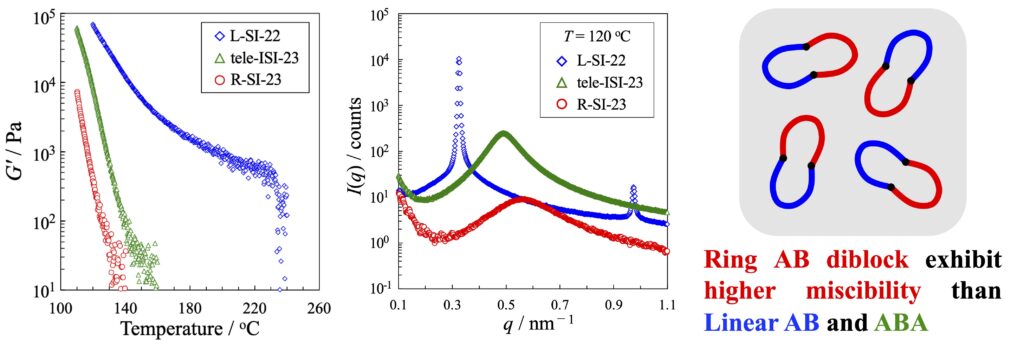
The researchers prepared three polystyrene/polyisoprene block copolymers with similar total molecular weights (≃ 20 kg/mol) and nearly symmetric composition: a linear SI diblock (L-SI-22), a telechelic linear ISI triblock (tele-ISI-23), and a ring SI diblock (R-SI-23). The ring sample was obtained through cyclization of a tele-ISI-23 precursor followed by size-exclusion chromatography fractionation, giving a high-purity ring diblock suitable for direct comparison. The narrow molecular weight distributions and closely matched polystyrene volume fractions were important because the study focused on topology as the variable of interest. SAXS immediately separated the linear diblock from the other two architectures. At 120 °C, L-SI-22 displayed sharp scattering peaks assigned to a lamellar microphase-separated structure, with a domain spacing of 19.4 nm. By contrast, both R-SI-23 and tele-ISI-23 showed a broad correlation-hole peak, placing it in the disordered state under conditions where the corresponding linear diblock remained ordered. R-SI-23 showed a broader correlation-hole peak, a slightly higher peak-top scattering vector than tele-ISI-23, and a scattering intensity more than an order of magnitude lower. These differences are consistent with a shorter apparent characteristic length and reduced concentration fluctuations in the ring diblock. The authors found the linear SI diblock show peak broadening, a modest shift to higher scattering vector, and disappearance of higher-order peaks as the temperature approached the order-disorder transition under heating. The telechelic triblock and ring diblock behaved as disordered systems across the measured range, with decreasing peak intensity and broader correlation-hole features at higher temperature. That pattern is consistent with upper critical solution temperature-type behavior for the polystyrene/polyisoprene pair: increasing temperature reduces concentration fluctuations and increases miscibility. The storage modulus of L-SI-22 decreased gradually and then sharply near the transition region under heating, while R-SI-23 and tele-ISI-23 had much lower storage moduli and disordered-state behavior already at low temperature. R-SI-23 also showed about one order of magnitude lower storage modulus than tele-ISI-23 over the measured range, a response the authors relate to the faster global relaxation dynamics characteristic of ring polymers.
The researchers fitted the correlation-hole scattering using RPA functions that account for the connectivity of the chains based on the Gaussian distribution, allowing the ring and telechelic architectures to be compared beyond a simple visual inspection of peak shape. Because both samples contain the same polystyrene and polyisoprene components, the intrinsic segmental interaction would normally be expected to depend mainly on chemistry. In this analysis, however, deviations caused by architecture and chain statistics were incorporated into an effective interaction parameter, χeff. The ring diblock consistently gave a lower χeff than the telechelic triblock across the measured temperature range, indicating weaker effective segregation between the S and I segments. Even a modest decrease in χeff had a pronounced effect on the calculated scattering intensity, supporting the interpretation that ring closure enhances miscibility by forcing the two chemically distinct blocks into closer spatial proximity.
The engineering relevance of the study by Dr. Yuya Doi and colleagues is in demonstrating that chain topology can tune melt phase behavior without changing the chemical identity of the component polymers. In practical polymer engineering, miscibility is often adjusted by changing chemical composition, molecular weight, additives, or processing temperature, but these routes can also alter mechanical response, thermal stability, or manufacturability. The ring polystyrene-block-polyisoprene system examined here shows that closing the chain into a ring can reduce the effective segregation power between otherwise incompatible blocks, producing a more miscible disordered melt than a comparable telechelic linear triblock. This new principle can be useful in designing thermoplastic elastomers, nanostructured coatings, damping materials, pressure-sensitive adhesives, and soft polymer blends where excessive microphase separation may lead to brittleness, poor optical clarity, slow relaxation, or processing difficulty. The rheological findings are also important from an engineering standpoint: the ring diblock displayed much lower storage modulus than the telechelic analogue across the measured temperature range, suggesting that ring architecture may offer a route to softer, faster-relaxing melts without simply lowering molecular weight. That distinction matters in extrusion, molding, film formation, hot-melt processing, and additive manufacturing, where viscosity, relaxation time, and phase uniformity strongly influence final material quality. The SAXS analysis adds a second practical implication: the higher-q, lower-intensity correlation-hole scattering of the ring diblock indicates shorter characteristic fluctuation lengths and weaker concentration fluctuations, which may help guide the design of more homogeneous nanoscale polymer systems. For materials design, ring closure or related topological constraints could, in principle, help shift the balance between ordering and mixing while retaining the same component polymers.

Reference
Yuya Doi, Naoto Sakabe, Yoshiaki Takahashi, Atsushi Takano, Yushu Matsushita, Miscibility enhancement in a symmetric ring diblock copolymer melt due to topological constraint studied by SAXS and rheology, Polymer, Volume 338, 2025, 129092,
Go to Polymer Journal